
From blades to buildings & skis: Old wind turbines are getting a second life in Europe
The new capacity can provide enough electricity for around seven million European households and replace fossil fuel imports equivalent to 25 LNG tankers a year.
- Sep 15, 2026,
- Updated Sep 15, 2026 1:30 AM IST
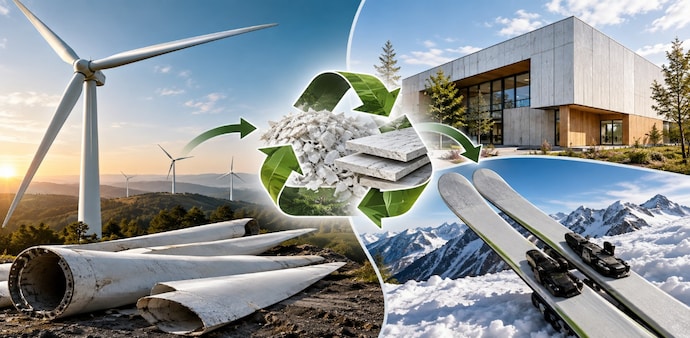
What happens to a wind turbine after it has spent years producing clean energy? In some parts of Europe, old turbine parts are being turned into homes, car parks and even skis instead of being sent to landfill, Euro News reported on Sunday.
Europe is heading for a record year for wind power, with 8.8 GW of new capacity installed in the first half of 2026, up 30 per cent from a year earlier, according to industry nonprofit WindEurope.
The new capacity can provide enough electricity for around seven million European households and replace fossil fuel imports equivalent to 25 LNG tankers a year.
But as new turbines are installed, older ones are reaching the end of their working lives, raising a difficult question: what happens to their huge blades and other components?
Why turbine blades are difficult to recycle
Up to 90 per cent of a wind turbine’s mass is made from materials such as steel, copper, aluminium and concrete that can be recycled relatively easily. The blades are a bigger challenge.
Blades can be between 50 and 100 metres long and are built to withstand harsh weather for up to 25 years. They contain layers of glass fibre, carbon fibre, epoxy resin, balsa wood, metals and fillers, making them difficult to separate.
Don't Miss: Inflation heats up: Food prices rise, crude crosses $100; what it means for your wallet
“Separating the composite materials from the resin requires specialised processes, often involving high temperatures or other energy-intensive treatment methods,” Eva Julius-Philipp, Director of Environment and Sustainability of Business Area Wind at Vattenfall, tells Euronews Earth. “In some cases, these processes can affect the quality and value of the recovered materials, making large-scale recycling more challenging.”
From turbine parts to tiny homes and car parks
Vattenfall has been exploring ways to give retired turbine components a second life. The company has a landfill ban on blades, nacelle covers and nose cones dating back to 2021.
One project involved turning a retired wind turbine nacelle cover into a compact home. The structure, once installed on an Austrian wind tower, is four metres wide, 10 metres long and three metres high. It now includes a kitchen, bathroom and living space, along with a heat pump, solar panels and a solar water heater.
Old blades have also been reused as construction material. The 57 blades from Denmark’s Nørre Økse Sø wind farm, decommissioned in 2023, were used as part of the facade of a multistorey car park in Lund.
Other experiments have included using retired blades for solar-panel frames and skis.
“Projects such as the Tiny House, blade-based building projects and recycled skis are not yet a large-scale solution, however they are intended to help us gain experience, develop new applications and stimulate the market for circular solutions,” says Julius-Philipp.
Recycling could become easier
Vattenfall is working towards 100 per cent circularity for composite materials by 2030. It currently uses mechanical recycling to turn blade material into composite flakes or fillers, while pyrolysis can recover fibres and other secondary materials.
But recycling at scale remains difficult because retired blades do not become available in a steady flow.
“Decommissioned blades do not become available in a steady and predictable flow, which makes it harder for recycling solutions to scale economically,” says Julius-Philipp.
Must Read: State finances are turning into a matter of concern. Here’s why
Some manufacturers are also designing blades with recycling in mind. Siemens Gamesa’s RecyclableBlades use a resin that dissolves in a low-temperature, mildly acidic solution, helping separate the blade’s materials without significantly affecting their properties.
The EU has not yet introduced a bloc-wide ban on landfilling decommissioned blades, although Austria, Finland, Germany and the Netherlands have national bans. WindEurope is pushing for tougher rules across the EU as more first-generation wind farms approach retirement.
What happens to a wind turbine after it has spent years producing clean energy? In some parts of Europe, old turbine parts are being turned into homes, car parks and even skis instead of being sent to landfill, Euro News reported on Sunday.
Europe is heading for a record year for wind power, with 8.8 GW of new capacity installed in the first half of 2026, up 30 per cent from a year earlier, according to industry nonprofit WindEurope.
The new capacity can provide enough electricity for around seven million European households and replace fossil fuel imports equivalent to 25 LNG tankers a year.
But as new turbines are installed, older ones are reaching the end of their working lives, raising a difficult question: what happens to their huge blades and other components?
Why turbine blades are difficult to recycle
Up to 90 per cent of a wind turbine’s mass is made from materials such as steel, copper, aluminium and concrete that can be recycled relatively easily. The blades are a bigger challenge.
Blades can be between 50 and 100 metres long and are built to withstand harsh weather for up to 25 years. They contain layers of glass fibre, carbon fibre, epoxy resin, balsa wood, metals and fillers, making them difficult to separate.
Don't Miss: Inflation heats up: Food prices rise, crude crosses $100; what it means for your wallet
“Separating the composite materials from the resin requires specialised processes, often involving high temperatures or other energy-intensive treatment methods,” Eva Julius-Philipp, Director of Environment and Sustainability of Business Area Wind at Vattenfall, tells Euronews Earth. “In some cases, these processes can affect the quality and value of the recovered materials, making large-scale recycling more challenging.”
From turbine parts to tiny homes and car parks
Vattenfall has been exploring ways to give retired turbine components a second life. The company has a landfill ban on blades, nacelle covers and nose cones dating back to 2021.
One project involved turning a retired wind turbine nacelle cover into a compact home. The structure, once installed on an Austrian wind tower, is four metres wide, 10 metres long and three metres high. It now includes a kitchen, bathroom and living space, along with a heat pump, solar panels and a solar water heater.
Old blades have also been reused as construction material. The 57 blades from Denmark’s Nørre Økse Sø wind farm, decommissioned in 2023, were used as part of the facade of a multistorey car park in Lund.
Other experiments have included using retired blades for solar-panel frames and skis.
“Projects such as the Tiny House, blade-based building projects and recycled skis are not yet a large-scale solution, however they are intended to help us gain experience, develop new applications and stimulate the market for circular solutions,” says Julius-Philipp.
Recycling could become easier
Vattenfall is working towards 100 per cent circularity for composite materials by 2030. It currently uses mechanical recycling to turn blade material into composite flakes or fillers, while pyrolysis can recover fibres and other secondary materials.
But recycling at scale remains difficult because retired blades do not become available in a steady flow.
“Decommissioned blades do not become available in a steady and predictable flow, which makes it harder for recycling solutions to scale economically,” says Julius-Philipp.
Must Read: State finances are turning into a matter of concern. Here’s why
Some manufacturers are also designing blades with recycling in mind. Siemens Gamesa’s RecyclableBlades use a resin that dissolves in a low-temperature, mildly acidic solution, helping separate the blade’s materials without significantly affecting their properties.
The EU has not yet introduced a bloc-wide ban on landfilling decommissioned blades, although Austria, Finland, Germany and the Netherlands have national bans. WindEurope is pushing for tougher rules across the EU as more first-generation wind farms approach retirement.