
From milk bottles to roads: How 6,000+ discarded plastics found a second life in China
Milk bottles can contain leftover milk residue, increasing the risk of contamination during recycling.
- Sep 14, 2026,
- Updated Sep 14, 2026 4:27 PM IST
A milk bottle that would otherwise be thrown away could end up under your feet instead.
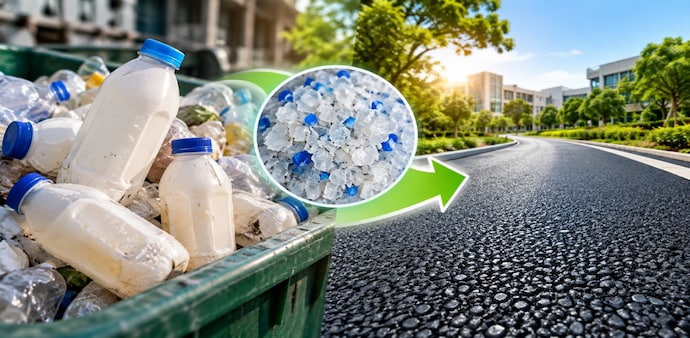
In Shanghai, more than 6,000 used milk bottles and other plastic waste have been turned into a road, showing how discarded packaging can find a second life in everyday infrastructure, The Economic Times reported on Tuesday.
The project, called the “Milk Bottle Road”, was developed through a partnership between Dow and Shiny Meadow, a premium dairy brand in China. It was unveiled at the East China University of Science and Technology (ECUST) Xuhui Campus in Shanghai.
The road uses recycled plastic from used milk bottles and other plastic waste in polymer-modified asphalt (PMA), giving discarded packaging a new use instead of sending it to landfill or leaving it to enter waterways.
For consumers, the project highlights a less visible problem with plastic recycling: even packaging that can technically be recycled may not always be attractive to recyclers.
Don't Miss: Zomato adds a new charge for cash payments: Here's what customers choosing COD need to know
Why milk bottles can be difficult to recycle
Milk bottles can contain leftover milk residue, increasing the risk of contamination during recycling. As a result, recycling companies may be reluctant to take some of these bottles, particularly when the material has relatively low value.
Dow said it used its materials science and technology expertise to collect such difficult-to-recycle plastic and process it into postconsumer recycled plastic for PMA, which can then be used in roads and other pavement applications.
For brands, this offers another way to deal with packaging after it has been used.
Shiny Meadow said it was already using recyclable packaging materials in production, but faced a challenge when dealing with bottles that recycling companies considered low-value.
Lin Rong, brand director of Shiny Meadow, stated, "We are pleased to have found a meaningful use for our empty bottles. At Shiny Meadow, we uphold the vision of a more sustainable earth, and this includes ensuring that the plastic products we use have a circular journey instead of the traditional take-make-use path."
University backs the idea
The East China University of Science and Technology welcomed the completion of the “Milk Bottle Road”, viewing it as an example of how science and innovation can be used to tackle plastic waste.
Prof. Li Tao, vice president of East China University of Science and Technology (ECUST), said, "The University is delighted to see the construction of the "Milk Bottle Road" come to fruition today. As a tertiary institution focused on science and innovation, this collaboration gives us an actualized example of how we can tackle plastic waste in unique ways."
The university also said it hoped the project would encourage students to look at unconventional approaches to sustainability and develop similar applications at a larger scale within their communities.
Plastic roads beyond Shanghai
The Shanghai project is part of Dow's broader work on using recycled plastic in roads across the Asia Pacific region.
Dow began working on roads using recycled plastic in Depok City, Indonesia, in 2017. The initiative was linked to the Indonesian government's goal of reducing plastic waste entering the ocean by 70 percent by 2025.
The company later worked with KK Plastic Waste Management, Ltd., Rudra Environmental Solutions and two local governments on roads improved with recycled plastic in Pune and Bangalore, India.
More recently, Dow began working with Siam Cement Group in Thailand on using plastic in asphalt roads.
Together, these projects point to a different way of looking at plastic waste. Instead of treating difficult-to-recycle packaging only as something to be discarded, the material can potentially be recovered and used in infrastructure such as roads and pavements.
A milk bottle that would otherwise be thrown away could end up under your feet instead.
In Shanghai, more than 6,000 used milk bottles and other plastic waste have been turned into a road, showing how discarded packaging can find a second life in everyday infrastructure, The Economic Times reported on Tuesday.
The project, called the “Milk Bottle Road”, was developed through a partnership between Dow and Shiny Meadow, a premium dairy brand in China. It was unveiled at the East China University of Science and Technology (ECUST) Xuhui Campus in Shanghai.
The road uses recycled plastic from used milk bottles and other plastic waste in polymer-modified asphalt (PMA), giving discarded packaging a new use instead of sending it to landfill or leaving it to enter waterways.
For consumers, the project highlights a less visible problem with plastic recycling: even packaging that can technically be recycled may not always be attractive to recyclers.
Don't Miss: Zomato adds a new charge for cash payments: Here's what customers choosing COD need to know
Why milk bottles can be difficult to recycle
Milk bottles can contain leftover milk residue, increasing the risk of contamination during recycling. As a result, recycling companies may be reluctant to take some of these bottles, particularly when the material has relatively low value.
Dow said it used its materials science and technology expertise to collect such difficult-to-recycle plastic and process it into postconsumer recycled plastic for PMA, which can then be used in roads and other pavement applications.
For brands, this offers another way to deal with packaging after it has been used.
Shiny Meadow said it was already using recyclable packaging materials in production, but faced a challenge when dealing with bottles that recycling companies considered low-value.
Lin Rong, brand director of Shiny Meadow, stated, "We are pleased to have found a meaningful use for our empty bottles. At Shiny Meadow, we uphold the vision of a more sustainable earth, and this includes ensuring that the plastic products we use have a circular journey instead of the traditional take-make-use path."
University backs the idea
The East China University of Science and Technology welcomed the completion of the “Milk Bottle Road”, viewing it as an example of how science and innovation can be used to tackle plastic waste.
Prof. Li Tao, vice president of East China University of Science and Technology (ECUST), said, "The University is delighted to see the construction of the "Milk Bottle Road" come to fruition today. As a tertiary institution focused on science and innovation, this collaboration gives us an actualized example of how we can tackle plastic waste in unique ways."
The university also said it hoped the project would encourage students to look at unconventional approaches to sustainability and develop similar applications at a larger scale within their communities.
Plastic roads beyond Shanghai
The Shanghai project is part of Dow's broader work on using recycled plastic in roads across the Asia Pacific region.
Dow began working on roads using recycled plastic in Depok City, Indonesia, in 2017. The initiative was linked to the Indonesian government's goal of reducing plastic waste entering the ocean by 70 percent by 2025.
The company later worked with KK Plastic Waste Management, Ltd., Rudra Environmental Solutions and two local governments on roads improved with recycled plastic in Pune and Bangalore, India.
More recently, Dow began working with Siam Cement Group in Thailand on using plastic in asphalt roads.
Together, these projects point to a different way of looking at plastic waste. Instead of treating difficult-to-recycle packaging only as something to be discarded, the material can potentially be recovered and used in infrastructure such as roads and pavements.