
Global economy to grow 2.8% in 2027: How cheaper oil & $1.8 trillion AI investment will drive growth
The investment surge is expected to be concentrated in the first half of 2027, with AI-related spending continuing to support economic activity even as the pace of investment growth moderates.
- Nov 15, 2026,
- Updated Nov 15, 2026 10:08 AM IST
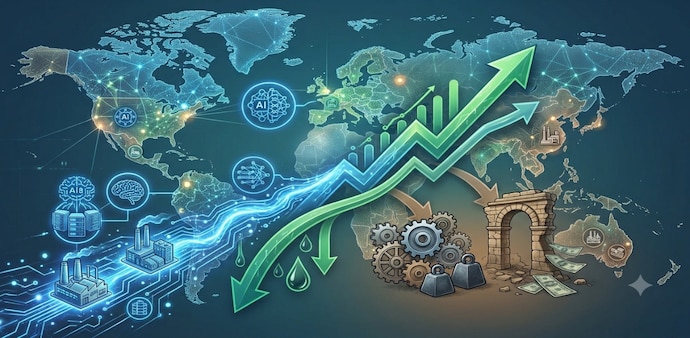
The global economy is expected to grow by 2.8% in 2027, marginally faster than the estimated 2.7% expansion in 2026, as easing energy prices and sustained investment in artificial intelligence (AI) help offset tighter financial conditions and fading government spending support, according to Goldman Sachs Research.
In its latest global economic outlook, Goldman Sachs projected that the global economy would maintain steady growth next year, with the United States, Japan and the United Kingdom expected to outperform consensus estimates.
However, the investment bank cautioned that the risks to its outlook remain tilted to the downside, particularly amid geopolitical tensions involving Iran, rising fiscal deficits and uncertainty surrounding the next phase of AI investment.
Jan Hatzius, chief economist and head of Goldman Sachs Research, said the global economy was likely to witness another year of solid but unremarkable growth in 2027, although several factors driving economic activity in 2026 would change.
Oil prices could turn from economic headwind to tailwind
One of the biggest changes expected in 2027 is the impact of energy prices on global economic growth.
The energy supply shock and elevated oil prices weighed on economic activity in 2026. However, Goldman Sachs expects this pressure to ease next year as global energy supplies gradually normalise.
The bank's commodity strategists forecast Brent crude prices to decline to $78 per barrel by the end of 2027, supported by the gradual recovery and adaptation of supplies from the Middle East. Global liquefied natural gas (LNG) prices are also expected to moderate.
Lower energy prices could provide relief to businesses and households by reducing production, transportation and electricity costs. This, in turn, could support consumption and investment while helping central banks bring inflation closer to their targets.
However, Europe could continue to face some pressure because higher energy costs are expected to filter through to consumers with a delay.
India could benefit from easing crude oil prices
Although Goldman Sachs' outlook does not provide a separate GDP growth forecast for India, its projection of lower global energy prices has important implications for the Indian economy.
India is heavily dependent on imported crude oil to meet its domestic energy requirements. A sustained decline in international oil prices could therefore help reduce the country's oil import bill, ease pressure on the current account deficit and provide some relief on domestic inflation.
Lower crude prices could also reduce input and transportation costs for businesses, potentially supporting consumption and improving corporate margins.
However, the expected benefit will depend on the extent of the decline in global crude prices, currency movements and the pace at which lower international prices are passed on to domestic consumers.
Goldman Sachs expects Brent crude prices to fall to $78 per barrel by the end of 2027 as Middle Eastern supplies gradually normalise. For India, a major energy importer, this could offer an important external economic tailwind if the forecast materialises.
AI investment to reach $1.8 trillion in 2027
Artificial intelligence is expected to remain another major driver of global economic growth. Goldman Sachs forecasts global nominal AI investment to increase to $1.8 trillion in 2027, compared with $1.1 trillion in 2026. Much of the increase is expected to come from higher hardware spending in the United States, which could rise by more than $500 billion.
The investment surge is expected to be concentrated in the first half of 2027, with AI-related spending continuing to support economic activity even as the pace of investment growth moderates.
Goldman Sachs estimates that AI investment alone could contribute 0.4 percentage point to global GDP growth in 2027. In the US, the contribution could reach 0.6 percentage point to underlying GDP growth, after accounting for the undercounting of semiconductor investment and chip-related intellectual property exports.
However, the bank highlighted that the economic benefits of AI would unfold in two phases.
The first phase is being driven by heavy investment in computing infrastructure, semiconductors and data centres. This is boosting corporate profits and economic growth, although productivity gains remain relatively limited.
The second phase is expected to involve greater business reorganisation and wider adoption of AI across industries. While this could deliver more substantial productivity improvements, it could also lead to labour market disruption and job displacement.
Goldman Sachs expects the impact of AI adoption on employment to remain relatively small in 2027, with more significant effects potentially emerging in 2028 and 2029.
US, China and Japan: What is the growth outlook?
Among major economies, Goldman Sachs expects the US, Japan and the UK to perform better than consensus forecasts.
The US economic outlook remains relatively resilient, supported by investment spending. However, tighter financial conditions and uncertainty surrounding the AI investment cycle remain potential risks.
China's economy is forecast to grow by 4.5% in 2027, slightly above the consensus estimate of 4.4%.
The bank expects Chinese exports to remain strong, potentially resulting in a further increase in the country's trade surplus. However, domestic demand is likely to remain weak because of continued pressure from the property sector and subdued consumer spending.
China's economic performance could also have implications for other economies. Goldman Sachs estimates that weak domestic demand and China's expanding trade surplus could create a 0.1-percentage-point drag on global GDP growth outside China.
The impact could be more pronounced in manufacturing-dependent economies, including Germany, which could face a 0.3-percentage-point growth headwind, and Central Europe, where the estimated drag is 0.2 percentage point.
Inflation could ease as energy costs decline
Lower energy prices are expected to help moderate global inflation in 2027.
In the US, Goldman Sachs expects core personal consumption expenditures (PCE) inflation, the Federal Reserve's preferred underlying inflation measure, to decline to 2.4% by the end of 2027 from 3.2% at the end of 2026.
The moderation is expected to reflect the fading impact of tariffs on year-on-year inflation figures, alongside a smaller inflationary impact from the Iran war and lower energy prices.
However, the decline in inflation may not be uniform across major economies. Goldman Sachs expects US core inflation to moderate more steadily, while other developed economies could experience a more delayed decline as the impact of the energy price shock gradually passes through.
What will central banks do in 2027?
Despite the expected moderation in inflation, Goldman Sachs anticipates further monetary tightening in several major economies through early 2027.
The US Federal Reserve is expected to raise interest rates in December and March before softer inflation allows it to begin cutting rates. The bank forecasts one rate cut in December 2027, followed by three additional cuts in 2028, taking the terminal rate to 3.25%-3.5%.
The European Central Bank is expected to deliver its final rate hike in December before gradually easing policy towards a terminal rate of 2.25% in the fourth quarter of 2027.
The Bank of England is forecast to raise rates to 4.25% in February 2027 and then hold them steady for the remainder of the year. Goldman Sachs expects rate cuts towards a 3.25% terminal rate only in 2028.
Japan is expected to follow a different trajectory. The Bank of Japan could raise interest rates by 25 basis points in December, followed by further increases in March and June 2027. Goldman Sachs expects the Japanese central bank's policy rate to reach 2%, reflecting persistent inflationary pressures and the impact of higher global interest rates on the yen.
Despite the relatively stable outlook, Goldman Sachs warned that several factors could derail the global growth trajectory. A renewed escalation in the Iran conflict could trigger another surge in energy prices, reversing the expected relief from normalising oil and gas supplies.
The bank also flagged early indications that AI adoption could be weighing on employment, adding another layer of uncertainty to the global economic outlook.
The global economy is expected to grow by 2.8% in 2027, marginally faster than the estimated 2.7% expansion in 2026, as easing energy prices and sustained investment in artificial intelligence (AI) help offset tighter financial conditions and fading government spending support, according to Goldman Sachs Research.
In its latest global economic outlook, Goldman Sachs projected that the global economy would maintain steady growth next year, with the United States, Japan and the United Kingdom expected to outperform consensus estimates.
However, the investment bank cautioned that the risks to its outlook remain tilted to the downside, particularly amid geopolitical tensions involving Iran, rising fiscal deficits and uncertainty surrounding the next phase of AI investment.
Jan Hatzius, chief economist and head of Goldman Sachs Research, said the global economy was likely to witness another year of solid but unremarkable growth in 2027, although several factors driving economic activity in 2026 would change.
Oil prices could turn from economic headwind to tailwind
One of the biggest changes expected in 2027 is the impact of energy prices on global economic growth.
The energy supply shock and elevated oil prices weighed on economic activity in 2026. However, Goldman Sachs expects this pressure to ease next year as global energy supplies gradually normalise.
The bank's commodity strategists forecast Brent crude prices to decline to $78 per barrel by the end of 2027, supported by the gradual recovery and adaptation of supplies from the Middle East. Global liquefied natural gas (LNG) prices are also expected to moderate.
Lower energy prices could provide relief to businesses and households by reducing production, transportation and electricity costs. This, in turn, could support consumption and investment while helping central banks bring inflation closer to their targets.
However, Europe could continue to face some pressure because higher energy costs are expected to filter through to consumers with a delay.
India could benefit from easing crude oil prices
Although Goldman Sachs' outlook does not provide a separate GDP growth forecast for India, its projection of lower global energy prices has important implications for the Indian economy.
India is heavily dependent on imported crude oil to meet its domestic energy requirements. A sustained decline in international oil prices could therefore help reduce the country's oil import bill, ease pressure on the current account deficit and provide some relief on domestic inflation.
Lower crude prices could also reduce input and transportation costs for businesses, potentially supporting consumption and improving corporate margins.
However, the expected benefit will depend on the extent of the decline in global crude prices, currency movements and the pace at which lower international prices are passed on to domestic consumers.
Goldman Sachs expects Brent crude prices to fall to $78 per barrel by the end of 2027 as Middle Eastern supplies gradually normalise. For India, a major energy importer, this could offer an important external economic tailwind if the forecast materialises.
AI investment to reach $1.8 trillion in 2027
Artificial intelligence is expected to remain another major driver of global economic growth. Goldman Sachs forecasts global nominal AI investment to increase to $1.8 trillion in 2027, compared with $1.1 trillion in 2026. Much of the increase is expected to come from higher hardware spending in the United States, which could rise by more than $500 billion.
The investment surge is expected to be concentrated in the first half of 2027, with AI-related spending continuing to support economic activity even as the pace of investment growth moderates.
Goldman Sachs estimates that AI investment alone could contribute 0.4 percentage point to global GDP growth in 2027. In the US, the contribution could reach 0.6 percentage point to underlying GDP growth, after accounting for the undercounting of semiconductor investment and chip-related intellectual property exports.
However, the bank highlighted that the economic benefits of AI would unfold in two phases.
The first phase is being driven by heavy investment in computing infrastructure, semiconductors and data centres. This is boosting corporate profits and economic growth, although productivity gains remain relatively limited.
The second phase is expected to involve greater business reorganisation and wider adoption of AI across industries. While this could deliver more substantial productivity improvements, it could also lead to labour market disruption and job displacement.
Goldman Sachs expects the impact of AI adoption on employment to remain relatively small in 2027, with more significant effects potentially emerging in 2028 and 2029.
US, China and Japan: What is the growth outlook?
Among major economies, Goldman Sachs expects the US, Japan and the UK to perform better than consensus forecasts.
The US economic outlook remains relatively resilient, supported by investment spending. However, tighter financial conditions and uncertainty surrounding the AI investment cycle remain potential risks.
China's economy is forecast to grow by 4.5% in 2027, slightly above the consensus estimate of 4.4%.
The bank expects Chinese exports to remain strong, potentially resulting in a further increase in the country's trade surplus. However, domestic demand is likely to remain weak because of continued pressure from the property sector and subdued consumer spending.
China's economic performance could also have implications for other economies. Goldman Sachs estimates that weak domestic demand and China's expanding trade surplus could create a 0.1-percentage-point drag on global GDP growth outside China.
The impact could be more pronounced in manufacturing-dependent economies, including Germany, which could face a 0.3-percentage-point growth headwind, and Central Europe, where the estimated drag is 0.2 percentage point.
Inflation could ease as energy costs decline
Lower energy prices are expected to help moderate global inflation in 2027.
In the US, Goldman Sachs expects core personal consumption expenditures (PCE) inflation, the Federal Reserve's preferred underlying inflation measure, to decline to 2.4% by the end of 2027 from 3.2% at the end of 2026.
The moderation is expected to reflect the fading impact of tariffs on year-on-year inflation figures, alongside a smaller inflationary impact from the Iran war and lower energy prices.
However, the decline in inflation may not be uniform across major economies. Goldman Sachs expects US core inflation to moderate more steadily, while other developed economies could experience a more delayed decline as the impact of the energy price shock gradually passes through.
What will central banks do in 2027?
Despite the expected moderation in inflation, Goldman Sachs anticipates further monetary tightening in several major economies through early 2027.
The US Federal Reserve is expected to raise interest rates in December and March before softer inflation allows it to begin cutting rates. The bank forecasts one rate cut in December 2027, followed by three additional cuts in 2028, taking the terminal rate to 3.25%-3.5%.
The European Central Bank is expected to deliver its final rate hike in December before gradually easing policy towards a terminal rate of 2.25% in the fourth quarter of 2027.
The Bank of England is forecast to raise rates to 4.25% in February 2027 and then hold them steady for the remainder of the year. Goldman Sachs expects rate cuts towards a 3.25% terminal rate only in 2028.
Japan is expected to follow a different trajectory. The Bank of Japan could raise interest rates by 25 basis points in December, followed by further increases in March and June 2027. Goldman Sachs expects the Japanese central bank's policy rate to reach 2%, reflecting persistent inflationary pressures and the impact of higher global interest rates on the yen.
Despite the relatively stable outlook, Goldman Sachs warned that several factors could derail the global growth trajectory. A renewed escalation in the Iran conflict could trigger another surge in energy prices, reversing the expected relief from normalising oil and gas supplies.
The bank also flagged early indications that AI adoption could be weighing on employment, adding another layer of uncertainty to the global economic outlook.