
Gold crosses $4,600: Goldman Sachs sees a bigger rally ahead. Is $4,900 the next stop?
The post-2022 surge in official-sector buying suggests that reserve diversification is no longer a temporary response. Countries are increasingly looking to gold as a way to reduce dependence on traditional foreign-currency assets and protect reserves from geopolitical risks.
- Aug 30, 2026,
- Updated Aug 30, 2026 1:27 PM IST
Gold has crossed $4,600 an ounce. Central banks are buying more of it. And Goldman Sachs now sees the precious metal reaching $4,900 by the end of 2026.
The latest rally is not being driven by one factor alone. Central-bank demand, expectations around US interest rates and rising geopolitical uncertainty are combining to give gold another leg higher.
Central banks are changing the gold game
The biggest force behind the rally is central-bank buying.
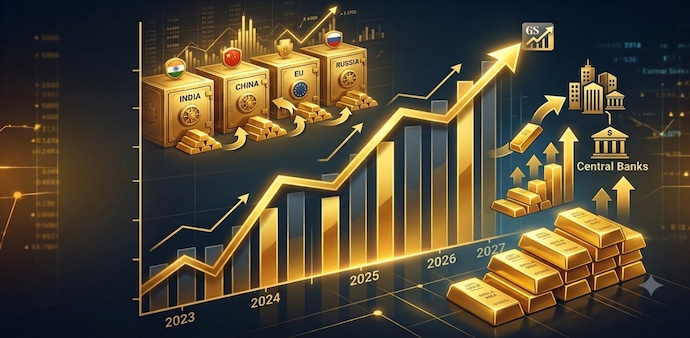
Goldman Sachs expects central banks to purchase an average of 50 tonnes of gold a month in 2026. That is significantly higher than the pre-2022 average of around 17 tonnes a month.
The shift gained momentum after Western countries froze Russia's foreign-exchange reserves following its invasion of Ukraine. For governments looking to reduce exposure to assets that can be restricted or frozen by other countries, gold offers an alternative reserve asset.
Central-bank purchases accelerated further in 2026. Goldman Sachs estimates buying reached roughly 100 tonnes a month in June, based on a three-month seasonally adjusted measure, compared with 66 tonnes in May.
China was the largest identifiable central-bank buyer during the month.
Rate outlook adds another tailwind
Gold does not generate interest income, making it less attractive when interest rates and bond yields are high. But that equation changes when markets anticipate easier monetary policy.
Goldman Sachs expects US monetary policy to become less of a drag on gold as expectations for rate hikes diminish and inflation continues to ease.
Lower rates can make non-yielding assets such as gold relatively more attractive, potentially bringing additional investment demand into the market.
Geopolitics could push gold beyond $4,900
There is another factor supporting the metal: uncertainty.
From conflicts and trade tensions to concerns over the stability of global financial systems, geopolitical risks can encourage investors and governments to seek assets viewed as stores of value.
That could create a powerful combination. Central banks provide structural demand, while private investors can add to buying when geopolitical or economic risks intensify.
Goldman Sachs believes this could push prices above its $4,900 year-end forecast if the underlying forces prove stronger than expected.
The risk: a more volatile gold market
The rally, however, may not be a smooth one. Growing activity in gold derivatives is adding another layer to the market. Investors are increasingly using call options to position for higher prices or hedge against major market risks.
As prices approach key option strike levels, dealers may need to buy more gold to hedge their positions, potentially accelerating gains. The same mechanism can work in reverse if prices fall, increasing selling pressure.
That means gold could overshoot Goldman Sachs' target — but it could also experience sharper swings along the way.
Gold's role is changing
The bigger story is that gold is increasingly becoming more than an inflation hedge or safe-haven investment. For central banks, it is becoming a strategic reserve asset.
The post-2022 surge in official-sector buying suggests that reserve diversification is no longer a temporary response to market turbulence. Countries are increasingly looking to gold as a way to reduce dependence on traditional foreign-currency assets and protect reserves from geopolitical risks.
That structural shift could keep underpinning demand even when investor sentiment changes.
Gold has crossed $4,600 an ounce. Central banks are buying more of it. And Goldman Sachs now sees the precious metal reaching $4,900 by the end of 2026.
The latest rally is not being driven by one factor alone. Central-bank demand, expectations around US interest rates and rising geopolitical uncertainty are combining to give gold another leg higher.
Central banks are changing the gold game
The biggest force behind the rally is central-bank buying.
Goldman Sachs expects central banks to purchase an average of 50 tonnes of gold a month in 2026. That is significantly higher than the pre-2022 average of around 17 tonnes a month.
The shift gained momentum after Western countries froze Russia's foreign-exchange reserves following its invasion of Ukraine. For governments looking to reduce exposure to assets that can be restricted or frozen by other countries, gold offers an alternative reserve asset.
Central-bank purchases accelerated further in 2026. Goldman Sachs estimates buying reached roughly 100 tonnes a month in June, based on a three-month seasonally adjusted measure, compared with 66 tonnes in May.
China was the largest identifiable central-bank buyer during the month.
Rate outlook adds another tailwind
Gold does not generate interest income, making it less attractive when interest rates and bond yields are high. But that equation changes when markets anticipate easier monetary policy.
Goldman Sachs expects US monetary policy to become less of a drag on gold as expectations for rate hikes diminish and inflation continues to ease.
Lower rates can make non-yielding assets such as gold relatively more attractive, potentially bringing additional investment demand into the market.
Geopolitics could push gold beyond $4,900
There is another factor supporting the metal: uncertainty.
From conflicts and trade tensions to concerns over the stability of global financial systems, geopolitical risks can encourage investors and governments to seek assets viewed as stores of value.
That could create a powerful combination. Central banks provide structural demand, while private investors can add to buying when geopolitical or economic risks intensify.
Goldman Sachs believes this could push prices above its $4,900 year-end forecast if the underlying forces prove stronger than expected.
The risk: a more volatile gold market
The rally, however, may not be a smooth one. Growing activity in gold derivatives is adding another layer to the market. Investors are increasingly using call options to position for higher prices or hedge against major market risks.
As prices approach key option strike levels, dealers may need to buy more gold to hedge their positions, potentially accelerating gains. The same mechanism can work in reverse if prices fall, increasing selling pressure.
That means gold could overshoot Goldman Sachs' target — but it could also experience sharper swings along the way.
Gold's role is changing
The bigger story is that gold is increasingly becoming more than an inflation hedge or safe-haven investment. For central banks, it is becoming a strategic reserve asset.
The post-2022 surge in official-sector buying suggests that reserve diversification is no longer a temporary response to market turbulence. Countries are increasingly looking to gold as a way to reduce dependence on traditional foreign-currency assets and protect reserves from geopolitical risks.
That structural shift could keep underpinning demand even when investor sentiment changes.