
'Iran is weaker than ever': Israel PM Benjamin Netanyahu warns as exit polls indicate tight contest
Netanyahu and Eisenkot both claimed victory after Israel's tightly contested parliamentary election. Exit polls left neither bloc with a majority, setting up difficult coalition negotiations.
- Oct 28, 2026,
- Updated Oct 28, 2026 7:45 AM IST
Prime Minister Benjamin Netanyahu warned that Israel faced a “historic opportunity to remove the Iranian threat” even as exit polls showed both his bloc and the opposition led by former IDF chief Gadi Eisenkot falling short of a parliamentary majority.
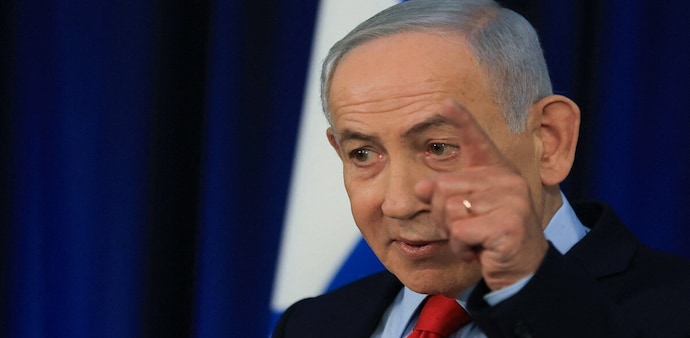
“Iran is weaker than ever, Israel is stronger than ever,” Netanyahu said after voting ended. He said Israel was awaiting the “real results”, while claiming his bloc had won a “decisive majority” and calling for a strong right-wing government.
Exit polls leave both blocs short
Projections by Channel 13, Channel 12 and public broadcaster Kan put Netanyahu’s bloc at 50 seats in the 120-member Knesset, below the 61 required for a majority. The opposition bloc was projected to win 52 to 53 seats, while Arab-led parties could secure 17 to 18.
A separate i24NEWS exit poll gave Netanyahu’s bloc 55 seats, Eisenkot’s grouping 49 and Arab-led parties 16. The estimates left neither side with a clear route to government and pointed to potentially prolonged coalition negotiations.
Exit polls may differ from the final results as votes are counted. The Central Elections Committee said turnout was 77.7 per cent, up 7.1 percentage points from 2022 and the highest since 1999.
Likud projected as largest party
Channel 13 projected Netanyahu’s Likud to win 25 seats and Eisenkot’s centrist Yashar party 23. Channel 12 put them at 24 and 22 seats, respectively, while Kan projected 25 seats for Likud and 21 for Yashar. The i24NEWS poll gave Likud 27 seats and Yashar 20.
Naftali Bennett’s opposition alliance B’Yachad was projected to win 12 to 14 seats. The left-leaning Democrats, led by Yair Golan, were expected to secure nine or 10 seats.
Likud and the far-right and ultra-Orthodox parties aligned with Netanyahu were projected to win a combined 50 seats in the three main broadcasters’ polls.
Arab-led parties could influence talks
Channel 13 and Kan projected 17 seats for Arab-led parties, while Channel 12 put their combined tally at 18. The Joint List was projected to win 10 or 11 seats, with the Islamist Ra’am party expected to secure seven.
Although the Arab-led parties oppose Netanyahu, they are not formally part of the main Jewish-led opposition bloc. Their outside support or abstention in a confidence vote could help the opposition form a minority government. However, both Netanyahu and Eisenkot have ruled out a formal partnership with them.
According to Al Jazeera, Netanyahu accused opposition parties of seeking to govern with support from Palestinian-Israeli parties. He said Israel needed a united “Zionist majority” and should not depend on Arab parties that he accused of being “against our existence”.
Eisenkot claims victory
Eisenkot claimed victory after polling ended. “The public has spoken, it has fired the Netanyahu government,” he said on X, adding that Yashar would work with its partners to bridge differences and seek to form a government.
Netanyahu ally Gideon Sa’ar urged caution. “The celebrations on the left are premature,” he said, noting that Likud was projected to remain Israel’s largest party.
Some analysts said Netanyahu could allow the opposition to attempt to assemble a coalition and wait for it to falter over internal differences, potentially leading to another election. A national unity government involving Netanyahu and Eisenkot also appeared unlikely because of strained relations and Eisenkot’s opposition to partnering with Netanyahu.
What happens next
The Central Elections Committee has begun counting ballots. The final count is expected by October 30, with official results scheduled for November 4.
Under Israel’s proportional representation system, winning the most seats does not automatically give a party the right to form the government. President Isaac Herzog will consult political factions and nominate the lawmaker he believes has the best chance of assembling a coalition.
The nominee will have up to 42 days to secure support from at least 61 lawmakers. If the candidate fails, another lawmaker may be given an opportunity. Failure to form a majority could force another election, with the outgoing government remaining in a caretaker capacity.