
Iran President Pezeshkian urges US to revive June truce agreement before November midterms
Addressing international concern over Tehran's nuclear capabilities, Pezeshkian insisted the technology is strictly for peaceful applications. He reaffirmed Tehran's readiness to allow international monitors back into its facilities and dilute enriched nuclear stockpiles if Washington respects its commitments.
- Sep 25, 2026,
- Updated Sep 25, 2026 8:53 AM IST
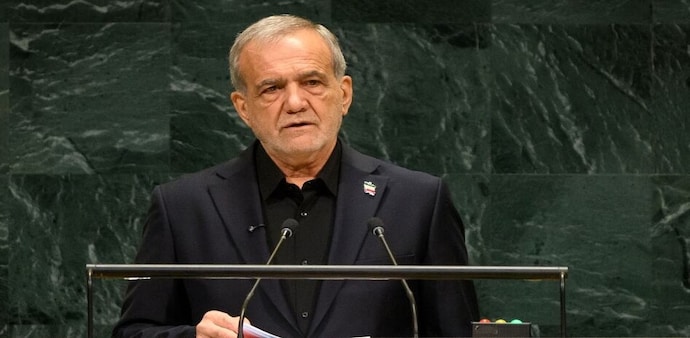
Iranian President Masoud Pezeshkian called on Washington to re-enter the June ceasefire Memorandum of Understanding (MoU) before the US midterm elections in November, using his platform at the United Nations General Assembly to forcefully turn terrorism accusations back on Western critics while putting the burden on the Trump administration to halt a months-long military stand-off.
Addressing the assembly hall, Pezeshkian delivered a direct rebuttal to US President Donald Trump, who a day earlier had branded Iran the "number one sponsor of terror."
“Those who are terrorists…describe us using that word,” Pezeshkian countered from the podium. To drive home his point, the Iranian leader held up a picture of former supreme leader Ayatollah Ali Khamenei, who he said was “assassinated without any legal framework or reason” in a joint US-Israeli strike last February.
He then displayed photos of children killed in US-Israeli strikes on a school and sports hall alongside images of their graves, emphasizing, “They were innocent. They had committed no crimes. We have been the victims of terrorism.”
Pezeshkian underscored that Iran has not attacked another nation in two centuries and framed Tehran's actions as pure self-defense. “We did not bend the knee; we did not bow our heads. We responded, but we did not hit civilian populations,” he said.
On the sidelines of the UN gathering, Pezeshkian pressed for urgent diplomatic action regarding the June arrangement — a deal signed in Islamabad to cease hostilities, reopen the Strait of Hormuz, and ease naval blockades before it unraveled amid mutual accusations of breaches.
“We don’t want it to get to the midterm elections,” Pezeshkian said. “We wish Americans to return to the MOU before the midterms.”
“We did reach an agreement with your president, that agreement was signed, and based on that, we are willing and still wish to move forward,” Pezeshkian stated during an interview. “And the framework was agreed upon. We had not closed the Strait of Hormuz; it was open, without any legal justification or framework... They attacked us.”
Addressing international concern over Tehran's nuclear capabilities, Pezeshkian insisted the technology is strictly for peaceful applications — such as medicine, agriculture, and industrial development — while calling out a persistent global asymmetry.
“The nuclear weapon is in Israel, but the inspectors are in Iran. Israel kills, but Iran is subject to sanctions,” Pezeshkian highlighted, pointing out that Israel remains outside the Non-Proliferation Treaty (NPT) without international inspection. He reaffirmed Tehran's readiness to allow international monitors back into its facilities and dilute enriched nuclear stockpiles if Washington respects its commitments.
Turning to regional conflicts, Pezeshkian sharply criticised operations in Gaza, stating that 80,000 innocent civilians have been "brutally murdered" and hundreds of thousands displaced. “They are committing genocide...then they label others as terrorists,” he said.
Addressing domestic affairs, Pezeshkian framed seven months of widespread protests across Iran not as antigovernment unrest, but as patriotic rallies. He claimed citizens took to the streets nightly “to not allow those who were equipped and trained and armed by Israel and America to cause disruption to the security of their country.”
Closing his address with a message aimed squarely at Washington, Pezeshkian warned that sanctions and military pressure would fail to elicit concessions.
“We will keep resisting,” he said. “We will find ways, and the life of our country will continue. But we do not wish to continue. It’s America that must choose whether it wants to end this or not.” He added that President Trump "must know that the resistance of the Iranian people will only increase in the face of sanctions, pressure, and bullying."
US officials have expressed ongoing skepticism. US Secretary of State Marco Rubio noted that securing a lasting agreement requires rigorous negotiation, stating that President Trump retains "a number of options available, including military options." President Trump, addressing the UN earlier, warned of severe consequences if a deal is not reached quickly, while suggesting Tehran was attempting to delay progress until after the midterms.
Iranian President Masoud Pezeshkian called on Washington to re-enter the June ceasefire Memorandum of Understanding (MoU) before the US midterm elections in November, using his platform at the United Nations General Assembly to forcefully turn terrorism accusations back on Western critics while putting the burden on the Trump administration to halt a months-long military stand-off.
Addressing the assembly hall, Pezeshkian delivered a direct rebuttal to US President Donald Trump, who a day earlier had branded Iran the "number one sponsor of terror."
“Those who are terrorists…describe us using that word,” Pezeshkian countered from the podium. To drive home his point, the Iranian leader held up a picture of former supreme leader Ayatollah Ali Khamenei, who he said was “assassinated without any legal framework or reason” in a joint US-Israeli strike last February.
He then displayed photos of children killed in US-Israeli strikes on a school and sports hall alongside images of their graves, emphasizing, “They were innocent. They had committed no crimes. We have been the victims of terrorism.”
Pezeshkian underscored that Iran has not attacked another nation in two centuries and framed Tehran's actions as pure self-defense. “We did not bend the knee; we did not bow our heads. We responded, but we did not hit civilian populations,” he said.
On the sidelines of the UN gathering, Pezeshkian pressed for urgent diplomatic action regarding the June arrangement — a deal signed in Islamabad to cease hostilities, reopen the Strait of Hormuz, and ease naval blockades before it unraveled amid mutual accusations of breaches.
“We don’t want it to get to the midterm elections,” Pezeshkian said. “We wish Americans to return to the MOU before the midterms.”
“We did reach an agreement with your president, that agreement was signed, and based on that, we are willing and still wish to move forward,” Pezeshkian stated during an interview. “And the framework was agreed upon. We had not closed the Strait of Hormuz; it was open, without any legal justification or framework... They attacked us.”
Addressing international concern over Tehran's nuclear capabilities, Pezeshkian insisted the technology is strictly for peaceful applications — such as medicine, agriculture, and industrial development — while calling out a persistent global asymmetry.
“The nuclear weapon is in Israel, but the inspectors are in Iran. Israel kills, but Iran is subject to sanctions,” Pezeshkian highlighted, pointing out that Israel remains outside the Non-Proliferation Treaty (NPT) without international inspection. He reaffirmed Tehran's readiness to allow international monitors back into its facilities and dilute enriched nuclear stockpiles if Washington respects its commitments.
Turning to regional conflicts, Pezeshkian sharply criticised operations in Gaza, stating that 80,000 innocent civilians have been "brutally murdered" and hundreds of thousands displaced. “They are committing genocide...then they label others as terrorists,” he said.
Addressing domestic affairs, Pezeshkian framed seven months of widespread protests across Iran not as antigovernment unrest, but as patriotic rallies. He claimed citizens took to the streets nightly “to not allow those who were equipped and trained and armed by Israel and America to cause disruption to the security of their country.”
Closing his address with a message aimed squarely at Washington, Pezeshkian warned that sanctions and military pressure would fail to elicit concessions.
“We will keep resisting,” he said. “We will find ways, and the life of our country will continue. But we do not wish to continue. It’s America that must choose whether it wants to end this or not.” He added that President Trump "must know that the resistance of the Iranian people will only increase in the face of sanctions, pressure, and bullying."
US officials have expressed ongoing skepticism. US Secretary of State Marco Rubio noted that securing a lasting agreement requires rigorous negotiation, stating that President Trump retains "a number of options available, including military options." President Trump, addressing the UN earlier, warned of severe consequences if a deal is not reached quickly, while suggesting Tehran was attempting to delay progress until after the midterms.