
'MAKE DEALS, and get them built': Trump tells tech giants to give local communities data centre 'dividend'
Trump also called for large-scale facilities to generate their own power on-site. He argued that requiring developers to supply their own energy would insulate residents from rate spikes and allow excess generation to feed back into local systems to lower power bills.
- Oct 22, 2026,
- Updated Oct 22, 2026 8:50 AM IST
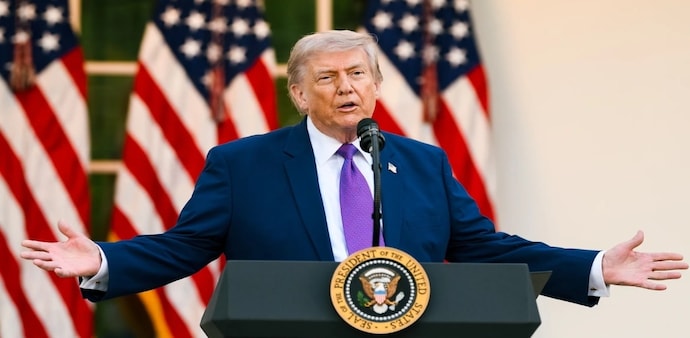
President Donald Trump has urged tech companies and AI infrastructure developers to pay host communities or individual residents a “dividend” to defuse mounting public resistance and accelerate construction across the United States.
In a Truth Social post, Trump argued that direct financial arrangements with host towns can transform fiercely opposed infrastructure proposals into favored local investments.
“If companies want to make their Data Centers popular, pay the community, and/or individuals within the community, a ‘dividend,’” Trump wrote. “I have watched the process closely, and Data Centers that were highly unpopular in a certain area, have become extremely popular when a financial deal is struck.” He concluded with a direct directive to developers: “MAKE DEALS, and get them built!!!”
Self-powering mandate to protect grid pricing
Beyond community payouts, Trump called for large-scale facilities to generate their own power on-site rather than pulling heavily from municipal utility grids. He argued that requiring developers to supply their own energy would insulate residents from rate spikes and allow excess generation to feed back into local systems to lower power bills.
"New and large, in some cases gigantic, Data Centers are mandated by me to make their own electricity, and give or sell any excess back to the local community, or grid, and therefore there is [no] electric price increase. In fact, there could be a substantial decrease," Trump wrote.
Public backlash against AI expansion
Trump’s comments come as Big Tech’s multi-billion-dollar push to build out AI capacity encounters sharp nationwide opposition. A recent Pew Research Center survey of over 10,000 adults highlights a swift turn in sentiment:
- Environmental footprint: 54% of Americans now view data centers as mostly bad for the environment, up from 39% at the start of the year.
- Utility surges: Half of respondents say the facilities hurt residential energy costs, compared to 38% earlier this year.
- Quality of life: 49% reported that local facilities negatively impact quality of life for nearby residents, up from 30%.
The pushback extends beyond public sentiment to government intervention. New York enacted a one-year moratorium on data center construction for projects requiring 50 megawatts or more, while Texas Governor Greg Abbott halted approvals for roughly 1,800 proposed facilities amid grid reliability concerns.
Moreover, Democratic candidates across several states have seized on energy reliability and water usage to challenge political rivals.
While Trump did not specify legal frameworks or required dividend amounts, developers and investors are weighing the financial implications:
Some operators signaled openness to structured local funding models. Marc Boroditsky, chief revenue officer at AI infrastructure firm Nebius, noted his company is "100% in principle" engaging in community investment discussions as developers compete for land, grid equipment, and labor.
Shares across AI hyperscalers and utility suppliers fluctuated as investors evaluated potential capital cost increases and tighter regulatory conditions against the urgency to build capacity.