
Meet ‘Granny’, Poland’s 63-year-old train that refuses to retire & is back on the tracks
In 2003, the train was transferred to Masovia, the province around Warsaw, where it has operated ever since.
- Sep 9, 2026,
- Updated Sep 9, 2026 12:00 PM IST
Poland’s oldest operating electric train is returning to the tracks after a major refurbishment, bringing a 63-year-old piece of the country’s railway history back into passenger service, Notes From Poland reported on Friday
The train, known as Babcia, or “Granny”, will resume services early Saturday morning on a 10-km weekend route between the town of Tłuszcz and the village of Mostówka, north-east of Warsaw.
A train built in 1963
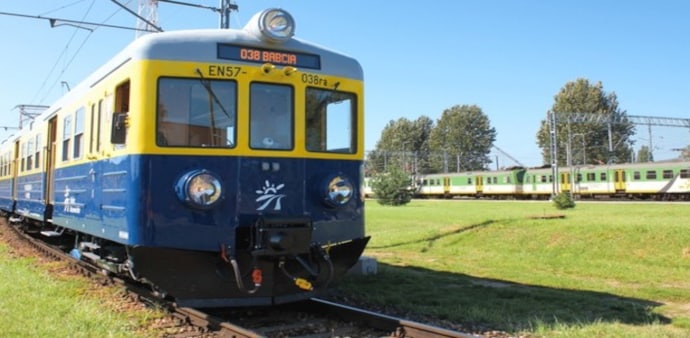
Officially known as EN57-038, the train rolled off the production line on 9 May 1963 at the Pafawag factory in Wrocław, which was then a state-owned locomotive manufacturer.
For decades, it operated in the southern Małopolska province, carrying passengers in cities including Kraków, Tarnów, Nowy Sącz and Sucha Beskidzka.
In 2003, the train was transferred to Masovia, the province around Warsaw, where it has operated ever since.
“Masovian Railways continually invests in modern rolling stock, making our fleet among the most modern in Poland,” said Czesław Sulima, the operations director for the regional rail operator. “However, we fully understand the importance of tradition and sentiment.”
Must Read: Samsung lays off nearly 100 executives in India as appliance businesses face mounting pressure
“Babcia has become a permanent fixture in Polish railway history,” he added. “We are delighted that after a major overhaul, this unique vehicle will once again serve passengers and delight lovers of old-time travel, combining history with modernity.”
What has changed after the refurbishment?
Babcia has undergone regular maintenance and modernisation over the years. Its most recent major work was carried out in 2022, when it regained its original yellow and blue colours associated with the historic Pafawag factory.
The latest refurbishment included upgrades to the train's monitoring system and toilet.
The toilet now uses a “closed circulation” system. This means waste is stored instead of being discharged directly onto the tracks.
The train will now return to service on weekends, running the 10-km route between Tłuszcz and Mostówka.
Poland’s oldest EN57 train
EN57-038 is part of the EN57 class of electric multiple-unit trains produced by Pafawag between 1961 and 1993.
A total of 1,429 EN57 trains were manufactured, with many still in use. However, none is as old as EN57-038.
The train has therefore become a notable part of Poland's railway history, even as newer trains are being introduced across the country.
From Pafawag to Alstom
The history of Babcia is closely linked to the factory where it was built.
The Wrocław factory dates back to the 1830s, when the city was part of Germany and known as Breslau. It became one of Europe's oldest manufacturers of rolling stock.
After World War Two, Wrocław became part of Poland following border changes, and the factory came under the ownership of the new communist state.
After the fall of communism, the factory was privatised. German company ADtranz acquired it in 1997.
ADtranz was taken over by Canada's Bombardier Transportation in 2001. Bombardier was then acquired by France's Alstom in 2021.
Old trains find new fans
The return of Babcia comes as train travel continues to grow in Poland.
In the first half of 2026, a record 44.7 million passengers travelled with PKP Intercity, the country's main long-distance operator.
That was more than 10% higher than the previous year's record and about 45% higher than three years earlier.
Poland is also working to expand its high-speed rail network, with plans to increase train speeds to 320 km/h (199 mph).
But alongside the push for faster and newer trains, interest in older railway vehicles has also grown.
Earlier this year, PKP launched a special “unhurried” service, allowing passengers to travel along scenic routes in restored trains from the 1980s.
Now, Babcia is set to offer passengers another chance to experience Poland's railway past, while continuing to operate as a working passenger train.
Poland’s oldest operating electric train is returning to the tracks after a major refurbishment, bringing a 63-year-old piece of the country’s railway history back into passenger service, Notes From Poland reported on Friday
The train, known as Babcia, or “Granny”, will resume services early Saturday morning on a 10-km weekend route between the town of Tłuszcz and the village of Mostówka, north-east of Warsaw.
A train built in 1963
Officially known as EN57-038, the train rolled off the production line on 9 May 1963 at the Pafawag factory in Wrocław, which was then a state-owned locomotive manufacturer.
For decades, it operated in the southern Małopolska province, carrying passengers in cities including Kraków, Tarnów, Nowy Sącz and Sucha Beskidzka.
In 2003, the train was transferred to Masovia, the province around Warsaw, where it has operated ever since.
“Masovian Railways continually invests in modern rolling stock, making our fleet among the most modern in Poland,” said Czesław Sulima, the operations director for the regional rail operator. “However, we fully understand the importance of tradition and sentiment.”
Must Read: Samsung lays off nearly 100 executives in India as appliance businesses face mounting pressure
“Babcia has become a permanent fixture in Polish railway history,” he added. “We are delighted that after a major overhaul, this unique vehicle will once again serve passengers and delight lovers of old-time travel, combining history with modernity.”
What has changed after the refurbishment?
Babcia has undergone regular maintenance and modernisation over the years. Its most recent major work was carried out in 2022, when it regained its original yellow and blue colours associated with the historic Pafawag factory.
The latest refurbishment included upgrades to the train's monitoring system and toilet.
The toilet now uses a “closed circulation” system. This means waste is stored instead of being discharged directly onto the tracks.
The train will now return to service on weekends, running the 10-km route between Tłuszcz and Mostówka.
Poland’s oldest EN57 train
EN57-038 is part of the EN57 class of electric multiple-unit trains produced by Pafawag between 1961 and 1993.
A total of 1,429 EN57 trains were manufactured, with many still in use. However, none is as old as EN57-038.
The train has therefore become a notable part of Poland's railway history, even as newer trains are being introduced across the country.
From Pafawag to Alstom
The history of Babcia is closely linked to the factory where it was built.
The Wrocław factory dates back to the 1830s, when the city was part of Germany and known as Breslau. It became one of Europe's oldest manufacturers of rolling stock.
After World War Two, Wrocław became part of Poland following border changes, and the factory came under the ownership of the new communist state.
After the fall of communism, the factory was privatised. German company ADtranz acquired it in 1997.
ADtranz was taken over by Canada's Bombardier Transportation in 2001. Bombardier was then acquired by France's Alstom in 2021.
Old trains find new fans
The return of Babcia comes as train travel continues to grow in Poland.
In the first half of 2026, a record 44.7 million passengers travelled with PKP Intercity, the country's main long-distance operator.
That was more than 10% higher than the previous year's record and about 45% higher than three years earlier.
Poland is also working to expand its high-speed rail network, with plans to increase train speeds to 320 km/h (199 mph).
But alongside the push for faster and newer trains, interest in older railway vehicles has also grown.
Earlier this year, PKP launched a special “unhurried” service, allowing passengers to travel along scenic routes in restored trains from the 1980s.
Now, Babcia is set to offer passengers another chance to experience Poland's railway past, while continuing to operate as a working passenger train.