
‘Mega El Niño’ grows stronger as Pacific hotspot hits 18°F above average, threatening weather disruption worldwide
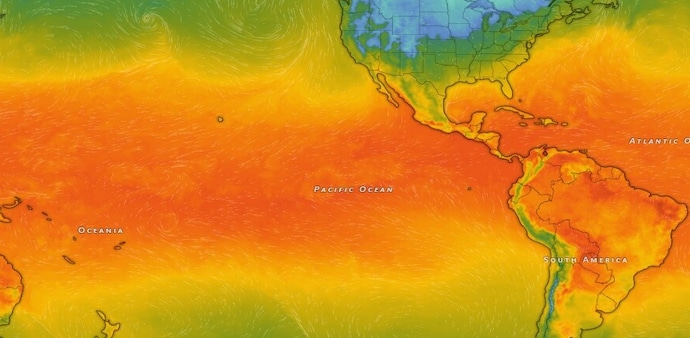
A map shared by Maue showed an unusually warm stretch of water extending across the equatorial Pacific, from the coast of South America towards the central Pacific Ocean.
- Nov 25, 2026,
- Updated Nov 25, 2026 4:53 PM IST
A powerful El Niño is intensifying, with parts of the Pacific Ocean recording sea surface temperatures as much as 18°F above average, raising concerns over how the weather pattern could affect countries around the world, the New York Post reported.
Meteorologist Ryan Maue described the development as a “Mega El Niño” after temperatures near the Galapagos Islands and off the coast of Peru climbed sharply above normal.
“+10°C (18 degrees F) sea surface temperature anomaly near Galapagos and off [the] coast of Peru,” Maue said in a post on X. “This is now a Mega El Niño.”
A map shared by Maue showed an unusually warm stretch of water extending across the equatorial Pacific, from the coast of South America towards the central Pacific Ocean.
The 18°F rise, however, is limited to a localised hotspot. In the wider central Pacific, sea surface temperatures were around 3°C (5.4°F) or 4°C (7.2°F) above average.
Even so, the temperatures are being described as unprecedented, with experts warning that the unusually strong El Niño could amplify weather-related impacts across several parts of the world.
Don't Miss: Why is El Niño 2026 a crucial case for India’s thermal power assets?
The effects linked to the weather pattern have included wildfires in Indonesia, the absence of crucial monsoon rains in India and disruption to aquatic food webs.
Experts predict that temperatures could rise to more than six times that of a typical El Niño between November and January, according to the World Meteorological Organization.
Climate scientist Rebekah Jones warned about the potential impact of the developing weather pattern.
“I can’t emphasize enough how potentially catastrophic this El Niño will be,” she said on X.
Jones also said the climate anomaly could be on track to break the record of 3.5°C logged during the 1877 El Niño event. That event was blamed for the deaths of 50 million people, or around 3-4% of the global population at the time.
The full impact of the current El Niño is still unclear, but projections point to a potentially serious toll from extreme heat.
An analysis by the Climate Impact Lab projects 920,000 additional heat-related deaths between June 2026 and April 2027 due to El Niño.