
Morgues at capacity as Nepal struggles to identify bodies carried downstream by floods
The mounting death toll has also overwhelmed facilities in Pokhara, where bodies recovered from neighbouring districts are being transported.
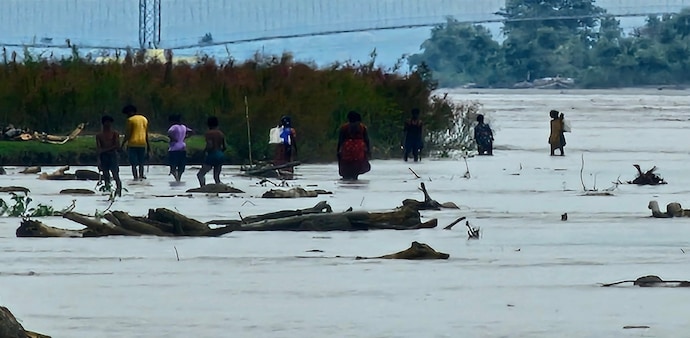
- Aug 28, 2026,
- Updated Aug 28, 2026 7:10 PM IST
As rescue teams continue searching for survivors after Nepal's devastating flash floods, another humanitarian crisis is unfolding downstream. Hospitals and morgues across central Nepal are running out of space as bodies recovered from the Bhotekoshi and Trishuli river systems continue to arrive, forcing authorities to convert government buildings into temporary morgues while racing to identify the dead.
After being ravaged by flash floods that have killed hundreds and left more than 1,000 people unaccounted for, Nepal is now grappling with the challenge of storing and identifying bodies recovered from the Bhotekoshi and Trishuli river systems.
The pressure has intensified as morgues in several districts have reached or exceeded capacity, with remains continuing to wash up far downstream.
According to The Kathmandu Post, bodies swept away by the Bhotekoshi flood have been recovered across a vast stretch of central Nepal, including in Nuwakot, Chitwan, Tanahun and Nawalparasi.
With local hospitals unable to accommodate the growing number of bodies, authorities have begun transferring remains to other districts while preparing temporary facilities for those yet to be recovered.
Chitwan emerges as key recovery hub
Chitwan has become one of the main recovery points in the aftermath of the disaster. As of 9.30 am on Thursday, 137 bodies had been recovered along the Chitwan stretch of the Trishuli and Narayani rivers, between Phishling and Golaghat, The Kathmandu Post reported.
Since hospital morgues can hold only around 30 to 50 bodies at a time, officials have started converting an unused government building in Bharatpur into a temporary storage centre.
The facility is expected to accommodate around 250 bodies. Authorities plan to use air conditioners and dry ice to slow decomposition, while local industry and business groups have agreed to help arrange the dry ice, according to The Kathmandu Post. If the temporary facility also reaches capacity, officials have identified the electric crematorium at Devghat as another alternative.
News agency PTI shared a video of relatives gathering outside the morgue at Teaching Hospital in Kathmandu, where posters of flood victims had been displayed to help families identify missing loved ones.
Founder and CEO of the Kathmandu-based MeroAdda LegalTech initiatives, Aalok Subedi, shared an image on X and wrote, "Family members and relatives trying to identify their loved ones from the picture of the bodies recovered from the flood, outside the morgue at the Teaching Hospital, Maharajgunj, Kathmandu."
Don't Miss: Nepal floods: Families of 33 missing British tourists head to Nepal as death toll reaches 475
Pokhara struggles as body count rises
The mounting death toll has also overwhelmed facilities in Pokhara, where bodies recovered from neighbouring districts are being transported.
By Thursday, 93 bodies had arrived in Pokhara from Tanahun, Gorkha, Nawalparasi East and Dhading, according to The Kathmandu Post. Hospitals and medical institutions across Kaski district can collectively accommodate only 88 bodies, meaning the number of victims transported to the city had already exceeded available capacity.
Nine bodies arrived from Tanahun on Wednesday, followed by 41 from Nawalparasi East, 27 from Dhading and 11 from Gorkha on Thursday.
Kaski Chief District Officer told The Kathmandu Post that the bodies had been accommodated for the time being, but further arrivals could require coordination with neighbouring districts.
Storage remains another major challenge. Bodies at the Pokhara Academy of Health Science are being preserved at temperatures between 2 and 6 degrees Celsius.
Sushil Aryal, an information officer at the hospital, told The Kathmandu Post that remains can generally be preserved under those conditions for only around 10 days to two weeks. Longer-term preservation would require sub-zero storage facilities, which Pokhara currently does not have.
Identifying the dead
Authorities say identifying bodies that have travelled long distances through the river system is proving as difficult as storing them.
In Kaski, police photograph every recovered body, record fingerprints, conduct post-mortems and collect DNA samples, Superintendent of Police Nabin Karki told The Kathmandu Post. Where possible, photographs are released publicly to help families determine whether a recovered body belongs to a missing relative. DNA samples are sent to Kathmandu for testing when necessary.
Relatives of missing people have already begun travelling to Chitwan from districts including Rasuwa, Nuwakot and Gorkha, hoping to identify loved ones among the recovered bodies. Many have arrived carrying photographs of missing family members as authorities continue preparing temporary storage facilities.
QR code helps families search for missing relatives
Nepal Police has prepared a list of people who died in the floods in the Bhotekoshi River in Rasuwa, including bodies that have been recovered but are yet to be identified.
According to Kathmandu-based news portal OnlineKhabar, the list includes photographs of unidentified bodies along with physical descriptions and other identifying details that could help families locate missing relatives.
The list has been made accessible through a QR code published on Nepal Police's official Facebook page. By scanning the code, people can view photographs and identifying details of recovered bodies and check whether any could be their missing family members, OnlineKhabar reported.
Police said the list was made public to assist families searching for relatives who have remained missing since the floods.
Storage crisis spreads to other districts
The shortage of storage facilities extends well beyond Chitwan and Pokhara.
In Gorkha, 11 bodies recovered from the Trishuli river were transferred to Gandaki Provincial Hospital in Pokhara after the local morgue ran out of space. By Thursday evening, authorities had recovered 39 bodies from areas bordering the river, The Kathmandu Post reported.
Nawalparasi East has also been forced to move bodies after hospitals and government health facilities reached capacity. Forty-one bodies were transported to Pokhara and eight to Palpa, while others remain at hospitals in Madhyabindu, Gaindakot, Devchuli and Kawasoti. Officials are also preparing a community forest hall to serve as a temporary morgue.
In Dhading, authorities had recovered 37 bodies and human remains, including 13 body parts, by Thursday. Six bodies were sent to Kathmandu because local facilities lacked adequate refrigeration and storage, while the remaining remains were transferred to Pokhara, according to The Kathmandu Post.
Must Read: Fresh crisis: Nepal issues flood warning after dam burst in Tibet, halts rescue work
Second flood threat complicates rescue efforts
The disaster has also complicated rescue operations upstream.
The BBC reported that massive landslides and flash floods along the Nepal-Tibet border have left hundreds dead or missing, with search and rescue teams continuing operations amid the threat of further flooding.
While initial reports suggested an earthquake had triggered the disaster, the US Geological Survey determined that the event was caused by a glacial collapse.
According to USGS data cited by the BBC, the force of the collapsing glacier striking the valley floor registered as a magnitude 5.2 event, triggering a massive debris flow that caused catastrophic destruction downstream.
A newly formed lake near the Nepal-Tibet border began overflowing on Friday, threatening to unleash a second deadly surge and disrupting ongoing rescue efforts.
Even as search operations continue, authorities are preparing for more bodies to arrive. Under Nepal's Unidentified and Unclaimed Bodies Management Guidelines, 2021, police must document and process remains before unidentified bodies can be buried. Officials are also identifying designated burial sites while preserving identification records so bodies can potentially be traced in the future.
With rivers continuing to carry bodies downstream and morgues stretched far beyond capacity, Nepal's recovery effort is increasingly shifting from rescue to the painstaking task of preserving, documenting and identifying the dead.
As rescue teams continue searching for survivors after Nepal's devastating flash floods, another humanitarian crisis is unfolding downstream. Hospitals and morgues across central Nepal are running out of space as bodies recovered from the Bhotekoshi and Trishuli river systems continue to arrive, forcing authorities to convert government buildings into temporary morgues while racing to identify the dead.
After being ravaged by flash floods that have killed hundreds and left more than 1,000 people unaccounted for, Nepal is now grappling with the challenge of storing and identifying bodies recovered from the Bhotekoshi and Trishuli river systems.
The pressure has intensified as morgues in several districts have reached or exceeded capacity, with remains continuing to wash up far downstream.
According to The Kathmandu Post, bodies swept away by the Bhotekoshi flood have been recovered across a vast stretch of central Nepal, including in Nuwakot, Chitwan, Tanahun and Nawalparasi.
With local hospitals unable to accommodate the growing number of bodies, authorities have begun transferring remains to other districts while preparing temporary facilities for those yet to be recovered.
Chitwan emerges as key recovery hub
Chitwan has become one of the main recovery points in the aftermath of the disaster. As of 9.30 am on Thursday, 137 bodies had been recovered along the Chitwan stretch of the Trishuli and Narayani rivers, between Phishling and Golaghat, The Kathmandu Post reported.
Since hospital morgues can hold only around 30 to 50 bodies at a time, officials have started converting an unused government building in Bharatpur into a temporary storage centre.
The facility is expected to accommodate around 250 bodies. Authorities plan to use air conditioners and dry ice to slow decomposition, while local industry and business groups have agreed to help arrange the dry ice, according to The Kathmandu Post. If the temporary facility also reaches capacity, officials have identified the electric crematorium at Devghat as another alternative.
News agency PTI shared a video of relatives gathering outside the morgue at Teaching Hospital in Kathmandu, where posters of flood victims had been displayed to help families identify missing loved ones.
Founder and CEO of the Kathmandu-based MeroAdda LegalTech initiatives, Aalok Subedi, shared an image on X and wrote, "Family members and relatives trying to identify their loved ones from the picture of the bodies recovered from the flood, outside the morgue at the Teaching Hospital, Maharajgunj, Kathmandu."
Don't Miss: Nepal floods: Families of 33 missing British tourists head to Nepal as death toll reaches 475
Pokhara struggles as body count rises
The mounting death toll has also overwhelmed facilities in Pokhara, where bodies recovered from neighbouring districts are being transported.
By Thursday, 93 bodies had arrived in Pokhara from Tanahun, Gorkha, Nawalparasi East and Dhading, according to The Kathmandu Post. Hospitals and medical institutions across Kaski district can collectively accommodate only 88 bodies, meaning the number of victims transported to the city had already exceeded available capacity.
Nine bodies arrived from Tanahun on Wednesday, followed by 41 from Nawalparasi East, 27 from Dhading and 11 from Gorkha on Thursday.
Kaski Chief District Officer told The Kathmandu Post that the bodies had been accommodated for the time being, but further arrivals could require coordination with neighbouring districts.
Storage remains another major challenge. Bodies at the Pokhara Academy of Health Science are being preserved at temperatures between 2 and 6 degrees Celsius.
Sushil Aryal, an information officer at the hospital, told The Kathmandu Post that remains can generally be preserved under those conditions for only around 10 days to two weeks. Longer-term preservation would require sub-zero storage facilities, which Pokhara currently does not have.
Identifying the dead
Authorities say identifying bodies that have travelled long distances through the river system is proving as difficult as storing them.
In Kaski, police photograph every recovered body, record fingerprints, conduct post-mortems and collect DNA samples, Superintendent of Police Nabin Karki told The Kathmandu Post. Where possible, photographs are released publicly to help families determine whether a recovered body belongs to a missing relative. DNA samples are sent to Kathmandu for testing when necessary.
Relatives of missing people have already begun travelling to Chitwan from districts including Rasuwa, Nuwakot and Gorkha, hoping to identify loved ones among the recovered bodies. Many have arrived carrying photographs of missing family members as authorities continue preparing temporary storage facilities.
QR code helps families search for missing relatives
Nepal Police has prepared a list of people who died in the floods in the Bhotekoshi River in Rasuwa, including bodies that have been recovered but are yet to be identified.
According to Kathmandu-based news portal OnlineKhabar, the list includes photographs of unidentified bodies along with physical descriptions and other identifying details that could help families locate missing relatives.
The list has been made accessible through a QR code published on Nepal Police's official Facebook page. By scanning the code, people can view photographs and identifying details of recovered bodies and check whether any could be their missing family members, OnlineKhabar reported.
Police said the list was made public to assist families searching for relatives who have remained missing since the floods.
Storage crisis spreads to other districts
The shortage of storage facilities extends well beyond Chitwan and Pokhara.
In Gorkha, 11 bodies recovered from the Trishuli river were transferred to Gandaki Provincial Hospital in Pokhara after the local morgue ran out of space. By Thursday evening, authorities had recovered 39 bodies from areas bordering the river, The Kathmandu Post reported.
Nawalparasi East has also been forced to move bodies after hospitals and government health facilities reached capacity. Forty-one bodies were transported to Pokhara and eight to Palpa, while others remain at hospitals in Madhyabindu, Gaindakot, Devchuli and Kawasoti. Officials are also preparing a community forest hall to serve as a temporary morgue.
In Dhading, authorities had recovered 37 bodies and human remains, including 13 body parts, by Thursday. Six bodies were sent to Kathmandu because local facilities lacked adequate refrigeration and storage, while the remaining remains were transferred to Pokhara, according to The Kathmandu Post.
Must Read: Fresh crisis: Nepal issues flood warning after dam burst in Tibet, halts rescue work
Second flood threat complicates rescue efforts
The disaster has also complicated rescue operations upstream.
The BBC reported that massive landslides and flash floods along the Nepal-Tibet border have left hundreds dead or missing, with search and rescue teams continuing operations amid the threat of further flooding.
While initial reports suggested an earthquake had triggered the disaster, the US Geological Survey determined that the event was caused by a glacial collapse.
According to USGS data cited by the BBC, the force of the collapsing glacier striking the valley floor registered as a magnitude 5.2 event, triggering a massive debris flow that caused catastrophic destruction downstream.
A newly formed lake near the Nepal-Tibet border began overflowing on Friday, threatening to unleash a second deadly surge and disrupting ongoing rescue efforts.
Even as search operations continue, authorities are preparing for more bodies to arrive. Under Nepal's Unidentified and Unclaimed Bodies Management Guidelines, 2021, police must document and process remains before unidentified bodies can be buried. Officials are also identifying designated burial sites while preserving identification records so bodies can potentially be traced in the future.
With rivers continuing to carry bodies downstream and morgues stretched far beyond capacity, Nepal's recovery effort is increasingly shifting from rescue to the painstaking task of preserving, documenting and identifying the dead.