
Nepal flash floods: Principal rings school bell, saves 1,643 children as floodwaters sweep through village
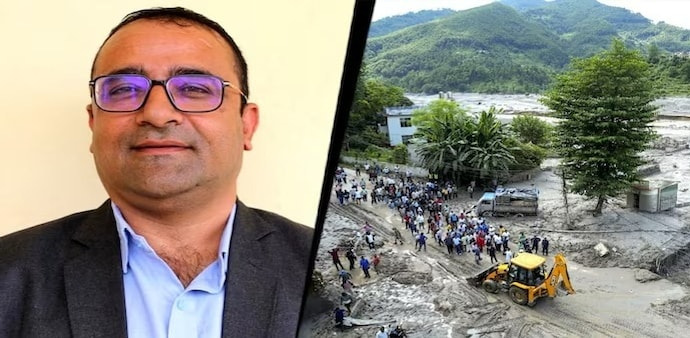
Dawadi, a 47-year-old English teacher, had 1,643 children in and around the three-storey school when the flood struck.
- Aug 30, 2026,
- Updated Aug 30, 2026 2:26 PM IST
A school principal in Nepal’s Trishuli Valley had only minutes to get more than 1,600 children to safety after a sudden flash flood swept through the area on Wednesday morning, according to a report by India Today.
Rajendra Dawadi, principal of Tribhuvan Trishuli Secondary School in Nuwakot, received a warning from a friend at 9:20 am. “He said the village was gone: taken by the river. He told me to run.”
Dawadi, a 47-year-old English teacher, had 1,643 children in and around the three-storey school when the flood struck. The disaster, triggered by a glacier collapse, tore through mountain river systems, killing 734 people in Nepal and 16 in Tibet.
Buildings, bridges and power stations were swept away as torrents of rock, ice, mud and debris moved through the region. About 2,498 people remain missing in Nepal, while another 546 are missing in Tibet's Gyirong County, according to the latest figures.
At first, Dawadi believed the school was safe. The concrete building stood about 60 metres above the river and was at the same level as the steel bridge connecting the village to the eastern bank, The Times reported.
That changed when a parent arrived and warned that the water was rising rapidly.
Don't Miss: China says it has shared satellite, hydrological and early-warning data with Nepal
Dawadi immediately rang the school bell and told teachers to evacuate the classrooms. He called the school bus drivers and instructed all but one to turn back. He then saw the bus he could not reach crossing the bridge.
The children soon realised the seriousness of the situation. One girl suffered a panic attack and was taken uphill on a motorbike. The rest escaped on foot, with Dawadi following them.
The students eventually gathered under a bodhi tree as floodwaters destroyed the school buildings.
Dawadi’s actions helped save 1,643 children and all but one member of the teaching staff. Social history teacher Santos Pariyar, 32, was washed away after returning to his rented room beside the river to cook breakfast. School janitor Sultan Lama was also killed after going back to close the doors.
Must Read: India sends 68.5 tonnes of relief, tunnel experts and Bailey bridge equipment to Nepal
‘What else could I do?’
Residents have described Dawadi as a hero, but he does not see himself that way.
“What else could I do?” he said while looking at the muddy ruins of the school.
The flash flood followed the collapse of a huge mass of ice and rock from Langtang Lirung peak. It plunged about 1,200 metres into the steep upper gorge of the Lhende Khola river near the Tibet border.
Daniel Shugar, a geomorphologist at the University of Calgary, estimated that the mass covered nearly 50 acres, roughly the size of Green Park in London.
The disaster has brought back memories of the region’s earlier tragedies. In April 2015, a magnitude 7.8 earthquake killed 8,962 people across South Asia and triggered an avalanche that buried all 300 residents of Langtang in the flood-hit Rasuwa district.
A school principal in Nepal’s Trishuli Valley had only minutes to get more than 1,600 children to safety after a sudden flash flood swept through the area on Wednesday morning, according to a report by India Today.
Rajendra Dawadi, principal of Tribhuvan Trishuli Secondary School in Nuwakot, received a warning from a friend at 9:20 am. “He said the village was gone: taken by the river. He told me to run.”
Dawadi, a 47-year-old English teacher, had 1,643 children in and around the three-storey school when the flood struck. The disaster, triggered by a glacier collapse, tore through mountain river systems, killing 734 people in Nepal and 16 in Tibet.
Buildings, bridges and power stations were swept away as torrents of rock, ice, mud and debris moved through the region. About 2,498 people remain missing in Nepal, while another 546 are missing in Tibet's Gyirong County, according to the latest figures.
At first, Dawadi believed the school was safe. The concrete building stood about 60 metres above the river and was at the same level as the steel bridge connecting the village to the eastern bank, The Times reported.
That changed when a parent arrived and warned that the water was rising rapidly.
Don't Miss: China says it has shared satellite, hydrological and early-warning data with Nepal
Dawadi immediately rang the school bell and told teachers to evacuate the classrooms. He called the school bus drivers and instructed all but one to turn back. He then saw the bus he could not reach crossing the bridge.
The children soon realised the seriousness of the situation. One girl suffered a panic attack and was taken uphill on a motorbike. The rest escaped on foot, with Dawadi following them.
The students eventually gathered under a bodhi tree as floodwaters destroyed the school buildings.
Dawadi’s actions helped save 1,643 children and all but one member of the teaching staff. Social history teacher Santos Pariyar, 32, was washed away after returning to his rented room beside the river to cook breakfast. School janitor Sultan Lama was also killed after going back to close the doors.
Must Read: India sends 68.5 tonnes of relief, tunnel experts and Bailey bridge equipment to Nepal
‘What else could I do?’
Residents have described Dawadi as a hero, but he does not see himself that way.
“What else could I do?” he said while looking at the muddy ruins of the school.
The flash flood followed the collapse of a huge mass of ice and rock from Langtang Lirung peak. It plunged about 1,200 metres into the steep upper gorge of the Lhende Khola river near the Tibet border.
Daniel Shugar, a geomorphologist at the University of Calgary, estimated that the mass covered nearly 50 acres, roughly the size of Green Park in London.
The disaster has brought back memories of the region’s earlier tragedies. In April 2015, a magnitude 7.8 earthquake killed 8,962 people across South Asia and triggered an avalanche that buried all 300 residents of Langtang in the flood-hit Rasuwa district.