
Pentagon faces $1.3 billion blow as Iran war wipes out 25% of US Reaper drone fleet: Report
The uncrewed aircraft, which cost between $30 million and $50 million depending on onboard sensors and armaments, have been tasked with continuous surveillance, mobile-target tracking, and precision strikes around the Strait of Hormuz.
- Aug 14, 2026,
- Updated Aug 14, 2026 2:37 PM IST
In a severe blow to American aerial surveillance and strike capabilities, the U.S. military has lost at least 45 MQ-9 Reaper drones during its ongoing conflict with Iran — wiping out roughly 25 percent of its operational fleet, according to The Washington Post.
The sustained attrition over Middle Eastern skies has stripped US commanders of key intelligence assets and inflicted a hardware loss exceeding $1.3 billion. Heavy deployments around the strategic Strait of Hormuz have left the uncrewed aircraft exposed to hostile fire, electronic disruption, and system link failures.
Heavily targeted over critical waterways
Before hostilities began, the US military maintained a fleet of approximately 185 Reapers — 165 in the Air Force and 20 operated by the Marine Corps, excluding assets held by US intelligence agencies. According to Marine Corps spokesman Lt. Col. Joshua Benson, units operating primarily in the Asia-Pacific have suffered no losses, leaving the Air Force to absorb the full impact of the conflict.
The uncrewed aircraft, which cost between $30 million and $50 million depending on onboard sensors and armaments, have been tasked with continuous surveillance, mobile-target tracking, and precision strikes around the Strait of Hormuz. However, the Reaper’s slow operating speed and low flying altitudes make it a vulnerable target for Iranian air defenses and regional proxy forces in Iraq and Yemen.
Not all 45 aircraft were downed by enemy fire. A fourth US official, speaking on condition of anonymity to discuss Pentagon data, told The Washington Post that an unspecified number of drones crashed after communication links between operators and the aircraft failed.
Growing strain on US arsenals
The scale of the losses began raising alarms inside the Pentagon months ago. In May, Lt. Gen. David Tabor, a senior Air Force officer at the Pentagon, told senators that the active inventory had fallen to around 135 aircraft, testifying that he was "concerned" about the losses and that the Air Force was exploring how to quickly replenish its fleet.
The Reaper attrition adds to broader resource constraints across the US military arsenal. In the campaign's first month alone, US forces expended more than 850 Tomahawk cruise missiles and over 1,000 Patriot and THAAD air-defense interceptors, forcing commanders to conserve interceptors and alter defensive tactics.
While the Pentagon is currently phasing out the General Atomics-produced Reaper in favour of lower-cost, swarm-capable surveillance drones, replacing depleted hardware will take considerable time.
What is MQ-9 Reaper drone
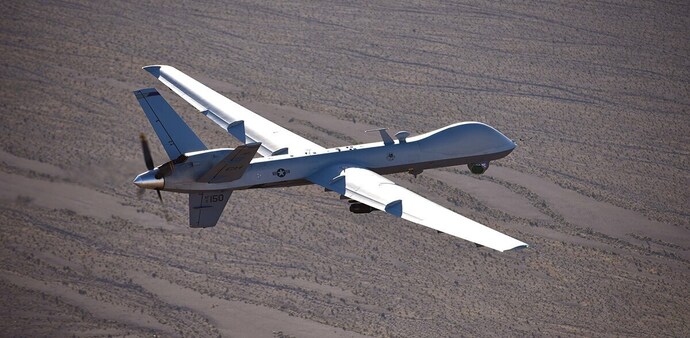
The MQ-9 Reaper (originally named Predator B) is a medium-altitude, long-endurance (MALE) uncrewed aerial vehicle (UAV) manufactured by General Atomics Aeronautical Systems. It is primarily operated by the U.S. Air Force, U.S. Marine Corps, and several international allies for high-altitude intelligence gathering and precision strike operations.
Key Capabilities & Role
- 'Hunter-Killer' Operations: Unlike its predecessor, the lighter MQ-1 Predator, the MQ-9 was built from the ground up as a "hunter-killer" drone. It combines long loiter times with heavy weapons payload capacity.
- Persistent Surveillance (ISR): Equipped with advanced electro-optical/infrared (EO/IR) sensors, synthetic aperture radar (SAR), and laser designators, allowing operators to monitor targets continuously for over 24 hours.
- Precision Munitions: Features six hardpoints capable of carrying up to 3,850 lbs (1,700 kg) of ordnance, including AGM-114 Hellfire air-to-ground missiles, GBU-12 Paveway II laser-guided bombs, and Joint Direct Attack Munitions (JDAM).
- Remote Operations: Operated by a two-person ground crew (a pilot and a sensor operator) using satellite data links, allowing teams stationed in the US to fly missions globally.
In a severe blow to American aerial surveillance and strike capabilities, the U.S. military has lost at least 45 MQ-9 Reaper drones during its ongoing conflict with Iran — wiping out roughly 25 percent of its operational fleet, according to The Washington Post.
The sustained attrition over Middle Eastern skies has stripped US commanders of key intelligence assets and inflicted a hardware loss exceeding $1.3 billion. Heavy deployments around the strategic Strait of Hormuz have left the uncrewed aircraft exposed to hostile fire, electronic disruption, and system link failures.
Heavily targeted over critical waterways
Before hostilities began, the US military maintained a fleet of approximately 185 Reapers — 165 in the Air Force and 20 operated by the Marine Corps, excluding assets held by US intelligence agencies. According to Marine Corps spokesman Lt. Col. Joshua Benson, units operating primarily in the Asia-Pacific have suffered no losses, leaving the Air Force to absorb the full impact of the conflict.
The uncrewed aircraft, which cost between $30 million and $50 million depending on onboard sensors and armaments, have been tasked with continuous surveillance, mobile-target tracking, and precision strikes around the Strait of Hormuz. However, the Reaper’s slow operating speed and low flying altitudes make it a vulnerable target for Iranian air defenses and regional proxy forces in Iraq and Yemen.
Not all 45 aircraft were downed by enemy fire. A fourth US official, speaking on condition of anonymity to discuss Pentagon data, told The Washington Post that an unspecified number of drones crashed after communication links between operators and the aircraft failed.
Growing strain on US arsenals
The scale of the losses began raising alarms inside the Pentagon months ago. In May, Lt. Gen. David Tabor, a senior Air Force officer at the Pentagon, told senators that the active inventory had fallen to around 135 aircraft, testifying that he was "concerned" about the losses and that the Air Force was exploring how to quickly replenish its fleet.
The Reaper attrition adds to broader resource constraints across the US military arsenal. In the campaign's first month alone, US forces expended more than 850 Tomahawk cruise missiles and over 1,000 Patriot and THAAD air-defense interceptors, forcing commanders to conserve interceptors and alter defensive tactics.
While the Pentagon is currently phasing out the General Atomics-produced Reaper in favour of lower-cost, swarm-capable surveillance drones, replacing depleted hardware will take considerable time.
What is MQ-9 Reaper drone
The MQ-9 Reaper (originally named Predator B) is a medium-altitude, long-endurance (MALE) uncrewed aerial vehicle (UAV) manufactured by General Atomics Aeronautical Systems. It is primarily operated by the U.S. Air Force, U.S. Marine Corps, and several international allies for high-altitude intelligence gathering and precision strike operations.
Key Capabilities & Role
- 'Hunter-Killer' Operations: Unlike its predecessor, the lighter MQ-1 Predator, the MQ-9 was built from the ground up as a "hunter-killer" drone. It combines long loiter times with heavy weapons payload capacity.
- Persistent Surveillance (ISR): Equipped with advanced electro-optical/infrared (EO/IR) sensors, synthetic aperture radar (SAR), and laser designators, allowing operators to monitor targets continuously for over 24 hours.
- Precision Munitions: Features six hardpoints capable of carrying up to 3,850 lbs (1,700 kg) of ordnance, including AGM-114 Hellfire air-to-ground missiles, GBU-12 Paveway II laser-guided bombs, and Joint Direct Attack Munitions (JDAM).
- Remote Operations: Operated by a two-person ground crew (a pilot and a sensor operator) using satellite data links, allowing teams stationed in the US to fly missions globally.