
Popular forest trail becomes burial site: Nepal begins mass burials of unidentified victims
Nepal flash flood: The disaster, triggered on August 26 by a glacial collapse or an avalanche of ice and rock near the Nepal-Tibet border, has killed hundreds and left thousands missing in Nepal.
- Aug 31, 2026,
- Updated Aug 31, 2026 8:05 AM IST
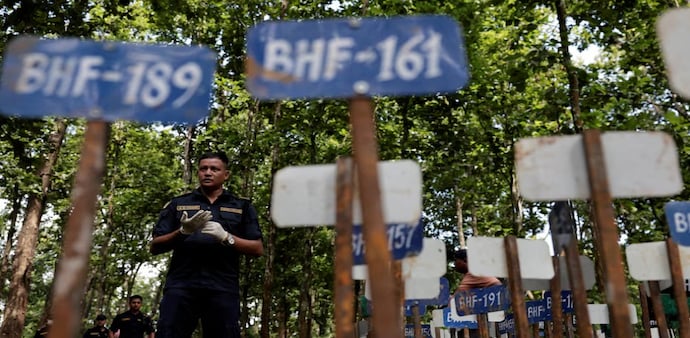
Nepal flash flood: A forest in Nepal's Chitwan district that was used for morning walks has now become a burial site for many unidentified flood victims. Authorities are dealing with the aftermath of flash floods that hit areas along the Nepal-China border. In Devghat forest, nearly 200 km from the flood-affected valleys of Rasuwa, officials have dug hundreds of graves for bodies swept downstream by the Bhotekoshi River and found in an advanced state of decomposition.
The disaster, triggered on August 26 by a glacial collapse or an avalanche of ice and rock near the Nepal-Tibet border, has killed hundreds and left thousands missing in Nepal. It has also caused deaths and disappearances on the Chinese side. Recovery operations continue amid intermittent rain, rising water levels, and warnings from authorities for residents and rescue teams to remain alert.
According to a report in Reuters, authorities in Chitwan buried 96 unidentified bodies on Saturday after completing legal formalities and planned to bury more than 100 on Sunday as recovery teams continued retrieving bodies from rivers and debris. Ganesh Aryal, chief district officer in Chitwan, said the step was necessary due to the risk to public health from the rapid decomposition of the bodies.
Officials said every burial site was carefully recorded, with identification markers placed above and below ground and precise location data logged. DNA samples were collected from each unidentified body before burial to allow future identification through family claims, official records, or genetic testing. Nepal's Foreign Secretary Amrit Bahadur Rai said bodies that could not be identified were buried following standard protocols, with medical teams taking DNA samples to help families match records later and allow exhumation for necessary rituals.
Police spokesperson Rajendra Prasad Dhamala said only 17 bodies had been identified so far, as most were in a dilapidated state or amputated. Identified bodies were handed over to relatives after verification. Around 100 rescue workers, police personnel, and officials have been involved in documenting the dead, photographing remains, assisting relatives with identification, and preparing bodies for burial.
IDENTIFICATION OF NEPAL FLASH FLOOD VICTIMS
Meanwhile, India has sent an 18-member team of forensic experts specialising in DNA analysis to work with Nepali authorities, while Nepal is also in contact with a team from China. An 11-member Indian tunnel rescue team is assisting operations at hydropower sites. The Indian embassy in Nepal said the team worked with the Nepali Army in Chilime and Langtang and would continue search and rescue operations in close coordination.
DON'T MISS | China says it has shared satellite, hydrological and early-warning data with Nepal
At Bharatpur Hospital, the stench of decomposition was noticeable near a temporary morgue where around 50 police officers and hospital staff handled recovered bodies, most wearing only basic surgical masks. About 125 bodies lay on the floor, overwhelming a mortuary built for 50. Inspector Anil Thapa, overseeing one of the facilities, said more than half the bodies were beyond recognition, with many having no visible faces.
Nearby, the Chitwan Expo Centre became a focal point for families searching for missing relatives. More than 200 people gathered outside a hall where photographs of recovered bodies were expected to be displayed for identification. Many had travelled from distant districts and had not yet been allowed inside.
A nearby single-storey house was turned into a temporary storage facility for bodies awaiting identification. Three tents stood outside, including a Nepal Red Cross helpdesk and a police registration point. Inside, body bags were stacked on bunk beds, with dry ice near doorways and air conditioners and an industrial cooling unit running continuously to slow decomposition.
NEPAL FLASH FLOODS TOLL
The death toll in Nepal was about 750 in one official account but rose to 788 by Saturday as more bodies were recovered. More than 2,500 people remain missing, including 591 foreigners, according to the National Disaster Risk Reduction and Management Authority. Nearly 9,500 people have been rescued. Earlier reports had put the missing at over 3,000. Nepal's education ministry said the missing included 238 students and 18 teachers from schools in three affected districts. India's Ministry of External Affairs said more than 275 Indians and 128 persons of Indian origin remained missing or uncontactable in Nepal, while sharing a list of 149 rescued people.
The Bhotekoshi River swept away homes, vehicles, roads, bridges, and damaged hydropower projects. Nineteen motorable bridges and several highways and arterial roads were washed away. Transport on the Prithvi Highway was halted after a section near Krishnabhir was washed away by the Trishuli River, with officials saying reopening would take time. The flash floods damaged eight operating hydropower projects with a total capacity of 354 MW and five under-construction projects in Nuwakot and Rasuwa. As many as 537 workers remained unaccounted for at nine hydropower projects. Nepali Army engineers intensified efforts to reach people believed trapped inside the Upper Trishuli-3A hydropower tunnel using heavy equipment and blasting.
DON'T MISS | India sends 68.5 tonnes of relief, tunnel experts and Bailey bridge equipment to Nepal
Authorities mobilised more than 20,000 security personnel for search and rescue work, with helicopters carrying out repeated sorties to evacuate stranded people and deliver relief supplies. Those rescued included local residents and tourists from India, the US, China, Russia, the UK, Spain, Belgium, Germany, Italy, Malta, Turkiye, Switzerland, and Portugal. So far, 37 trucks and 35 SUVs carrying food supplies, along with eight helicopters loaded with food and non-food items, have been dispatched. India sent 68.5 tonnes of relief material, including blankets, sleeping bags, tarpaulins, plastic sheets, and hygiene kits, along with technical teams, forensic experts, and equipment.
On the Chinese side, the disaster killed 16 people and left 546 missing, including 261 foreigners from 23 countries and 49 Indians in Tibet. Fears of further flooding grew after a lake formed on the Chinese side following the glacier collapse, though reports said the barrier lake had begun to shrink. Fresh reports said a landslide near the natural dam formed another dam lake, prompting evacuation. Nepal's meteorology department warned of fresh rainfall and thunderstorms, while the NDRRMA said water levels in the Bhotekoshi had risen again and urged precautions.
Nepal flash flood: A forest in Nepal's Chitwan district that was used for morning walks has now become a burial site for many unidentified flood victims. Authorities are dealing with the aftermath of flash floods that hit areas along the Nepal-China border. In Devghat forest, nearly 200 km from the flood-affected valleys of Rasuwa, officials have dug hundreds of graves for bodies swept downstream by the Bhotekoshi River and found in an advanced state of decomposition.
The disaster, triggered on August 26 by a glacial collapse or an avalanche of ice and rock near the Nepal-Tibet border, has killed hundreds and left thousands missing in Nepal. It has also caused deaths and disappearances on the Chinese side. Recovery operations continue amid intermittent rain, rising water levels, and warnings from authorities for residents and rescue teams to remain alert.
According to a report in Reuters, authorities in Chitwan buried 96 unidentified bodies on Saturday after completing legal formalities and planned to bury more than 100 on Sunday as recovery teams continued retrieving bodies from rivers and debris. Ganesh Aryal, chief district officer in Chitwan, said the step was necessary due to the risk to public health from the rapid decomposition of the bodies.
Officials said every burial site was carefully recorded, with identification markers placed above and below ground and precise location data logged. DNA samples were collected from each unidentified body before burial to allow future identification through family claims, official records, or genetic testing. Nepal's Foreign Secretary Amrit Bahadur Rai said bodies that could not be identified were buried following standard protocols, with medical teams taking DNA samples to help families match records later and allow exhumation for necessary rituals.
Police spokesperson Rajendra Prasad Dhamala said only 17 bodies had been identified so far, as most were in a dilapidated state or amputated. Identified bodies were handed over to relatives after verification. Around 100 rescue workers, police personnel, and officials have been involved in documenting the dead, photographing remains, assisting relatives with identification, and preparing bodies for burial.
IDENTIFICATION OF NEPAL FLASH FLOOD VICTIMS
Meanwhile, India has sent an 18-member team of forensic experts specialising in DNA analysis to work with Nepali authorities, while Nepal is also in contact with a team from China. An 11-member Indian tunnel rescue team is assisting operations at hydropower sites. The Indian embassy in Nepal said the team worked with the Nepali Army in Chilime and Langtang and would continue search and rescue operations in close coordination.
DON'T MISS | China says it has shared satellite, hydrological and early-warning data with Nepal
At Bharatpur Hospital, the stench of decomposition was noticeable near a temporary morgue where around 50 police officers and hospital staff handled recovered bodies, most wearing only basic surgical masks. About 125 bodies lay on the floor, overwhelming a mortuary built for 50. Inspector Anil Thapa, overseeing one of the facilities, said more than half the bodies were beyond recognition, with many having no visible faces.
Nearby, the Chitwan Expo Centre became a focal point for families searching for missing relatives. More than 200 people gathered outside a hall where photographs of recovered bodies were expected to be displayed for identification. Many had travelled from distant districts and had not yet been allowed inside.
A nearby single-storey house was turned into a temporary storage facility for bodies awaiting identification. Three tents stood outside, including a Nepal Red Cross helpdesk and a police registration point. Inside, body bags were stacked on bunk beds, with dry ice near doorways and air conditioners and an industrial cooling unit running continuously to slow decomposition.
NEPAL FLASH FLOODS TOLL
The death toll in Nepal was about 750 in one official account but rose to 788 by Saturday as more bodies were recovered. More than 2,500 people remain missing, including 591 foreigners, according to the National Disaster Risk Reduction and Management Authority. Nearly 9,500 people have been rescued. Earlier reports had put the missing at over 3,000. Nepal's education ministry said the missing included 238 students and 18 teachers from schools in three affected districts. India's Ministry of External Affairs said more than 275 Indians and 128 persons of Indian origin remained missing or uncontactable in Nepal, while sharing a list of 149 rescued people.
The Bhotekoshi River swept away homes, vehicles, roads, bridges, and damaged hydropower projects. Nineteen motorable bridges and several highways and arterial roads were washed away. Transport on the Prithvi Highway was halted after a section near Krishnabhir was washed away by the Trishuli River, with officials saying reopening would take time. The flash floods damaged eight operating hydropower projects with a total capacity of 354 MW and five under-construction projects in Nuwakot and Rasuwa. As many as 537 workers remained unaccounted for at nine hydropower projects. Nepali Army engineers intensified efforts to reach people believed trapped inside the Upper Trishuli-3A hydropower tunnel using heavy equipment and blasting.
DON'T MISS | India sends 68.5 tonnes of relief, tunnel experts and Bailey bridge equipment to Nepal
Authorities mobilised more than 20,000 security personnel for search and rescue work, with helicopters carrying out repeated sorties to evacuate stranded people and deliver relief supplies. Those rescued included local residents and tourists from India, the US, China, Russia, the UK, Spain, Belgium, Germany, Italy, Malta, Turkiye, Switzerland, and Portugal. So far, 37 trucks and 35 SUVs carrying food supplies, along with eight helicopters loaded with food and non-food items, have been dispatched. India sent 68.5 tonnes of relief material, including blankets, sleeping bags, tarpaulins, plastic sheets, and hygiene kits, along with technical teams, forensic experts, and equipment.
On the Chinese side, the disaster killed 16 people and left 546 missing, including 261 foreigners from 23 countries and 49 Indians in Tibet. Fears of further flooding grew after a lake formed on the Chinese side following the glacier collapse, though reports said the barrier lake had begun to shrink. Fresh reports said a landslide near the natural dam formed another dam lake, prompting evacuation. Nepal's meteorology department warned of fresh rainfall and thunderstorms, while the NDRRMA said water levels in the Bhotekoshi had risen again and urged precautions.