
Riot police, protests and coup claims: What triggered Poland's midnight constitutional crisis?
At the centre of the confrontation is a power struggle over the country's judiciary, pitting Prime Minister Donald Tusk's pro-European government against Nawrocki and the conservative opposition Law and Justice (PiS) party.
- Oct 31, 2026,
- Updated Oct 31, 2026 12:01 PM IST
Poland has been plunged into a fresh constitutional crisis after a late-night showdown at its Constitutional Tribunal brought riot police onto the streets of Warsaw, triggered protests and prompted President Karol Nawrocki to cut short an overseas trip and return home.
At the centre of the confrontation is a power struggle over the country's judiciary, pitting Prime Minister Donald Tusk's pro-European government against Nawrocki and the conservative opposition Law and Justice (PiS) party.
The immediate trigger was the suspension of Constitutional Tribunal President Bogdan Święczkowski and Vice-President Bartłomiej Sochański by another judge, Anna Korwin-Piotrowska. The move was rejected by the tribunal's existing leadership, which described it as an attempted coup and insisted that its senior officials remained in office.
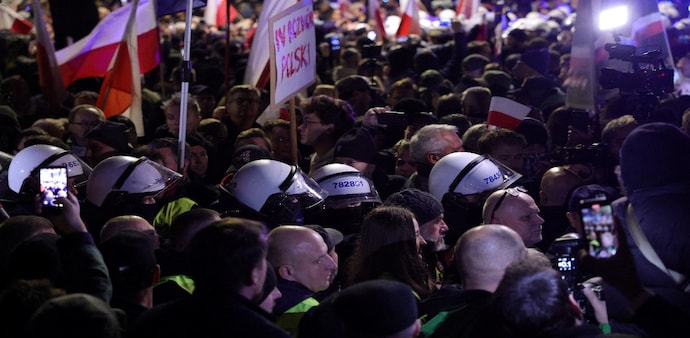
The situation escalated as hundreds of protesters gathered outside the tribunal in Warsaw. Riot police were deployed to secure the premises after demonstrators attempted to breach security barriers and threw objects at officers. Three people were detained.
Nawrocki, who was travelling to Senegal on an official visit, turned his plane around and returned to Warsaw. He reached the tribunal shortly before 1 am on Saturday, October 31, and accused the government of violating the Constitution.
The confrontation has exposed a deeper institutional conflict over judicial appointments, the authority of Poland's highest constitutional court and the limits of executive power.
What triggered Poland's midnight crisis?
The confrontation unfolded on Friday, October 30, and continued into the early hours of Saturday.
Judge Anna Korwin-Piotrowska issued orders suspending Święczkowski and Sochański from their positions. She accused the tribunal's leadership of obstructing judges elected by the current parliamentary majority and preventing the court from functioning properly.
Korwin-Piotrowska is among five judges elected by the current parliament but not sworn in by Nawrocki. Citing her seniority, she claimed authority to assume leadership of the tribunal.
The existing leadership rejected her move, maintaining that Święczkowski remained the tribunal's president and Sochański its vice-president. The institution's official communication described the developments as an attempted coup d'état.
The competing claims quickly turned the dispute into a street-level confrontation, with police securing the tribunal building as opposition supporters and lawmakers gathered outside.
Why is Poland's Constitutional Tribunal so important?
The Constitutional Tribunal determines whether laws and other legal provisions comply with Poland's Constitution. Its decisions can invalidate legislation and influence the balance of power between parliament, the government and the presidency.
The current crisis has created competing claims of authority within the same institution, with rival groups disputing the legitimacy of appointments and the right to exercise control over the court.
How did Poland's judicial crisis begin?
The roots of the confrontation go back to 2015, when the conservative Law and Justice party (PiS) came to power.
The dispute began with competing appointments to the Constitutional Tribunal. The outgoing parliament had elected five judges shortly before the new parliament took office. The incoming PiS majority challenged some of these appointments and elected its own candidates to positions already considered filled.
The resulting conflict triggered years of legal and political disputes over the legitimacy of judicial appointments.
The European Court of Human Rights and the Court of Justice of the European Union subsequently raised concerns about the tribunal's independence and the legality of certain appointments.
The European Union also took action against Poland over judicial reforms introduced under PiS, arguing that they undermined judicial independence by increasing political influence over the courts. PiS defended the changes as necessary to reform an inefficient judicial system.
The dispute left Poland with a deeply divided judiciary and competing interpretations of the country's constitutional order.
Why is Donald Tusk trying to overhaul the judiciary?
Donald Tusk returned to power in December 2023 after his pro-European coalition defeated the PiS-led government.
Restoring judicial independence and reversing controversial reforms introduced by his predecessors were among his key promises. His government also sought to repair relations with the European Union, which had raised concerns over Poland's rule-of-law standards.
However, implementing the changes has proved difficult. Many judges appointed during the PiS years remain in office, while the president has significant constitutional powers, including the ability to veto legislation.
Tusk's government argues that the Constitutional Tribunal was politicised under PiS and that its composition must be corrected. It has accused Święczkowski, who became tribunal president under the previous administration, of obstructing judges elected by the current parliamentary majority.
Critics, however, argue that the government's methods risk creating fresh constitutional violations rather than resolving the existing dispute.
Why is President Karol Nawrocki opposing the government?
Nawrocki, backed by the conservative PiS political camp, has emerged as a key opponent of Tusk's judicial overhaul.
A major point of contention is his refusal to swear in five judges elected by the current parliamentary majority. The government maintains that they should be allowed to assume their positions, while the president's resistance has complicated efforts to change the tribunal's composition.
The Council of Europe's Venice Commission said in October that the president's refusal to swear in the five judges should not prevent them from taking up their positions.
Korwin-Piotrowska, who issued the latest suspension orders, is one of those five judges. The dispute has therefore become a broader confrontation over who has the authority to determine the tribunal's composition and leadership.
Why are both sides accusing each other of a coup?
The term 'coup d'état' has become central to the political rhetoric surrounding the crisis. The tribunal's existing leadership and PiS leaders argue that suspending its president and vice-president through a disputed procedure amounts to an unlawful seizure of a constitutional institution.
Nawrocki has similarly accused the government of violating the Constitution and undermining the country's legal order.
Tusk's government offers a different interpretation. It argues that restoring judicial independence requires decisive action to reverse years of political interference and enable legitimately elected judges to perform their duties.
The legality of the suspension orders remains contested. The competing accusations do not, by themselves, establish that a coup has taken place. The central question is whether the actions taken by either side comply with Poland's constitutional and judicial procedures.
The timing is politically significant, with Poland heading towards another parliamentary election in 2027. The judicial dispute could become a major issue in the contest between Tusk's coalition and the opposition.
The confrontation risks further weakening public confidence in Poland's judicial institutions and deepening divisions between the governing coalition and the conservative opposition. It also complicates Warsaw's efforts to rebuild relations with the European Union, which has repeatedly raised concerns about judicial independence and the rule of law.
The United States has also expressed concern, with US Ambassador to Poland Tom Rose urging both sides to avoid escalation.