
Tankers on fire, marine life at risk: UK swimmer's 15-km Hormuz swim highlights environmental crisis
Describing the strait as one of the most beautiful places he had visited, Pugh highlighted the contrast between its natural richness and the destruction unfolding around it. His concern centres on the possibility that continued attacks on commercial vessels could cause extensive and long-lasting damage to the region's marine environment.
- Nov 22, 2026,
- Updated Nov 22, 2026 11:43 AM IST
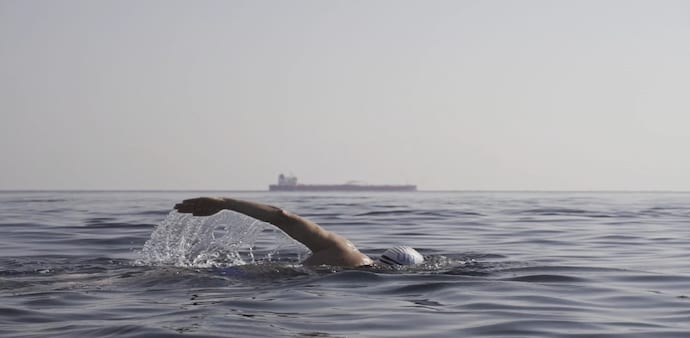
British endurance swimmer Lewis Pugh has completed a three-day swim through the Strait of Hormuz, one of the world's most strategically important oil shipping routes, to draw attention to the environmental consequences of the ongoing West Asia conflict. His challenge, however, unfolded against a backdrop of attacks on commercial vessels, explosions and burning tankers.
Pugh, a United Nations Patron of the Oceans, said an oil tanker was struck just a few kilometres away barely 30 minutes after he began swimming. The explosions were powerful enough to rock the surrounding waters. Over the following days, he witnessed further attacks on commercial shipping and vessels engulfed in flames.
In a detailed post on X (formally twitter), Pugh said he had undertaken the swim to highlight a consequence of war that often receives little attention: the destruction of marine ecosystems and wildlife.
"War causes immense human suffering. Lives are lost, families are torn apart, and homes are destroyed. But there is another casualty that receives far too little attention: nature itself," he wrote.
Wearing only swimming trunks, goggles and a swimming cap bearing the United Nations logo, Pugh began his journey from the Musandam peninsula on the southern side of the strait and completed the approximately 15-km (9.3-mile) swim by rounding the Cape of Hormuz. He is believed to be the first person to undertake a long-distance swim through the waterway since the war began.
The scale of the maritime security crisis is reflected in figures released by India's Directorate General of Maritime Administration (DGMA). Between March 1 and October 18, 2026, a total of 86 vessels were affected by maritime security incidents across the Strait of Hormuz, Persian Gulf and Gulf of Oman. These included five Indian-flagged vessels and 81 foreign-flagged vessels.
The incidents also resulted in one reported fatality among crew members aboard Indian-flagged vessels, 10 fatalities and three missing crew members aboard foreign-flagged vessels, and 18 injuries across Indian and foreign-flagged vessels.
The situation has continued to deteriorate. In its November 13 assessment, the United Kingdom Maritime Trade Operations (UKMTO) recorded 141 reports of damage to vessels and 163 total maritime events since February 28, when the conflict began. These figures cover the wider Strait of Hormuz, Arabian Gulf and Gulf of Oman region, rather than the strait alone.
Why is Lewis Pugh swimming through the Strait of Hormuz?
Pugh's challenge was intended to draw attention to the environmental risks posed by attacks on oil tankers, gas carriers and other commercial shipping in the region.
The Strait of Hormuz is not just a critical artery for global energy supplies. It is also home to a diverse marine ecosystem, with coral reefs, mangrove forests and waters supporting dolphins, sea turtles and dugongs.
"Just 30 minutes after I began swimming, an oil tanker was struck a few kilometres away. The explosions rocked the sea around me. Over the following days, I witnessed further attacks on commercial shipping and saw vessels engulfed in flames," he wrote, highlighting the volatile situation in the waterway.
Describing the strait as one of the most beautiful places he had visited, Pugh highlighted the contrast between its natural richness and the destruction unfolding around it.
"Yet this extraordinary place is now caught in the middle of a war. Oil tankers, gas carriers and other merchant ships are being attacked. The environmental consequences will last for decades," he said.
His concern centres on the possibility that continued attacks on commercial vessels could cause extensive and long-lasting damage to the region's marine environment.
How can tanker attacks damage the marine ecosystem?
Oil spills are among the most immediate environmental threats associated with attacks on tankers. Damage to a vessel carrying crude oil or petroleum products can release large quantities of hydrocarbons into the sea, potentially contaminating coastlines, coral reefs and sensitive marine habitats.
The consequences can extend well beyond the initial spill. Oil contamination can affect fish, marine mammals, seabirds and sea turtles. It can also damage mangrove ecosystems, whose coastal root systems provide breeding grounds and shelter for marine organisms.
Coral reefs are particularly vulnerable to pollution. Oil exposure and associated toxic compounds can interfere with coral growth and reproduction, while cleanup operations can cause additional physical damage to fragile habitats.
There are also risks from fires, explosions and the release of other hazardous materials carried by commercial vessels. Even when a major oil spill does not occur, repeated attacks and maritime disruptions can increase the environmental pressure on an already sensitive ecosystem.
A maritime security register updated on November 20 documented 172 vessels involved in 147 incidents across the Gulf and Hormuz conflict theatre. It recorded six ships sunk, nine seized and four confirmed pollution incidents. The register also highlighted a major information gap: for 124 of the 172 vessels, there was no published assessment of whether they had caused an oil or other pollution spill.
This does not establish that all these vessels leaked pollutants. Rather, it underlines how difficult it has been to assess the full environmental consequences of the maritime conflict.
Why the Strait of Hormuz matters beyond global oil supplies
The Strait of Hormuz connects the Persian Gulf with the Gulf of Oman and the Arabian Sea, making it one of the world's most important maritime chokepoints.
A significant share of global oil and liquefied natural gas shipments normally passes through this narrow waterway. Any prolonged disruption can affect energy markets, shipping costs and international trade. But the economic significance of the strait often overshadows its ecological importance.
Pugh's swim sought to bring that overlooked dimension into focus, highlighting how a conflict centred on military and strategic objectives can also threaten marine biodiversity and coastal ecosystems.
The environmental consequences of maritime attacks could persist long after the immediate conflict ends, particularly if pollution reaches sensitive habitats or cleanup efforts are delayed.
Pugh's message: Stop the fighting, open the Strait
Pugh has previously undertaken endurance swims in some of the world's most extreme environments, including the North Pole and Antarctica, to raise awareness about climate change and ocean conservation.
His latest challenge brought that environmental advocacy into an active conflict zone, exposing him to the risks faced by commercial shipping and highlighting the vulnerability of marine ecosystems during wartime.
Concluding his message on X, Pugh called for an end to the fighting, the reopening of the waterway and action to address pollution. "My message is simple: Stop the fighting. Open the Strait. Clean up the pollution. Please help share this message," he wrote.