
Trump-Xi meet: Warm words, sharp divide on AI as US-China moves into ‘superintelligence’ age
Trump-Xi meet: Warm words, sharp divide on AI as US-China moves into ‘superintelligence’ age
The Chinese president said the US and China, as leading AI powers, have a responsibility to ensure the technology is developed “for good” and remains “under human control”.
Business Today Desk
- Sep 25, 2026,
- Updated Sep 25, 2026 8:36 AM IST
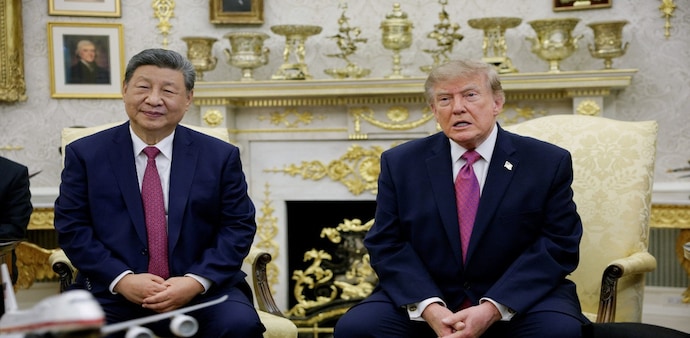
US President Donald Trump and Chinese President Xi Jinping struck a cordial tone ahead of their White House state dinner, even as Washington and Beijing remain divided over trade, Taiwan, advanced technology and artificial intelligence.
AI emerged as a key issue, with Trump saying “superintelligence” would be a major topic of discussion and Xi stressing that AI development must remain under human control.
Advertisement
Trump has increasingly framed AI as a strategic race between the US and China. Ahead of the meeting, he said superintelligence would be a major subject of talks, while signalling that Washington did not want to slow the pace of AI development.
The US President has also argued that maintaining American leadership in AI is critical to economic and national power. The administration has simultaneously explored limited cooperation with Beijing, including discussions around an AI dialogue and mechanisms for notifying each other about AI-related incidents with national-security implications.
Xi's emphasis was different.
The Chinese president said the US and China, as leading AI powers, have a responsibility to ensure the technology is developed “for good” and remains “under human control”. He linked AI governance to the broader need for Washington and Beijing to manage their rivalry responsibly.
Advertisement
The contrast highlights the competing priorities of the two countries. Washington is focused on maintaining its technological lead and accelerating AI development, while Beijing is publicly emphasising oversight, safety and the responsible use of increasingly powerful systems.
Xi urges limits on US-China rivalry
Xi also called for competition between the two countries to remain within limits, arguing that Washington and Beijing should coexist peacefully and avoid turning their relationship into a zero-sum contest.
He referred to the so-called Thucydides trap, the idea that rivalry between an established and rising power can lead to conflict, and said the US and China could avoid such an outcome through dialogue and crisis-management mechanisms.
Advertisement
Xi also called for stronger communication between the two militaries to prevent disagreements from escalating.
Trump, meanwhile, highlighted his personal relationship with Xi, describing it as a strong friendship built over years of negotiations. Trade remained another major focus, with Trump pointing to progress on market access and US agricultural exports.
The cordial public messaging came against a backdrop of continuing disputes over tariffs, semiconductor controls, rare-earth supplies, Taiwan and technology.
AI becomes a strategic battleground
The presence of major technology executives at the White House dinner underscored the growing importance of AI to the US-China relationship.
Among the technology leaders attending were OpenAI CEO Sam Altman, Nvidia CEO Jensen Huang, Tesla and SpaceX CEO Elon Musk, Amazon founder Jeff Bezos, Google CEO Sundar Pichai and Meta CEO Mark Zuckerberg.
The competition extends far beyond chatbots and consumer AI. The US and China are competing over advanced semiconductor technology, computing infrastructure, AI models, data centres, supply chains and military applications.
That creates a difficult balance. Both countries want to move faster than the other in AI, but increasingly powerful systems also create risks that neither Washington nor Beijing can easily manage alone.
US President Donald Trump and Chinese President Xi Jinping struck a cordial tone ahead of their White House state dinner, even as Washington and Beijing remain divided over trade, Taiwan, advanced technology and artificial intelligence.
AI emerged as a key issue, with Trump saying “superintelligence” would be a major topic of discussion and Xi stressing that AI development must remain under human control.
Advertisement
Trump has increasingly framed AI as a strategic race between the US and China. Ahead of the meeting, he said superintelligence would be a major subject of talks, while signalling that Washington did not want to slow the pace of AI development.
The US President has also argued that maintaining American leadership in AI is critical to economic and national power. The administration has simultaneously explored limited cooperation with Beijing, including discussions around an AI dialogue and mechanisms for notifying each other about AI-related incidents with national-security implications.
Xi's emphasis was different.
The Chinese president said the US and China, as leading AI powers, have a responsibility to ensure the technology is developed “for good” and remains “under human control”. He linked AI governance to the broader need for Washington and Beijing to manage their rivalry responsibly.
Advertisement
The contrast highlights the competing priorities of the two countries. Washington is focused on maintaining its technological lead and accelerating AI development, while Beijing is publicly emphasising oversight, safety and the responsible use of increasingly powerful systems.
Xi urges limits on US-China rivalry
Xi also called for competition between the two countries to remain within limits, arguing that Washington and Beijing should coexist peacefully and avoid turning their relationship into a zero-sum contest.
He referred to the so-called Thucydides trap, the idea that rivalry between an established and rising power can lead to conflict, and said the US and China could avoid such an outcome through dialogue and crisis-management mechanisms.
Advertisement
Xi also called for stronger communication between the two militaries to prevent disagreements from escalating.
Trump, meanwhile, highlighted his personal relationship with Xi, describing it as a strong friendship built over years of negotiations. Trade remained another major focus, with Trump pointing to progress on market access and US agricultural exports.
The cordial public messaging came against a backdrop of continuing disputes over tariffs, semiconductor controls, rare-earth supplies, Taiwan and technology.
AI becomes a strategic battleground
The presence of major technology executives at the White House dinner underscored the growing importance of AI to the US-China relationship.
Among the technology leaders attending were OpenAI CEO Sam Altman, Nvidia CEO Jensen Huang, Tesla and SpaceX CEO Elon Musk, Amazon founder Jeff Bezos, Google CEO Sundar Pichai and Meta CEO Mark Zuckerberg.
The competition extends far beyond chatbots and consumer AI. The US and China are competing over advanced semiconductor technology, computing infrastructure, AI models, data centres, supply chains and military applications.
That creates a difficult balance. Both countries want to move faster than the other in AI, but increasingly powerful systems also create risks that neither Washington nor Beijing can easily manage alone.
Read more!