
US-Iran war enters 11th night as strikes continue, Hormuz crisis threatens global energy flows
The conflict, now spreading across multiple fronts and threatening global energy supplies, shows no sign of slowing, and President Donald Trump signalled it could intensify further.
- Jul 22, 2026,
- Updated Jul 22, 2026 7:47 AM IST
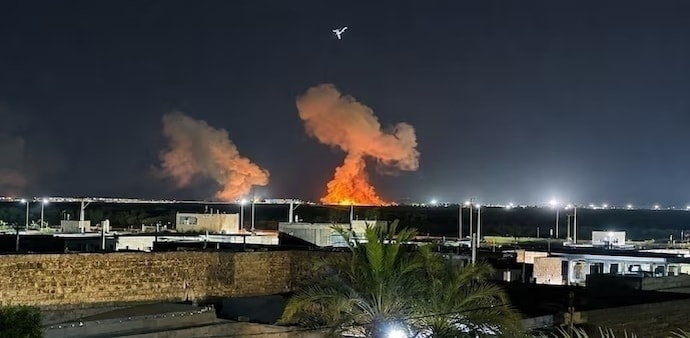
The US launched strikes on Iran for the 11th consecutive night on Wednesday as diplomatic efforts in Pakistan to revive a collapsed ceasefire failed to make progress. The conflict has expanded across multiple fronts, raising concerns over global energy supplies and regional stability.
US President Donald Trump said Iran was seeking talks but warned that Washington had no interest in negotiations unless Tehran was ready for a “meaningful” discussion. He also said the US would target areas near Pickaxe Mountain, an underground site close to one of Iran’s main nuclear facilities.
Iran responded with a warning that any attack on the site would be treated as an escalation of the war. “We declare that if the invading and terrorist military of that country enters such a phase, we will regard it as an expansion of the war across the region, and all interests of the United States, its allies, and its supporters will become targets of powerful attacks by the Armed Forces of the Islamic Republic of Iran,” Iran’s Khatam al-Anbiya Central Headquarters said.
Hormuz and shipping remain flashpoints
The Strait of Hormuz, a key route for global oil and gas shipments, remains at the centre of the conflict. The US said it targeted Iranian military command centres, maritime capabilities, missile sites and air defence systems.
Iran-backed forces have continued attacks on commercial shipping. A tanker was struck off Oman’s coast, forcing its crew to abandon the vessel, while CENTCOM said it had redirected commercial ships and taken action to enforce the blockade.
Conflict spreads across region
The crisis has drawn in neighbouring countries. Jordan intercepted Iranian drones and missiles, Bahrain issued missile alerts, and flights at Iraq’s Irbil airport were temporarily suspended after attacks.
Kuwait said Iranian strikes damaged desalination and power facilities for the fourth consecutive night, threatening a key source of drinking water. UN Secretary-General Antonio Guterres condemned attacks on civilian infrastructure as “unacceptable”.
Red Sea becomes another battleground
The Iran-backed Houthi group in Yemen has widened the crisis by announcing a naval blockade against Saudi Arabia and warning ships to avoid the Bab el-Mandeb Strait, a major global shipping route connecting the Red Sea.
Oil prices rise as casualties mount
Oil prices climbed above $91 a barrel, while petrol prices in the US moved higher. A US official said American military casualties had crossed 500, above the Pentagon’s publicly reported figure.
With both sides refusing to step back and trust between Washington and Tehran at a low point, diplomatic efforts remain stalled, leaving the conflict without a clear path towards de-escalation.
(With inputs from PTI)
The US launched strikes on Iran for the 11th consecutive night on Wednesday as diplomatic efforts in Pakistan to revive a collapsed ceasefire failed to make progress. The conflict has expanded across multiple fronts, raising concerns over global energy supplies and regional stability.
US President Donald Trump said Iran was seeking talks but warned that Washington had no interest in negotiations unless Tehran was ready for a “meaningful” discussion. He also said the US would target areas near Pickaxe Mountain, an underground site close to one of Iran’s main nuclear facilities.
Iran responded with a warning that any attack on the site would be treated as an escalation of the war. “We declare that if the invading and terrorist military of that country enters such a phase, we will regard it as an expansion of the war across the region, and all interests of the United States, its allies, and its supporters will become targets of powerful attacks by the Armed Forces of the Islamic Republic of Iran,” Iran’s Khatam al-Anbiya Central Headquarters said.
Hormuz and shipping remain flashpoints
The Strait of Hormuz, a key route for global oil and gas shipments, remains at the centre of the conflict. The US said it targeted Iranian military command centres, maritime capabilities, missile sites and air defence systems.
Iran-backed forces have continued attacks on commercial shipping. A tanker was struck off Oman’s coast, forcing its crew to abandon the vessel, while CENTCOM said it had redirected commercial ships and taken action to enforce the blockade.
Conflict spreads across region
The crisis has drawn in neighbouring countries. Jordan intercepted Iranian drones and missiles, Bahrain issued missile alerts, and flights at Iraq’s Irbil airport were temporarily suspended after attacks.
Kuwait said Iranian strikes damaged desalination and power facilities for the fourth consecutive night, threatening a key source of drinking water. UN Secretary-General Antonio Guterres condemned attacks on civilian infrastructure as “unacceptable”.
Red Sea becomes another battleground
The Iran-backed Houthi group in Yemen has widened the crisis by announcing a naval blockade against Saudi Arabia and warning ships to avoid the Bab el-Mandeb Strait, a major global shipping route connecting the Red Sea.
Oil prices rise as casualties mount
Oil prices climbed above $91 a barrel, while petrol prices in the US moved higher. A US official said American military casualties had crossed 500, above the Pentagon’s publicly reported figure.
With both sides refusing to step back and trust between Washington and Tehran at a low point, diplomatic efforts remain stalled, leaving the conflict without a clear path towards de-escalation.
(With inputs from PTI)