
West Asia war: Blaze engulfs Riyadh Aramco site after Houthis claim missile & drone strike
Houthi military spokesman Yahya Saree stated late Saturday that the group targeted the energy facility in retaliation for recent military strikes carried out by Saudi forces across Yemen, including the capital, Sanaa.
- Oct 4, 2026,
- Updated Oct 4, 2026 9:15 AM IST
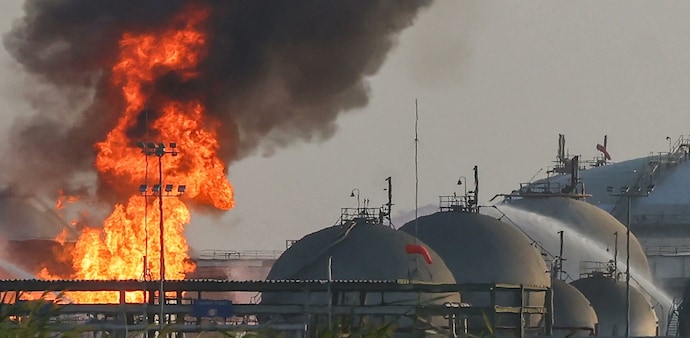
A massive fire erupted at a Saudi Aramco facility south of Riyadh, sending thick plumes of black smoke into the sky as emergency crews rushed to contain the blaze. The inferno followed claims by Yemen’s Iran-aligned Houthi movement that it launched a coordinated assault using ballistic missiles and drones against the site.
Eyewitnesses reported seeing flames erupting from within the refinery complex as fire engines and emergency responders worked to extinguish the blaze. Ambulances and security personnel set up a perimeter around the site while emergency teams moved to prevent the fire from spreading to neighboring infrastructure.
Houthi military spokesman Yahya Saree stated late Saturday that the group targeted the energy facility in retaliation for recent military strikes carried out by Saudi forces across Yemen, including the capital, Sanaa. Saree claimed the salvo of ballistic missiles and armed drones successfully struck the site, directly causing the blazes.
Saudi authorities and state oil company Aramco have not issued an official confirmation regarding the cause of the fire.
Pattern of escalations across Saudi energy hubs
The strike in Riyadh marks a sharp escalation in cross-border targeting. It follows claimed Houthi strikes targeting key Aramco energy assets across the kingdom, including critical export and processing infrastructure near Yanbu along the Red Sea coast. The repeated targeting of energy installations highlights growing vulnerabilities across Saudi Arabia’s industrial heartlands as regional proxy conflicts spill directly into major urban and economic corridors.
Broader regional conflict and stalling diplomacy
The attack comes against the backdrop of the widening West Asia war, where cross-border exchanges have surged in tandem with direct confrontations involving regional non-state actors and coalition forces. The spike in offensive military actions coincides with mounting friction over US-Iran peace talks, where diplomatic efforts aimed at de-escalation have stalled amid expanding trade sanctions and naval friction near critical maritime chokepoints.
Economic impact and energy security risks
With oil infrastructure repeatedly caught in the crossfire, security risks across major energy supply lines remain heightened. Analysts warn that sustained strikes against Aramco refining and transport networks threaten to disrupt global energy markets and push regional security into an increasingly volatile operational landscape.
A massive fire erupted at a Saudi Aramco facility south of Riyadh, sending thick plumes of black smoke into the sky as emergency crews rushed to contain the blaze. The inferno followed claims by Yemen’s Iran-aligned Houthi movement that it launched a coordinated assault using ballistic missiles and drones against the site.
Eyewitnesses reported seeing flames erupting from within the refinery complex as fire engines and emergency responders worked to extinguish the blaze. Ambulances and security personnel set up a perimeter around the site while emergency teams moved to prevent the fire from spreading to neighboring infrastructure.
Houthi military spokesman Yahya Saree stated late Saturday that the group targeted the energy facility in retaliation for recent military strikes carried out by Saudi forces across Yemen, including the capital, Sanaa. Saree claimed the salvo of ballistic missiles and armed drones successfully struck the site, directly causing the blazes.
Saudi authorities and state oil company Aramco have not issued an official confirmation regarding the cause of the fire.
Pattern of escalations across Saudi energy hubs
The strike in Riyadh marks a sharp escalation in cross-border targeting. It follows claimed Houthi strikes targeting key Aramco energy assets across the kingdom, including critical export and processing infrastructure near Yanbu along the Red Sea coast. The repeated targeting of energy installations highlights growing vulnerabilities across Saudi Arabia’s industrial heartlands as regional proxy conflicts spill directly into major urban and economic corridors.
Broader regional conflict and stalling diplomacy
The attack comes against the backdrop of the widening West Asia war, where cross-border exchanges have surged in tandem with direct confrontations involving regional non-state actors and coalition forces. The spike in offensive military actions coincides with mounting friction over US-Iran peace talks, where diplomatic efforts aimed at de-escalation have stalled amid expanding trade sanctions and naval friction near critical maritime chokepoints.
Economic impact and energy security risks
With oil infrastructure repeatedly caught in the crossfire, security risks across major energy supply lines remain heightened. Analysts warn that sustained strikes against Aramco refining and transport networks threaten to disrupt global energy markets and push regional security into an increasingly volatile operational landscape.