
‘Won’t stand by and watch…’: Georgia Meloni threatens to suspend Italy’s Schengen Agreement with Spain; here’s what that means
Spain migrant crisis: Georgia Meloni said "uncontrolled illegal immigration poses a concrete threat to the security of Europe's borders".
- Jul 31, 2026,
- Updated Jul 31, 2026 11:50 AM IST
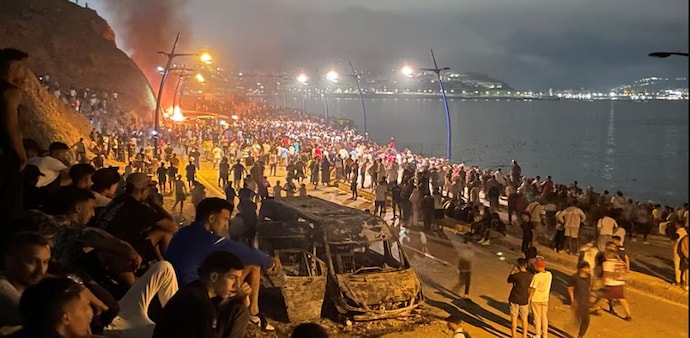
Amid an unprecedented inflow of migrants that breached Spanish borders to enter the enclave of Ceuta in North Africa, Italian Prime Minister Georgia Meloni has said her country will not stand and watch this take place. She also threatened to suspend Italy’s Schengen Agreement over this.
“The images coming from Ceuta are striking and demonstrate, once again, that uncontrolled illegal immigration poses a concrete threat to the security of Europe's borders,” she said as videos of migrants rushing into Ceuta went viral on social media. According to Spanish state television TVE, 2,000-3,000 people had crossed into Ceuta.
Meloni said: “I have spoken with Interior Minister Matteo Piantedosi. Italy will not stand by and watch. We are convening the relevant bodies, and following these meetings, we are prepared to intervene with extraordinary measures to defend the borders and the safety of citizens, including the suspension of the Schengen Area with Spain. On illegal immigration, we will not yield an inch: defending the borders, stopping human traffickers, and ensuring effective repatriations will continue to be the line of this Government.”
MUST READ | Unprecedented scenes: Thousands of migrants break through border to enter Spain’s Ceuta
What does this mean?
This means that border checks would return, and identity checks would be reinstated at land, air, or sea borders with the Schengen country. Inspections that are normally absent within the Schengen area might be reinstated.
People would still be able to travel between the Schengen countries but would experience delays, queues, and document checks.
What’s at stake?
As per the Schengen Agreement, EU countries in the Schengen area benefit from certain rules.
- These countries can cross the Schengen area’s internal borders, bypass identity checks
- Any person who is granted a short-stay visa with no territorial restrictions can move freely and stay in the Schengen area for the duration of the visa’ validity
- Third-country nations with a national residence permit of a Schengen country may travel to another Schengen nation for the duration of the validity, travel for up to 90 days every 180-day period
- Harmonised visa policies of Schengen countries
- All Schengen countries can access the Schengen Information System (SIS) that provides data on persons and objects throughout the Schengen area
- Close police and judicial cooperation, as well as joint efforts in drug-related crimes
Amid an unprecedented inflow of migrants that breached Spanish borders to enter the enclave of Ceuta in North Africa, Italian Prime Minister Georgia Meloni has said her country will not stand and watch this take place. She also threatened to suspend Italy’s Schengen Agreement over this.
“The images coming from Ceuta are striking and demonstrate, once again, that uncontrolled illegal immigration poses a concrete threat to the security of Europe's borders,” she said as videos of migrants rushing into Ceuta went viral on social media. According to Spanish state television TVE, 2,000-3,000 people had crossed into Ceuta.
Meloni said: “I have spoken with Interior Minister Matteo Piantedosi. Italy will not stand by and watch. We are convening the relevant bodies, and following these meetings, we are prepared to intervene with extraordinary measures to defend the borders and the safety of citizens, including the suspension of the Schengen Area with Spain. On illegal immigration, we will not yield an inch: defending the borders, stopping human traffickers, and ensuring effective repatriations will continue to be the line of this Government.”
MUST READ | Unprecedented scenes: Thousands of migrants break through border to enter Spain’s Ceuta
What does this mean?
This means that border checks would return, and identity checks would be reinstated at land, air, or sea borders with the Schengen country. Inspections that are normally absent within the Schengen area might be reinstated.
People would still be able to travel between the Schengen countries but would experience delays, queues, and document checks.
What’s at stake?
As per the Schengen Agreement, EU countries in the Schengen area benefit from certain rules.
- These countries can cross the Schengen area’s internal borders, bypass identity checks
- Any person who is granted a short-stay visa with no territorial restrictions can move freely and stay in the Schengen area for the duration of the visa’ validity
- Third-country nations with a national residence permit of a Schengen country may travel to another Schengen nation for the duration of the validity, travel for up to 90 days every 180-day period
- Harmonised visa policies of Schengen countries
- All Schengen countries can access the Schengen Information System (SIS) that provides data on persons and objects throughout the Schengen area
- Close police and judicial cooperation, as well as joint efforts in drug-related crimes