
BT BIG STORY: From factory floors to boardrooms, women are driving India’s EV revolution
BT BIG STORY: From factory floors to boardrooms, women are driving India’s EV revolution
As the auto industry moves increasingly to electric mobility, women are finding new opportunities in leadership and on the factory floor.
Karan Dhar
- Oct 28, 2026,
- Updated Oct 28, 2026 6:00 AM IST
When Suman Mishra took charge of Mahindra Group’s last-mile mobility business as chief executive in August 2021, she was in for a surprise. “Somebody called up and said you are the first woman professional CEO in the auto industry,” Mishra tells Business Today.
“I almost fell off my chair. I’m like, what are you saying? Are you saying the automotive industry in India hasn’t had professional female CEOs?” she recalls. “It was a shock.”
Advertisement
Women’s participation in the auto industry was so low that when Mishra began visiting manufacturing plants as CEO, she would ask a simple question: Where was the women’s washroom? Often, there wasn’t one. “Nobody’s there. Nobody uses it,” she recalls being told. By her second visit, a washroom would have been installed and a few women employees introduced to her.
“We have hired three-four women,” she remembers being told. From then on, Mishra made it a point to take a photograph with women employees during plant visits. Their numbers gradually rose until they outgrew the room where they used to gather.
The once-in-a-generation shift to electric mobility is beginning to change the equation, creating opportunities for newer players— and potentially more women—in an industry long dominated by men.
Advertisement
For Aanchal Jain, CEO of KKR-backed electric bus maker PMI Electro Mobility, electrification has transformed the auto industry’s landscape. “When the electrification of buses was happening in 2016-17, that was sort of a democratic movement. What legacy players had was the engine, and with electrification, the engine went away,” she says.
At the time, her family business built bus bodies in Haryana. The transition to electric mobility offered an opportunity to move up the value chain and enter a market dominated by automakers with expertise in internal combustion engines (ICE). “Pretty much everybody knew how to assemble a bus, and we knew that very well. That’s how we took the plunge—a leap of faith—and decided to become an electric bus OEM ourselves,” she says.
Advertisement
Cut to 2026: PMI Electro Mobility pipped legacy automakers such as Tata Motors and Ashok Leyland to bag the largest order—5,210 electric buses—under the Rs 10,900-crore PM E-Drive scheme. It also won an order for around 1,200 buses under the PM-eBus Sewa Scheme. The e-bus maker currently has an order book of 7,500 buses.
For M&M’s Mishra, too, the decision to go all-in on electric mobility helped the company establish its dominance in the last-mile mobility segment. When she took over as CEO in 2021, the business had a small electric three-wheeler presence alongside its ICE portfolio. With limited resources, she had to decide where to focus. “The future was electric,” she says. “I thought that’s where you have to focus because, first of all, it is something new. You are having a technology shift. And technology shift can always help you win, get leadership,” she explains.
Mishra says Mahindra Last Mile Mobility’s monthly electric three-wheeler sales have risen from 200-300 when she took over to 15,000-16,000 today.
Advertisement
Electrification is changing the nature of work in an industry where women have historically been scarce, particularly on factory floors. Mishra says electric vehicles are helping companies attract women to roles that were once harder to fill. Software, electronics and, increasingly, automated manufacturing processes are creating new entry points.
“Automobiles are mostly now software. So, we are able to attract a lot of women,” she says. “If you are getting women in the product development side, you know you can get women in the service side because debugging is also now technically a lot more application-oriented and software-driven.”
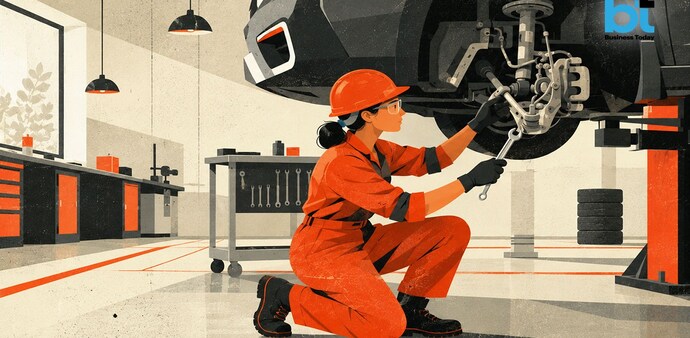
At Mahindra Last Mile Mobility, the change is visible on the shop floor as well. The battery line at its Zaheerabad plant has an all-women first shift. The Haridwar plant has a battery line staffed by women. Women also work in the company’s battery assembly operations in Bengaluru. Women are 13% of the workforce of 1,100-1,200 people, up from 10% two years ago, says Mishra. The absolute numbers have risen by 30-40% annually over the past two years. “Because of electrification, the barrier is slowly dissipating,” she adds.
Jain has adopted a similar approach at PMI Electro. The company runs an all-women battery assembly plant in Dharuhera and employs women in wiring-harness manufacturing. “We’ve tried creating safer spaces for women to work and increase employment in whatever way we can,” she says. “We encourage women employment. Gender equality is one of the core pillars we work on.”
Advertisement
One of the biggest barriers to women reaching leadership roles in the automobile industry is their limited representation in the management pipeline.
For Mishra, creating opportunities for women is not merely a matter of diversity but a business imperative. The CEO of Mahindra Last Mile Mobility believes as companies across sectors grapple with labour shortages, talent availability and attrition, widening the pool of women employees makes sound business sense. M&M runs a programme called SOAR, which helps women returning from career breaks of six months to three years reconnect with their careers, says Mishra.
While the transition to electric vehicles has opened up new opportunities for women, they are also taking the helm of India’s auto component industry.
For Anjali Singh, executive chairperson of legacy auto-component makers Anand Group and Gabriel and president-designate of the Automotive Component Manufacturers Association of India (ACMA), being a woman leader in the male-dominated industry has hardly been a challenge. “Often, at a conference of 400 men, there are three-four women, but I have never felt any disadvantage. You can have an iron fist with a velvet glove and use it to your advantage. You are on an equal playing field,” she tells BT.
Advertisement
Singh, who grew up accompanying her father on joint-venture signing trips as a teenager, says many Anand Group plants are headed by women. However, she believes supportive state policies are equally important. “The number of working hours. The shifts for women. That kind of change is also very structurally important. Automotive has just not been traditionally a field where women went into. So, breaking those barriers down can be tough,” she says.
According to Singh, skill development can increase women’s participation. “There is a lack of skilled labour in certain belts in the country,” she says.
Women have constituted a majority on Gabriel’s board for a long time. Besides Singh, it has two external women directors. “That’s not because we have to have but we wish to have. We continue to strive to improve those numbers,” she adds.
One can assume that these emerging opportunities are only the beginning. As electric mobility reshapes the automotive industry, the change is becoming visible not just in boardrooms but also on the shop floor, where women are taking on roles in battery assembly and manufacturing.
Yet, technology alone cannot drive lasting change. Sustaining the momentum will require companies to invest in skills, improve workplace infrastructure and build clearer pathways for women to grow into leadership positions. The real test of this transition will be whether it moves women’s participation beyond individual initiatives to become an integral part of the industry’s future.
Read more!