
Toyota Yaris Review: One for the head, not the heart
Exactly a month from now when Toyota launches its maiden mid-size car Yaris in the Indian market, it would be its first new car launch in seven years. The last one to hit the roads was the Etios in 2010.
- Apr 19, 2018,
- Updated Apr 19, 2018 5:35 PM IST
Exactly a month from now when Toyota launches its maiden mid-size car Yaris in the Indian market, it would be its first new car launch in seven years. The last one to hit the roads was the Etios in 2010, the smallest and most affordable sedan that the Japanese car major has ever made. That car did not quite burn the sales chart the way it was expected to forcing Toyota to go back to the drawing board. Like many others including Honda, Toyota has realised it does not have the wherewithal to make affordable low-cost cars for India the way Maruti does, and now wants to play its own game.
Originally developed as the Vios for emerging markets where the need for a sedan smaller than the Corolla was felt, Yaris is to Toyota what City is to Honda. As part of its global product line-up, it has all the attributes of a Toyota car, something that was missing in some ways in the Etios series. Yet, it comes at a time and in a segment that is fiercely competitive. The Hyundai Verna, longtime segment leader Honda City and current favorite Maruti Ciaz are all strong competitors. Courtesy our short drive on the outskirts of Bangalore, here is a low down on the new challenger.
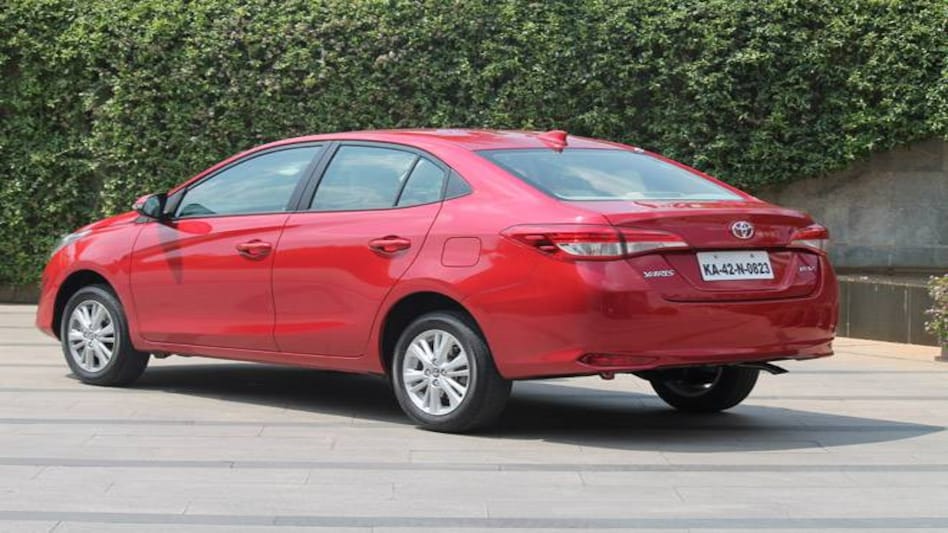
Dimensions, looks and stylingIn terms of styling as a carmaker, Toyota tends to be conservative aiming to keep everybody happy rather than floor a few at the cost of disappointing a few others. Going jugular, is not its way and so it is with the Yaris. It is a well built and competently designed car that one would take note of on the road even if you would not preen your neck for a second look. In that sense, this is not a Verna, which is a seriously good looking car. Viewed dead straight, you may be forgiven for thinking it is a small car. The big smiling grille at the front that has become a signature Toyota design element, coupled with the tear-drop shaped fog lamps impart a good presence on the road. Toyota could have however played around a bit with chrome to break the monotony of the mass of plastic in front. There are telltale signs of it being inspired by the bigger Corolla and the rear is where the resemblance is the highest. The large wrap around tail lamps with LED inserts gives it a premium look. If the front gives an impression of it being small, the rear makes it look larger than it is. In reality, it matches up well with the others in dimensions but it looks best when viewed from a distance.
The cabin also follows the template with a beige and black dashboard color combination and an uncluttered instrument console. The mentionables include a gesture sensitive multi-media system that you would not find even in cars from a segment above, which somewhat compensates for the lack of Android auto or Apple carplay. It, however, has a limited range and cannot be operated from the rear seat so the practicality of it, should this be used as a chauffeur driven car, will be suspect. The car also comes with excellent seats that have terrific side bolstering and rear AC vents that are mounted on the roof. The company claims it helps cool the cabin faster than those that are fitted on the floor and we take their word for it. In the 38 degree heat of Bangalore, it did chill efficiently. On the flipside, legroom and headroom is somewhat compromised at the back and the side armrest of the front is stretched so far back at the rear that a third passenger would feel uncomfortable. This is a four seater car where a fifth would be a squeeze. You would do better to grab the front seats first.
Powertrain, ride and handling The Yaris does not get a diesel engine unlike all its competitors and is powered by a singular 1.5 litre petrol powertrain that makes 107 PS power and 140 NM of torque. This is mated to a 6 speed manual and a well spread out 7 speed automatic CVT transmission. Yaris isn't the most eager car in the segment and takes its time to get going especially in the automatic where the rubber band effect of the CVT--the transmission holds on to the revvs for better fuel economy-- is pronounced. The strength lies elsewhere. Refinement levels are high and thanks to superior insulation, it has a very quiet cabin. The suspension has also been very well tuned for Indian conditions and it tackles potholes and bad roads with no fuss. The icing on the cake is the braking which is one of the best in its segment. Brake hard and the bite is instantaneous making the car stop dead in its tracks without any theatrics. The irony is that in context it looks more than adequate to handle a few more horses under the hood.
Features and fuel economyToyota is playing to the gallery as far as safety is concerned with the car. With the dual and curtain airbags, it comes with a total seven airbags. There is one for the driver's knee as well. All standard across variants. Also standard are some other active safety features like anti lock brakes, electronic brake distribution and brake assist. The top end trims also get disc brakes on all tyres, another first in the segment, vehicle stability control, hill start assist control--that prevents the car from rolling backwards if when stopped at an incline, and tyre pressure monitoring system. In addition there are parking sensors even in the front of the car. As mentioned before some of the misses include Apple car play or android auto and sun-roof at the top end trim. The Verna also comes in with ventilated seats which Yaris doesnt get. Yet it is a good bargain to have that extra bite in the brakes and additional airbags instead of the other bells and whistles provided they come for the same price.
The fuel efficiency figures of the car are on expected lines, 17.2 kpl for the manual and 17.7 kpl for automatic. It is less than the Ciaz, more than the Verna and at par with the City but largely follows the trend of power as inversely proportional to mileage.
Last wordThe lack of a diesel engine clearly implies Yaris is not really gunning for glory in a segment where the customer is already spoilt for choice. Even then, it is a welcome addition. While it does not score with its styling and looks though this is still subjective, and could have offered better space at the rear and more power on the road, it has a very sorted suspension set up that will keep you comfortable in the worst of roads and a very safe set of brakes, which should keep a driver happy. In case of a calamity you are also insured for safety with the airbags. In a country where more people die on the roads every year than anywhere else in the world, that counts for a lot. This is not the car to show off to your nosy neighbours, or to beat the wannabes in a drag race between traffic lights around town. It is for those who value safety and reliability above everything else. More for the head than the heart.
Exactly a month from now when Toyota launches its maiden mid-size car Yaris in the Indian market, it would be its first new car launch in seven years. The last one to hit the roads was the Etios in 2010, the smallest and most affordable sedan that the Japanese car major has ever made. That car did not quite burn the sales chart the way it was expected to forcing Toyota to go back to the drawing board. Like many others including Honda, Toyota has realised it does not have the wherewithal to make affordable low-cost cars for India the way Maruti does, and now wants to play its own game.
Originally developed as the Vios for emerging markets where the need for a sedan smaller than the Corolla was felt, Yaris is to Toyota what City is to Honda. As part of its global product line-up, it has all the attributes of a Toyota car, something that was missing in some ways in the Etios series. Yet, it comes at a time and in a segment that is fiercely competitive. The Hyundai Verna, longtime segment leader Honda City and current favorite Maruti Ciaz are all strong competitors. Courtesy our short drive on the outskirts of Bangalore, here is a low down on the new challenger.
Dimensions, looks and stylingIn terms of styling as a carmaker, Toyota tends to be conservative aiming to keep everybody happy rather than floor a few at the cost of disappointing a few others. Going jugular, is not its way and so it is with the Yaris. It is a well built and competently designed car that one would take note of on the road even if you would not preen your neck for a second look. In that sense, this is not a Verna, which is a seriously good looking car. Viewed dead straight, you may be forgiven for thinking it is a small car. The big smiling grille at the front that has become a signature Toyota design element, coupled with the tear-drop shaped fog lamps impart a good presence on the road. Toyota could have however played around a bit with chrome to break the monotony of the mass of plastic in front. There are telltale signs of it being inspired by the bigger Corolla and the rear is where the resemblance is the highest. The large wrap around tail lamps with LED inserts gives it a premium look. If the front gives an impression of it being small, the rear makes it look larger than it is. In reality, it matches up well with the others in dimensions but it looks best when viewed from a distance.
The cabin also follows the template with a beige and black dashboard color combination and an uncluttered instrument console. The mentionables include a gesture sensitive multi-media system that you would not find even in cars from a segment above, which somewhat compensates for the lack of Android auto or Apple carplay. It, however, has a limited range and cannot be operated from the rear seat so the practicality of it, should this be used as a chauffeur driven car, will be suspect. The car also comes with excellent seats that have terrific side bolstering and rear AC vents that are mounted on the roof. The company claims it helps cool the cabin faster than those that are fitted on the floor and we take their word for it. In the 38 degree heat of Bangalore, it did chill efficiently. On the flipside, legroom and headroom is somewhat compromised at the back and the side armrest of the front is stretched so far back at the rear that a third passenger would feel uncomfortable. This is a four seater car where a fifth would be a squeeze. You would do better to grab the front seats first.
Powertrain, ride and handling The Yaris does not get a diesel engine unlike all its competitors and is powered by a singular 1.5 litre petrol powertrain that makes 107 PS power and 140 NM of torque. This is mated to a 6 speed manual and a well spread out 7 speed automatic CVT transmission. Yaris isn't the most eager car in the segment and takes its time to get going especially in the automatic where the rubber band effect of the CVT--the transmission holds on to the revvs for better fuel economy-- is pronounced. The strength lies elsewhere. Refinement levels are high and thanks to superior insulation, it has a very quiet cabin. The suspension has also been very well tuned for Indian conditions and it tackles potholes and bad roads with no fuss. The icing on the cake is the braking which is one of the best in its segment. Brake hard and the bite is instantaneous making the car stop dead in its tracks without any theatrics. The irony is that in context it looks more than adequate to handle a few more horses under the hood.
Features and fuel economyToyota is playing to the gallery as far as safety is concerned with the car. With the dual and curtain airbags, it comes with a total seven airbags. There is one for the driver's knee as well. All standard across variants. Also standard are some other active safety features like anti lock brakes, electronic brake distribution and brake assist. The top end trims also get disc brakes on all tyres, another first in the segment, vehicle stability control, hill start assist control--that prevents the car from rolling backwards if when stopped at an incline, and tyre pressure monitoring system. In addition there are parking sensors even in the front of the car. As mentioned before some of the misses include Apple car play or android auto and sun-roof at the top end trim. The Verna also comes in with ventilated seats which Yaris doesnt get. Yet it is a good bargain to have that extra bite in the brakes and additional airbags instead of the other bells and whistles provided they come for the same price.
The fuel efficiency figures of the car are on expected lines, 17.2 kpl for the manual and 17.7 kpl for automatic. It is less than the Ciaz, more than the Verna and at par with the City but largely follows the trend of power as inversely proportional to mileage.
Last wordThe lack of a diesel engine clearly implies Yaris is not really gunning for glory in a segment where the customer is already spoilt for choice. Even then, it is a welcome addition. While it does not score with its styling and looks though this is still subjective, and could have offered better space at the rear and more power on the road, it has a very sorted suspension set up that will keep you comfortable in the worst of roads and a very safe set of brakes, which should keep a driver happy. In case of a calamity you are also insured for safety with the airbags. In a country where more people die on the roads every year than anywhere else in the world, that counts for a lot. This is not the car to show off to your nosy neighbours, or to beat the wannabes in a drag race between traffic lights around town. It is for those who value safety and reliability above everything else. More for the head than the heart.