
'Lala era has ended': Sparky founder on how India's garment business changed
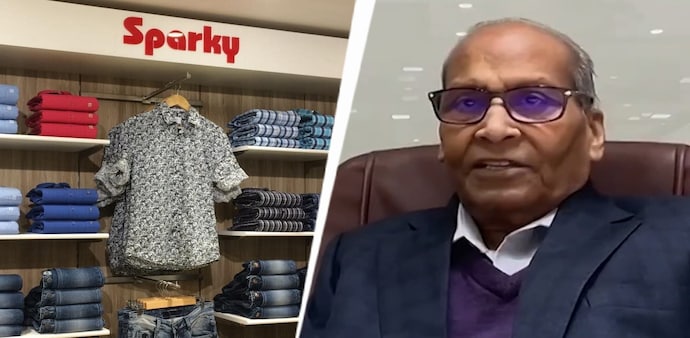
Jaikumar Jain said he started the business after completing his M.Com from Shri Ram College of Commerce in 1962, despite his father wanting him to pursue Chartered Accountancy
- May 7, 2026,
- Updated May 7, 2026 4:16 PM IST
Sparky founder Jaikumar Jain says the "Lala era" of Indian business is ending, as rising capital requirements, branded retail and corporate expansion reshape the country’s garment industry.
Speaking to Business Today TV as part of the EY-BT Hidden GEMs series, Jain reflected on a 65-year business journey that began in 1962 with ₹50,000 and evolved into a ₹1,000-crore apparel brand.
"What I would call the 'Lala era' has ended," Jain said.
"By 'Lala era', I mean a situation where if someone failed in Class 10 but had a little money, the family would simply ask him to sit at the shop and run the business. Today, business requires education and a lot of capital. Small-capital businesses are moving from small hands to big hands."
From ₹50,000 to ₹1,000 crore
Jain said he started the business after completing his M.Com from Shri Ram College of Commerce in 1962, despite his father wanting him to pursue Chartered Accountancy. "With a very nominal capital of ₹50,000, I started my work," he said.
"My journey has now been 65 years long. During this time, I have seen many ups and downs. I have worked extremely hard. I have witnessed wars, changes in business models, and major shifts in the market."
He said Sparky built its business on strong fundamentals, including a debt-free and rent-free operating model and 90% in-house production.
Jain traced the transformation of India’s consumer market through decades of economic and social change. "When I was young, there was no electricity in our house. There was no television, no refrigerator. People wore dhoti-kurta. Most people didn’t have money," he said. "At that time, people did not have money. If our shirts tore, we repaired them. If our pants tore, we got them darned."
He said liberalisation in the 1990s fundamentally changed consumer behaviour. "The biggest turning point came after liberalisation in the 1990s. When Maruti cars arrived, and the economy opened up, people began to have what you call disposable income."
"Today clothes don't wear out — we get tired of them before they wear out," he said. "We stop wearing them by choice. Every five or seven years, fashion changes completely."
Rise of brands and big capital
Jain said the ready-made garments sector has shifted rapidly from small traders to organised players and large corporates. "In our time, shops used to be just 10 by 10 feet. Businesses operated with very small capital," he said. "Today, large corporate groups like Reliance and Aditya Birla have entered areas that were once dominated by small-scale businesses."
He pointed to the spread of branded products and organised retail across smaller towns and villages. "Earlier, in villages, people bought local tooth powder brands. Today they buy Colgate," Jain said. "In the same way, branded ready-made garments are spreading everywhere."
Jain said Sparky adapted by constantly anticipating changes in fashion and retail trends instead of focusing only on the present. "Our philosophy was never to think only about today. We always tried to visualise what would happen two years later, five years later," he said.
Manipulated pricing
When asked about ethical manufacturing and marketing, Jain said aggressive discounting and inflated pricing by large brands have made it difficult for smaller players to survive in India's apparel market, questioning the ethics of current retail practices.
The veteran entrepreneur said consumer behaviour has shifted sharply from focusing on product quality to chasing brands and discounts. "In earlier times, people looked at the quality of clothes. Today, people look at brands," he said.
Jain alleged that several large brands artificially inflate maximum retail prices before offering deep discounts. "If a product costs ₹500, they put an MRP tag of ₹3,000 and then offer 50% discounts. Some even offer 70% discounts or schemes like 'buy two, get five free'," he said.
Jain said Sparky initially tried to avoid aggressive discounting after opening retail stores. "At present, we have opened 150 retail stores. I thought I would not go down that route. I wanted to keep genuine MRPs and offer only reasonable discounts of around 10%," he said.
But customer expectations forced the company to change its strategy. "When customers entered the store, the first question was: ‘What scheme do you have?’ I am very sorry to say that I had to change it too," Jain said. "I also had to increase MRPs accordingly and offer 50% discounts and schemes."
Jain accused large corporate retailers of prioritising market capture over profitability. He said big corporate players are expanding market share by taking losses today, believing they will earn later. He also criticised business models driven by valuations and IPOs rather than operating profits.
"We want to earn maybe ₹50 by selling a shirt or a pant. Their theory is different — generate sales of ₹5,000 crore, bring an IPO and raise ₹10,000 crore,” he said. "Company is in loss, but promoter is in tremendous profit. Tell me where is ethics."
Sparky founder Jaikumar Jain says the "Lala era" of Indian business is ending, as rising capital requirements, branded retail and corporate expansion reshape the country’s garment industry.
Speaking to Business Today TV as part of the EY-BT Hidden GEMs series, Jain reflected on a 65-year business journey that began in 1962 with ₹50,000 and evolved into a ₹1,000-crore apparel brand.
"What I would call the 'Lala era' has ended," Jain said.
"By 'Lala era', I mean a situation where if someone failed in Class 10 but had a little money, the family would simply ask him to sit at the shop and run the business. Today, business requires education and a lot of capital. Small-capital businesses are moving from small hands to big hands."
From ₹50,000 to ₹1,000 crore
Jain said he started the business after completing his M.Com from Shri Ram College of Commerce in 1962, despite his father wanting him to pursue Chartered Accountancy. "With a very nominal capital of ₹50,000, I started my work," he said.
"My journey has now been 65 years long. During this time, I have seen many ups and downs. I have worked extremely hard. I have witnessed wars, changes in business models, and major shifts in the market."
He said Sparky built its business on strong fundamentals, including a debt-free and rent-free operating model and 90% in-house production.
Jain traced the transformation of India’s consumer market through decades of economic and social change. "When I was young, there was no electricity in our house. There was no television, no refrigerator. People wore dhoti-kurta. Most people didn’t have money," he said. "At that time, people did not have money. If our shirts tore, we repaired them. If our pants tore, we got them darned."
He said liberalisation in the 1990s fundamentally changed consumer behaviour. "The biggest turning point came after liberalisation in the 1990s. When Maruti cars arrived, and the economy opened up, people began to have what you call disposable income."
"Today clothes don't wear out — we get tired of them before they wear out," he said. "We stop wearing them by choice. Every five or seven years, fashion changes completely."
Rise of brands and big capital
Jain said the ready-made garments sector has shifted rapidly from small traders to organised players and large corporates. "In our time, shops used to be just 10 by 10 feet. Businesses operated with very small capital," he said. "Today, large corporate groups like Reliance and Aditya Birla have entered areas that were once dominated by small-scale businesses."
He pointed to the spread of branded products and organised retail across smaller towns and villages. "Earlier, in villages, people bought local tooth powder brands. Today they buy Colgate," Jain said. "In the same way, branded ready-made garments are spreading everywhere."
Jain said Sparky adapted by constantly anticipating changes in fashion and retail trends instead of focusing only on the present. "Our philosophy was never to think only about today. We always tried to visualise what would happen two years later, five years later," he said.
Manipulated pricing
When asked about ethical manufacturing and marketing, Jain said aggressive discounting and inflated pricing by large brands have made it difficult for smaller players to survive in India's apparel market, questioning the ethics of current retail practices.
The veteran entrepreneur said consumer behaviour has shifted sharply from focusing on product quality to chasing brands and discounts. "In earlier times, people looked at the quality of clothes. Today, people look at brands," he said.
Jain alleged that several large brands artificially inflate maximum retail prices before offering deep discounts. "If a product costs ₹500, they put an MRP tag of ₹3,000 and then offer 50% discounts. Some even offer 70% discounts or schemes like 'buy two, get five free'," he said.
Jain said Sparky initially tried to avoid aggressive discounting after opening retail stores. "At present, we have opened 150 retail stores. I thought I would not go down that route. I wanted to keep genuine MRPs and offer only reasonable discounts of around 10%," he said.
But customer expectations forced the company to change its strategy. "When customers entered the store, the first question was: ‘What scheme do you have?’ I am very sorry to say that I had to change it too," Jain said. "I also had to increase MRPs accordingly and offer 50% discounts and schemes."
Jain accused large corporate retailers of prioritising market capture over profitability. He said big corporate players are expanding market share by taking losses today, believing they will earn later. He also criticised business models driven by valuations and IPOs rather than operating profits.
"We want to earn maybe ₹50 by selling a shirt or a pant. Their theory is different — generate sales of ₹5,000 crore, bring an IPO and raise ₹10,000 crore,” he said. "Company is in loss, but promoter is in tremendous profit. Tell me where is ethics."