
'You have to be close to customers, keep innovating': ACG MD Karan Singh on scaling globally in pharma supply
ACG began in 1962 with a single factory in Kandivali, then on the outskirts of Mumbai. Over six decades, it has expanded to 25 offices across countries and manufacturing facilities spanning six continents
- Mar 25, 2026,
- Updated Mar 25, 2026 2:19 PM IST
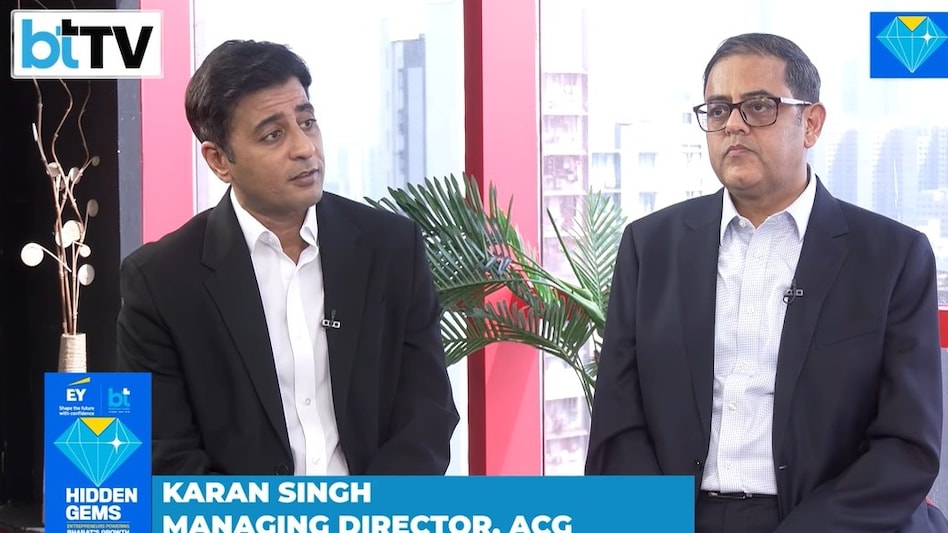
"To stay competitive, you have to continually improve and continually invest in technology," said ACG Managing Director Karan Singh in an exclusive conversation with Business Today TV.
During the discussion, Singh outlined the strategy that has driven the company's expansion from a domestic capsule maker into a global pharmaceutical supply player. He said innovation has remained central to the company's growth as it expanded operations across geographies and product segments.
Also read: Healthcare could more expensive for you as West Asia tension trigger supply fear
"Innovation has played a key role within the organisation. It's been one of the pillars on which we've thrived across these years," he said, adding that global customers increasingly expect constant upgrades. "In almost every conversation, they (foreign customers) will start with what's new."
ACG began in 1962 with a single factory in Kandivali, then on the outskirts of Mumbai. Over six decades, it has expanded to 25 offices across countries and manufacturing facilities spanning six continents. Singh said the company evolved from a capsule supplier into "a completely integrated solution provider to the pharmaceutical industry."
The shift to global markets accelerated after Singh joined the business in 2002. "What was really evident was that we had reached the top of our game here in India, and the challenge for me was really how can we replicate the success that we've had in India at a global scale."
The first overseas acquisition in 2008, a facility in Europe, came after a multinational client demanded local presence. "Unless you don't have a presence locally, we cannot buy from you," Singh recalled. That move led to further expansion across Latin America, the Middle East, Europe, and Southeast Asia.
He said proximity to customers became a key operating principle. "If we truly want to get intimate with our customers and build that trust, and the only way we can do it is by being close to them, where we can really partner with them."
Ajay Arora, Global M&A Advisory Leader at EY, said companies like ACG are drawing sustained interest from global investors. "Global investors love the pharma supply space," he said, pointing to the role of trust and compliance in building long-term relationships.
"The ability to deliver consistent quality to the customers, comply with stringent regulatory norms not just in India but in multiple jurisdictions around the world, gives a competitive edge," Arora said. He added that investors also look for "strong corporate governance" and the ability to scale globally.
On what separates companies that compound value over decades, Arora pointed to discipline and focus. "First and foremost, it's focus on the core business," he said, along with "very, very strong focus on fiscal discipline" and a "global outlook."
He said resilience across cycles remains critical. "They should have the ability to sustain that."
Looking ahead, Singh said ACG's next phase of growth will likely combine organic expansion with acquisitions. While the company has grown largely organically over the past decade, sustaining double-digit growth may require a greater push on acquisitions.
"If we want to continue to sustain the double-digit growth rates, the way it's going to be is largely through acquisitions," he said, adding that these could be within the core business or in adjacent areas that strengthen its base.
Arora said companies in ACG's position have multiple strategic options. "All options are open for them," he said, including selective acquisitions, capability building, and potential capital raises such as minority stakes or an IPO.
He cautioned that dealmaking in the current environment requires a calibrated approach. "It's time to be a cautious buyer rather than an aggressive buyer in the current geopolitical environment," he said, noting that companies must balance business and financial risks carefully.
Both executives pointed to a more uncertain global environment shaping decision-making.
The ACG MD said risks have shifted since the pandemic, with supply chain resilience and geopolitical uncertainty now taking priority. "You're going to constantly be faced with challenges," he said. "It's about building an organization that's agile, taking quick decisions but at the same time, be cautious."
He added that speed remains critical in capturing opportunities. "We see the opportunities we take fast decisions, we close the opportunities as quickly as we can because you know in this uncertain world, you just don't know how long that opportunity is going to present itself for."
"To stay competitive, you have to continually improve and continually invest in technology," said ACG Managing Director Karan Singh in an exclusive conversation with Business Today TV.
During the discussion, Singh outlined the strategy that has driven the company's expansion from a domestic capsule maker into a global pharmaceutical supply player. He said innovation has remained central to the company's growth as it expanded operations across geographies and product segments.
Also read: Healthcare could more expensive for you as West Asia tension trigger supply fear
"Innovation has played a key role within the organisation. It's been one of the pillars on which we've thrived across these years," he said, adding that global customers increasingly expect constant upgrades. "In almost every conversation, they (foreign customers) will start with what's new."
ACG began in 1962 with a single factory in Kandivali, then on the outskirts of Mumbai. Over six decades, it has expanded to 25 offices across countries and manufacturing facilities spanning six continents. Singh said the company evolved from a capsule supplier into "a completely integrated solution provider to the pharmaceutical industry."
The shift to global markets accelerated after Singh joined the business in 2002. "What was really evident was that we had reached the top of our game here in India, and the challenge for me was really how can we replicate the success that we've had in India at a global scale."
The first overseas acquisition in 2008, a facility in Europe, came after a multinational client demanded local presence. "Unless you don't have a presence locally, we cannot buy from you," Singh recalled. That move led to further expansion across Latin America, the Middle East, Europe, and Southeast Asia.
He said proximity to customers became a key operating principle. "If we truly want to get intimate with our customers and build that trust, and the only way we can do it is by being close to them, where we can really partner with them."
Ajay Arora, Global M&A Advisory Leader at EY, said companies like ACG are drawing sustained interest from global investors. "Global investors love the pharma supply space," he said, pointing to the role of trust and compliance in building long-term relationships.
"The ability to deliver consistent quality to the customers, comply with stringent regulatory norms not just in India but in multiple jurisdictions around the world, gives a competitive edge," Arora said. He added that investors also look for "strong corporate governance" and the ability to scale globally.
On what separates companies that compound value over decades, Arora pointed to discipline and focus. "First and foremost, it's focus on the core business," he said, along with "very, very strong focus on fiscal discipline" and a "global outlook."
He said resilience across cycles remains critical. "They should have the ability to sustain that."
Looking ahead, Singh said ACG's next phase of growth will likely combine organic expansion with acquisitions. While the company has grown largely organically over the past decade, sustaining double-digit growth may require a greater push on acquisitions.
"If we want to continue to sustain the double-digit growth rates, the way it's going to be is largely through acquisitions," he said, adding that these could be within the core business or in adjacent areas that strengthen its base.
Arora said companies in ACG's position have multiple strategic options. "All options are open for them," he said, including selective acquisitions, capability building, and potential capital raises such as minority stakes or an IPO.
He cautioned that dealmaking in the current environment requires a calibrated approach. "It's time to be a cautious buyer rather than an aggressive buyer in the current geopolitical environment," he said, noting that companies must balance business and financial risks carefully.
Both executives pointed to a more uncertain global environment shaping decision-making.
The ACG MD said risks have shifted since the pandemic, with supply chain resilience and geopolitical uncertainty now taking priority. "You're going to constantly be faced with challenges," he said. "It's about building an organization that's agile, taking quick decisions but at the same time, be cautious."
He added that speed remains critical in capturing opportunities. "We see the opportunities we take fast decisions, we close the opportunities as quickly as we can because you know in this uncertain world, you just don't know how long that opportunity is going to present itself for."