
Beyond the AI hype: How Industrial AI is reshaping India’s factories and infrastructure
From AI-powered engineering and digital twins to autonomous buildings and intelligent railways, artificial intelligence is moving into India’s physical economy, where higher productivity, faster innovation, energy efficiency and resilience are the measures that matter.
- Nov 2, 2026,
- Updated Nov 2, 2026 10:50 AM IST
Artificial intelligence is moving beyond chatbots, code generation and digital assistants into the physical systems that power the economy. Industrial AI combines artificial intelligence with engineering knowledge, real-time operational data, automation and digital twins to improve how factories, buildings, electricity grids and transportation systems operate.
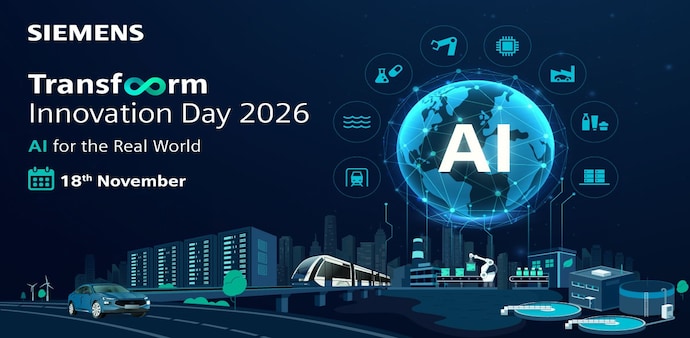
That transition is at the center of Transform, Siemens India Innovation Day 2026, under the theme “AI for the Real World.” The focus is not AI as an isolated experiment, but AI deployed in industrial environments where reliability, safety, cybersecurity and measurable outcomes are critical.
For businesses, the question is consequently changing from what can AI do? to where can AI deliver measurable value?
That could mean reducing engineering time, detecting defects before products leave a factory, predicting equipment failures, lowering energy consumption, validating a production line virtually or improving the availability of railway assets.
The technologies at Transform 2026 are best understood through that lens: not as individual products, but as interconnected capabilities designed to solve customer problems.
From automated factories to intelligent factories
Manufacturers have automated production for decades. Industrial AI adds the ability to make engineering and operations more adaptive, predictive and intelligent.
In an interview with Business Today, Sunil Mathur, Managing Director and Chief Executive Officer, Siemens Limited, explains: “When you talk about GenAI, you're looking more at information language models where if they're 95% accurate, it doesn't really matter. But on the industrial side, you can't be 95%. You've got to be 100% right, because if you are not 100% accurate, you could have a production line that stops, you could have an energy grid that trips, you could have a train that stops on the way.”
The applications include AI-assisted engineering, predictive maintenance, automated quality inspection and process optimization.
These depend on a connected foundation that brings together information technology and operational technology, contextualizes factory data and makes that information accessible to AI applications. Siemens technologies supporting this architecture include Industrial Edge, Industrial AI Suite, Senseye and comprehensive digital twins.
The Eigen Engineering Agent, connected to TIA Portal, illustrates the shift. Instead of only generating suggestions, the agent can undertake automation-engineering tasks such as PLC coding, Human-Machine-Interface visualization and device configuration.
Piloted with more than 100 customers across 19 countries, the Eigen Engineering Agent can complete AI-powered workflows two to five times faster than manual alternatives, with reported improvements of up to 80% in solution quality and 50% in engineering efficiency.
The connection of the Eigen Engineering Agent to Siemens’ TIA Portal is another step toward the vision of ‘automating automation.’ By enabling goal-driven, agentic engineering workflows, Siemens is eliminating repetitive effort for automation engineers while significantly increasing their productivity.
The value becomes clearer when measured through factory performance. At a Pringles factory in Poland, AI-led manufacturing technologies helped deliver 10% higher output, 13% less waste and 7% lower energy consumption. The significance is not AI for its own sake. It is the ability to improve productivity, quality and sustainability simultaneously.
Why digital twins change the economics of innovation
A digital twin is a virtual representation of a product, machine, factory or infrastructure asset that can be used to design, simulate, validate and optimize its physical counterpart.
For an aerospace manufacturer, for example, different engineering questions can be connected through a common digital thread. STAR-CCM+ can simulate airflow and aerodynamic performance. Simcenter can test structural behavior. NX supports mechanical design and manufacturability, while Capital manages electrical architecture. Teamcenter connects configuration and lifecycle information.
The objective is not simply to provide more software. It is to discover problems digitally, when correcting them is faster and less costly, rather than after a physical product or production system has been built.
Virtual simulation could help companies bring products to market up to 50% faster by enabling them to test and validate changes before physical execution.
What is Physical AI?
Traditional industrial automation generally follows predetermined instructions. Physical AI extends artificial intelligence into machines and physical systems, enabling them to interpret objectives, respond to changing conditions and act with greater autonomy. It is a progression from rule-based automation towards intent-based automation. Instead of programming every action, an operator increasingly defines the required outcome and the system determines how to accomplish it.
Physical AI is not limited to humanoid robots. Intelligent cobots, specialized robotics and flexible automation systems are likely to play equally important roles in industrial environments.
For India, this could create an opportunity to leapfrog older stages of industrial automation. Physical AI is an “equalizer” that can compress technological progress that previously took many years, while warning that companies that do not embrace it risk falling behind global competitors. The shift is already reaching product portfolios.
Why AI factories need physical infrastructure
AI may be digital, but its infrastructure is intensely physical. Every AI model depends on computing capacity, electricity, cooling, connectivity, automation and resilient operations.
As workloads become denser, the customer challenge is not simply how to build more datacenter capacity. It is how to design, build and operate that capacity efficiently and reliably at scale.
At Transform 2026, the AI-factory narrative brings together real-time digital twins, automation, intelligent power distribution and resilient infrastructure across the datacenter lifecycle. These technologies can help operators increase transparency, simulate design and operational choices, optimize energy and cooling, and improve scalability.
The same logic extends to power systems. AI-ready datacenters will require grids capable of managing rising demand while integrating renewable and distributed energy resources securely and reliably.
Can buildings become autonomous?
An autonomous building uses connected data and domain-specific AI to sense conditions, predict requirements and take governed action, while people continue to define objectives, policies and constraints.
Transform 2026 presents autonomous buildings as an evolution beyond conventional connected or smart buildings. The technology foundation includes interoperable systems, contextualized data, digital twins, agentic workflows and cybersecurity.
Potential applications include energy and utility optimization, predictive maintenance, fire and security monitoring, occupant comfort and environmental performance reporting. The customer outcomes include lower operating effort, improved energy efficiency, greater resilience and a better occupant experience.
The economic impact can be substantial in energy-intensive industries. Sunil Mathur has cited energy as accounting for around 40% of the fixed cost of running a hotel and approximately 60% of operating a cement plant. Even a modest efficiency improvement can therefore directly affect operating performance.
How can India’s railways become more intelligent?
India’s railway transformation has understandably focused on expanding and modernizing physical infrastructure. The next opportunity is to use digitalization, automation and data to make that infrastructure more intelligent.
Technologies such as Signaling X, Communications-Based Train Control (CBTC), European Train Control System (ETCS) and Kavach can support safer, more connected operations. RailXplore Fusion and predictive-maintenance applications can improve asset availability and lifecycle performance, while systems including Rigid Overhead Catenary System (ROCS) and Flexible Overhead Catenary System (FOCS) can support more efficient and future-ready rail electrification.
The objective is not only to build more rail infrastructure, but to obtain greater value from every train, signal, power system and physical asset throughout its operating life.
From AI pilots to measurable industrial value
Industrial AI needs more than algorithms. It requires domain expertise, contextualized data, software, automation, cybersecurity and electrification working together.
It also requires a pragmatic deployment method. Siemens experts recommend beginning with the business opportunity, standardizing the underlying data and engineering environment, establishing lighthouse applications and then scaling the use cases that demonstrate value.
That approach is particularly important for small and medium-sized manufacturers. These businesses may not have large internal AI teams, but they form an essential part of industrial supply chains. Industrial AI will become broadly valuable when advanced capabilities are accessible through products and engineering environments rather than requiring every manufacturer to become an AI specialist.
The technologies showcased at Transform 2026 point towards a connected industrial future: engineers working with AI agents, factories learning from operational data, products validated through digital twins, buildings optimizing their own performance and infrastructure becoming increasingly predictive.
The real breakthrough will not be measured by how visible AI is. It will be measured by whether businesses innovate faster, produce more efficiently, consume fewer resources and operate with greater resilience.
That is when AI moves beyond the hype and begins delivering value in the real world.