
Engineering the Possible: Reimagining EVs for the Roads That India Really Travels
Every Gravton bike is a connected machine, but more importantly, it’s a contextual machine — built to handle Indian monsoons, potholes, heatwaves, and power cuts.
- Jun 24, 2025,
- Updated Jun 24, 2025 9:44 AM IST
The road doesn’t always run straight.
Neither does the journey that leads us to innovation.
The road to innovation in India isn’t linear. And it’s rarely smooth. It twists through overburdened city flyovers, broken rural trails, power outages, policy gaps, and affordability ceilings. But that’s precisely the terrain where innovation matters most — not in isolation, but in real-world application. That’s where Gravton Motors was born: not with the ambition to create just what’s fashionable, but to engineer what’s fundamental.
India’s electric vehicle movement is undeniably gaining momentum. You see it in Tier 1 cities, where showroom-ready scooters zip past traffic. You feel it in the policy papers, investor decks, and LinkedIn announcements. But between the urban fast lane and the rural shoulder, a vast gap remains — in infrastructure, in relevance, in trust. At Gravton, our journey began not with the question “How can we innovate?” but with “Who is being left behind?”
We weren’t here to build a showroom trophy. We came back to build a platform that could take on the unpredictability of Indian conditions — a bike that’s as ready for Bengaluru’s signal-to-signal stop-start chaos as it is for a farmer riding 60 kilometers to the mandi. A vehicle that feels just as confident in a smart city as it does parked outside a single-room home in a Tier 4 town.
To make that real, we had to go full stack — and go deep. We didn’t assemble parts; we built them. Our patented motor, controller, and battery systems are all developed in-house, allowing us to engineer performance, efficiency, and cost control into every component. That’s how we’ve achieved price parity with ICE vehicles, even without relying on subsidies. That’s how we ensure repairability, part availability, and upgrade paths across regions and riders.
We also knew the charging ecosystem wouldn’t evolve fast enough for everyone. So we didn’t wait. We built modular, swappable battery systems, 90-minute fast charging, and portable charging units — so that a delivery executive in Mumbai and a schoolteacher in Mahbubnagar could both ride electric without wondering where the next charger is.
But tech doesn’t stop at batteries and motors. It needs a brain — and ours is called GOTAC: Gravton On board Telemetry and AI Control. It’s not a buzzword — it’s the intelligence layer that gives our users live diagnostics, real-time GPS tracking, geofencing, predictive maintenance, and battery health insights — whether you're managing a fleet of 50 bikes or just trying to avoid downtime during a rainy commute.
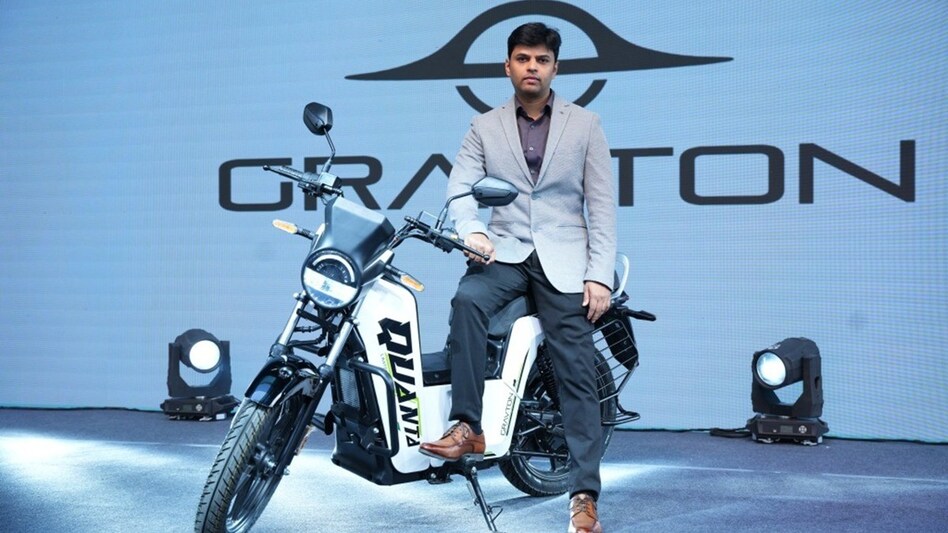
Every Gravton bike is a connected machine, but more importantly, it’s a contextual machine — built to handle Indian monsoons, potholes, heatwaves, and power cuts. From ARQ, our intelligent urban commuter, to QRX, a modular logistics backbone, to the Quanta, which famously rode from Kanyakumari to Khardung La at a cost of just ₹400 — we design products that perform across both ambition and adversity.
And we continue to ask the hard questions. Because this isn’t about just electrifying transport. It’s about building the infrastructure, intelligence, and inclusivity that India’s mobility revolution truly demands.
We don’t believe in one-size-fits-all. We believe in engineering that adapts. Innovation that translates. Mobility that reaches. Because the future isn’t just fast — it must be fair.
After all, a vehicle can only be called revolutionary when it’s built to reach every road India travels — not just the ones that lead to headlines.
Parshuram Paka is the Founder & CEO of Gravton Motors, India’s only full-stack EV motorcycle brand. A mechanical engineer and clean tech entrepreneur, he leads with a vision to build intelligent, scalable, and inclusive mobility systems for the India that is — and the India that’s coming.
The road doesn’t always run straight.
Neither does the journey that leads us to innovation.
The road to innovation in India isn’t linear. And it’s rarely smooth. It twists through overburdened city flyovers, broken rural trails, power outages, policy gaps, and affordability ceilings. But that’s precisely the terrain where innovation matters most — not in isolation, but in real-world application. That’s where Gravton Motors was born: not with the ambition to create just what’s fashionable, but to engineer what’s fundamental.
India’s electric vehicle movement is undeniably gaining momentum. You see it in Tier 1 cities, where showroom-ready scooters zip past traffic. You feel it in the policy papers, investor decks, and LinkedIn announcements. But between the urban fast lane and the rural shoulder, a vast gap remains — in infrastructure, in relevance, in trust. At Gravton, our journey began not with the question “How can we innovate?” but with “Who is being left behind?”
We weren’t here to build a showroom trophy. We came back to build a platform that could take on the unpredictability of Indian conditions — a bike that’s as ready for Bengaluru’s signal-to-signal stop-start chaos as it is for a farmer riding 60 kilometers to the mandi. A vehicle that feels just as confident in a smart city as it does parked outside a single-room home in a Tier 4 town.
To make that real, we had to go full stack — and go deep. We didn’t assemble parts; we built them. Our patented motor, controller, and battery systems are all developed in-house, allowing us to engineer performance, efficiency, and cost control into every component. That’s how we’ve achieved price parity with ICE vehicles, even without relying on subsidies. That’s how we ensure repairability, part availability, and upgrade paths across regions and riders.
We also knew the charging ecosystem wouldn’t evolve fast enough for everyone. So we didn’t wait. We built modular, swappable battery systems, 90-minute fast charging, and portable charging units — so that a delivery executive in Mumbai and a schoolteacher in Mahbubnagar could both ride electric without wondering where the next charger is.
But tech doesn’t stop at batteries and motors. It needs a brain — and ours is called GOTAC: Gravton On board Telemetry and AI Control. It’s not a buzzword — it’s the intelligence layer that gives our users live diagnostics, real-time GPS tracking, geofencing, predictive maintenance, and battery health insights — whether you're managing a fleet of 50 bikes or just trying to avoid downtime during a rainy commute.
Every Gravton bike is a connected machine, but more importantly, it’s a contextual machine — built to handle Indian monsoons, potholes, heatwaves, and power cuts. From ARQ, our intelligent urban commuter, to QRX, a modular logistics backbone, to the Quanta, which famously rode from Kanyakumari to Khardung La at a cost of just ₹400 — we design products that perform across both ambition and adversity.
And we continue to ask the hard questions. Because this isn’t about just electrifying transport. It’s about building the infrastructure, intelligence, and inclusivity that India’s mobility revolution truly demands.
We don’t believe in one-size-fits-all. We believe in engineering that adapts. Innovation that translates. Mobility that reaches. Because the future isn’t just fast — it must be fair.
After all, a vehicle can only be called revolutionary when it’s built to reach every road India travels — not just the ones that lead to headlines.
Parshuram Paka is the Founder & CEO of Gravton Motors, India’s only full-stack EV motorcycle brand. A mechanical engineer and clean tech entrepreneur, he leads with a vision to build intelligent, scalable, and inclusive mobility systems for the India that is — and the India that’s coming.