
From Turnaround to Teaching Case: How East-West Seed India's Transformation Reached the Global Classroom
A period of financial stress, hard choices, and disciplined rebuilding at East-West Seed India is now part of management curricula worldwide — a rare entry for an agribusiness into the literature of corporate business transformation.
- Jul 22, 2026,
- Updated Jul 22, 2026 3:15 PM IST
In 2018, East-West Seed India (EWIN) was, by most external measures, a company doing the right things. It was deeply committed to smallholder farmers. Customers trusted its products. Its people cared. And, quietly, it was in trouble.
Product returns stood at 15 percent. The cash recovery cycle had stretched to 160–180 days. The company was borrowing to fund its day-to-day operations, with almost no room to invest or expand.
Many within the organization accepted these conditions as the price of staying true to the mission. That acceptance, it turned out, was part of the problem.
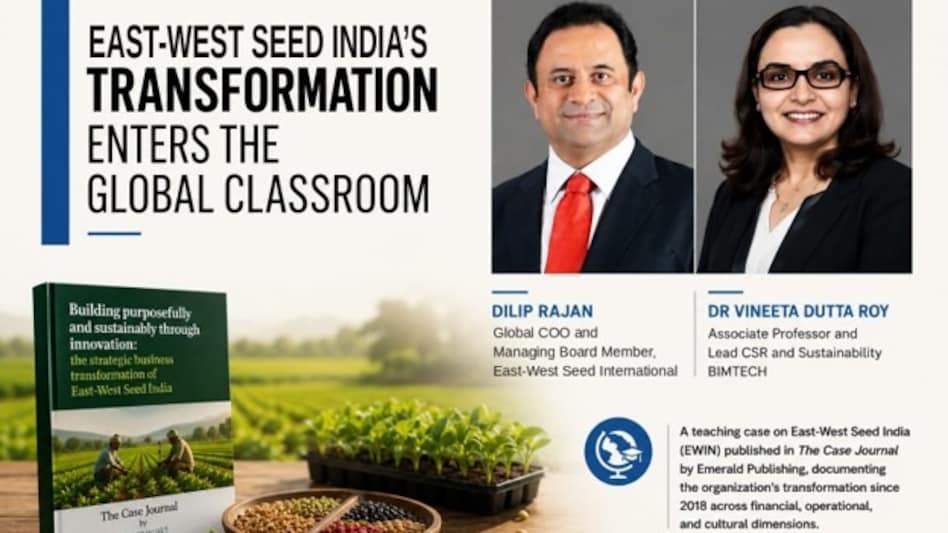
That moment of reckoning — and what followed — is now the subject of a peer-reviewed teaching case published in The Case Journal by Emerald Publishing, one of the world's foremost academic publishers. Authored by Dr. Vineeta Dutta Roy, Associate Professor and Head of CSR and Sustainability Studies at Birla Institute of Management and Technology (BIMTECH), the case is titled "Building Purposefully and Sustainably Through Innovation: The Strategic Business Transformation of East-West Seed India." It is indexed in Scopus, recognized by the ABDC journal quality list, and included in India's UGC CARE Group II — significant credentials for a case drawn from the vegetable seed sector, which is rarely represented in global management literature.
The case centers on Dilip Rajan, who joined EWIN as Country General Manager in 2018 and now serves as Global Chief Operating Officer and Board Director at East-West Seed International. His assessment of the business, within months of joining, was unsparing.
"The challenge was not choosing between purpose and profit," Rajan says. "It was building the discipline that made both possible. Cash flow, accountability, proper tools for the field team, systems that worked — none of that was in place the way it needed to be. We had to fix the fundamentals before the purpose could actually scale."
The interventions were methodical. Logistics were decentralized through regional carrying-and-forwarding agents, cutting supply turnaround from 40–45 days to 24–48 hours. Every field sales representative across the country was equipped with a car, laptop, and mobile phone — basic tools that had previously been unavailable. An in-house market intelligence platform was built to replace the informal, often conflicting data that had been guiding strategic decisions.
The financial results were visible within 18 months. Days Sales Outstanding fell from over 160 days to approximately 30. By 2019, the company had shifted from borrowing for operations to earning interest on bank deposits. By 2021, EWIN was debt-free, growing at 20 percent year-on-year, and serving nearly five lakh farmers — up from three lakh in 2017. It ranked first in South and Southeast Asia on the global Access to Seeds Index, ahead of Bayer, Syngenta, and Advanta. In 2024, the East-West Seed Group was named to Fortune magazine's Change the World list.
For Dr. Roy, what made the story worth documenting was not the scale of the recovery but its texture.
"This is not a story of disruption or overnight success," she says. "It is about fixing what needs fixing — financial discipline, operational systems, cultural alignment — and making consistent, sometimes uncomfortable decisions over time. What drew me to it was its honesty. The constraints here are real: financial, operational, and human. That is precisely what makes it useful in the classroom."
The case method works because students are placed inside genuine complexity, not sanitized scenarios. This case delivers that. It asks whether a purpose-driven organization can allow financial fragility in the name of mission alignment — and what it costs when the answer is yes for too long. It also asks something less comfortable: how do well-intentioned people mistake systemic dysfunction for principled trade-off?
Seeds today are not simply agricultural inputs. They influence productivity, disease resistance, crop resilience, water efficiency, marketability, and ultimately farmer profitability. In many ways, they sit at the foundation of agricultural transformation. Businesses in the sector manage complex R&D cycles, navigate regulatory regimes across countries, build distribution networks that reach remote rural markets, and engage millions of smallholder farmers as both producers and consumers.
The strategic challenges are formidable. How do you scale a business and still stay relevant to a farmer with two acres of land? How do you build supply chains resilient to climate disruption yet still efficient? How do you sell the value of innovation to a customer whose buying decision rests on years of habit and limited information?
A vegetable seed company operating across Indian smallholder markets — navigating distribution, R&D investment, farmer trust, and competitive pressure simultaneously — offers a richer strategic puzzle than many cases drawn from more familiar industries.
Which brings us to a quiet contradiction at the heart of Indian agriculture, one that warrants far more attention in boardrooms and business schools than it currently receives. The sector, and the seed industry in particular, is underrepresented in global case literature compared with technology and consumer goods — an absence that distorts what business school graduates understand about the industries that feed the world.
Rajan does not mince words about the gap. "Many students are not exposed to the breadth of opportunities that exist in the vegetable seed sector," he says. "We need to do a better job of telling our stories, and we need to create more visibility for the sector if we want to attract the best minds."
He is right — but industry is not entirely to blame. Business schools shape how the next generation of leaders sees the world: which industries matter, which problems deserve solving, which careers carry ambition and intellectual heft. The sectors that attract talent are the ones represented in case studies, guest lectures, and campus recruitment drives. Agriculture, despite its scale and complexity, has been almost entirely absent from that conversation.
Dr.Roy has been working to close that gap — and the East-West Seed India case gave her a live experiment. Reviewing her students' responses, she noticed something telling.
"The exclusion of agriculture from case studies and classroom discussion means that many talented young people never have the opportunity to appreciate its complexity or importance," she says. "But agriculture also offers some of the most interesting examples of innovation, leadership, resilience, and long-term value creation."
When students engaged with the material, the shift was unambiguous. "I thought agriculture was farming," says Raghav Dutt, a management student who worked on the case and calls it a turning point. "This case has really opened my eyes to the amount of innovation, strategy, and leadership that goes into building agricultural businesses. I came out of the workshop with the feeling that agriculture is not only important, but also intellectually challenging and very relevant to the future."
One case study. One classroom. One changed perception. Imagine what sustained, deliberate exposure could do.
Business schools must mainstream agriculture in their curriculum, not as a development-sector footnote but as a sophisticated, innovation-driven industry that demands the full range of management capability. And the professionals already building careers in the space must tell their stories, because the best recruitment tool any industry has is the authentic voice of someone who chose it and never looked back.
Emerald’s publication shows what happens when those stories travel: future managers, entrepreneurs, and policymakers drawing lessons from Indian seed farms. It demonstrates that Indian agriculture, viewed through the lens of innovation, resilience, and responsible growth, has stories worth sharing with the world.
What began as an internal effort to rebuild a business is now part of a global curriculum. The lesson it carries is not complicated: purpose is not self-sustaining. It has to be earned, funded, and protected — through strategy, execution, and the willingness to be honest about what is broken.
"If this case helps one future manager understand how to stay anchored in purpose while doing the hard operational work," Rajan says, "then it has done exactly what it should."
India's vegetable seed industry is not a hidden gem waiting to be discovered. It is a critical pillar of the country's food security, economic development, and climate resilience. It simply has to start acting like one — and recruiting like one.
The talent is there. The question is: will the industry go and get it?
In 2018, East-West Seed India (EWIN) was, by most external measures, a company doing the right things. It was deeply committed to smallholder farmers. Customers trusted its products. Its people cared. And, quietly, it was in trouble.
Product returns stood at 15 percent. The cash recovery cycle had stretched to 160–180 days. The company was borrowing to fund its day-to-day operations, with almost no room to invest or expand.
Many within the organization accepted these conditions as the price of staying true to the mission. That acceptance, it turned out, was part of the problem.
That moment of reckoning — and what followed — is now the subject of a peer-reviewed teaching case published in The Case Journal by Emerald Publishing, one of the world's foremost academic publishers. Authored by Dr. Vineeta Dutta Roy, Associate Professor and Head of CSR and Sustainability Studies at Birla Institute of Management and Technology (BIMTECH), the case is titled "Building Purposefully and Sustainably Through Innovation: The Strategic Business Transformation of East-West Seed India." It is indexed in Scopus, recognized by the ABDC journal quality list, and included in India's UGC CARE Group II — significant credentials for a case drawn from the vegetable seed sector, which is rarely represented in global management literature.
The case centers on Dilip Rajan, who joined EWIN as Country General Manager in 2018 and now serves as Global Chief Operating Officer and Board Director at East-West Seed International. His assessment of the business, within months of joining, was unsparing.
"The challenge was not choosing between purpose and profit," Rajan says. "It was building the discipline that made both possible. Cash flow, accountability, proper tools for the field team, systems that worked — none of that was in place the way it needed to be. We had to fix the fundamentals before the purpose could actually scale."
The interventions were methodical. Logistics were decentralized through regional carrying-and-forwarding agents, cutting supply turnaround from 40–45 days to 24–48 hours. Every field sales representative across the country was equipped with a car, laptop, and mobile phone — basic tools that had previously been unavailable. An in-house market intelligence platform was built to replace the informal, often conflicting data that had been guiding strategic decisions.
The financial results were visible within 18 months. Days Sales Outstanding fell from over 160 days to approximately 30. By 2019, the company had shifted from borrowing for operations to earning interest on bank deposits. By 2021, EWIN was debt-free, growing at 20 percent year-on-year, and serving nearly five lakh farmers — up from three lakh in 2017. It ranked first in South and Southeast Asia on the global Access to Seeds Index, ahead of Bayer, Syngenta, and Advanta. In 2024, the East-West Seed Group was named to Fortune magazine's Change the World list.
For Dr. Roy, what made the story worth documenting was not the scale of the recovery but its texture.
"This is not a story of disruption or overnight success," she says. "It is about fixing what needs fixing — financial discipline, operational systems, cultural alignment — and making consistent, sometimes uncomfortable decisions over time. What drew me to it was its honesty. The constraints here are real: financial, operational, and human. That is precisely what makes it useful in the classroom."
The case method works because students are placed inside genuine complexity, not sanitized scenarios. This case delivers that. It asks whether a purpose-driven organization can allow financial fragility in the name of mission alignment — and what it costs when the answer is yes for too long. It also asks something less comfortable: how do well-intentioned people mistake systemic dysfunction for principled trade-off?
Seeds today are not simply agricultural inputs. They influence productivity, disease resistance, crop resilience, water efficiency, marketability, and ultimately farmer profitability. In many ways, they sit at the foundation of agricultural transformation. Businesses in the sector manage complex R&D cycles, navigate regulatory regimes across countries, build distribution networks that reach remote rural markets, and engage millions of smallholder farmers as both producers and consumers.
The strategic challenges are formidable. How do you scale a business and still stay relevant to a farmer with two acres of land? How do you build supply chains resilient to climate disruption yet still efficient? How do you sell the value of innovation to a customer whose buying decision rests on years of habit and limited information?
A vegetable seed company operating across Indian smallholder markets — navigating distribution, R&D investment, farmer trust, and competitive pressure simultaneously — offers a richer strategic puzzle than many cases drawn from more familiar industries.
Which brings us to a quiet contradiction at the heart of Indian agriculture, one that warrants far more attention in boardrooms and business schools than it currently receives. The sector, and the seed industry in particular, is underrepresented in global case literature compared with technology and consumer goods — an absence that distorts what business school graduates understand about the industries that feed the world.
Rajan does not mince words about the gap. "Many students are not exposed to the breadth of opportunities that exist in the vegetable seed sector," he says. "We need to do a better job of telling our stories, and we need to create more visibility for the sector if we want to attract the best minds."
He is right — but industry is not entirely to blame. Business schools shape how the next generation of leaders sees the world: which industries matter, which problems deserve solving, which careers carry ambition and intellectual heft. The sectors that attract talent are the ones represented in case studies, guest lectures, and campus recruitment drives. Agriculture, despite its scale and complexity, has been almost entirely absent from that conversation.
Dr.Roy has been working to close that gap — and the East-West Seed India case gave her a live experiment. Reviewing her students' responses, she noticed something telling.
"The exclusion of agriculture from case studies and classroom discussion means that many talented young people never have the opportunity to appreciate its complexity or importance," she says. "But agriculture also offers some of the most interesting examples of innovation, leadership, resilience, and long-term value creation."
When students engaged with the material, the shift was unambiguous. "I thought agriculture was farming," says Raghav Dutt, a management student who worked on the case and calls it a turning point. "This case has really opened my eyes to the amount of innovation, strategy, and leadership that goes into building agricultural businesses. I came out of the workshop with the feeling that agriculture is not only important, but also intellectually challenging and very relevant to the future."
One case study. One classroom. One changed perception. Imagine what sustained, deliberate exposure could do.
Business schools must mainstream agriculture in their curriculum, not as a development-sector footnote but as a sophisticated, innovation-driven industry that demands the full range of management capability. And the professionals already building careers in the space must tell their stories, because the best recruitment tool any industry has is the authentic voice of someone who chose it and never looked back.
Emerald’s publication shows what happens when those stories travel: future managers, entrepreneurs, and policymakers drawing lessons from Indian seed farms. It demonstrates that Indian agriculture, viewed through the lens of innovation, resilience, and responsible growth, has stories worth sharing with the world.
What began as an internal effort to rebuild a business is now part of a global curriculum. The lesson it carries is not complicated: purpose is not self-sustaining. It has to be earned, funded, and protected — through strategy, execution, and the willingness to be honest about what is broken.
"If this case helps one future manager understand how to stay anchored in purpose while doing the hard operational work," Rajan says, "then it has done exactly what it should."
India's vegetable seed industry is not a hidden gem waiting to be discovered. It is a critical pillar of the country's food security, economic development, and climate resilience. It simply has to start acting like one — and recruiting like one.
The talent is there. The question is: will the industry go and get it?