
BT India @ 100: 'Kolkata best bet to anchor eastern India's growth,' says Sanjeev Sanyal
He suggested connecting Kolkata with Bhubaneswar, Ranchi, Guwahati, and Patna to create a wider urban growth network.
- Aug 21, 2026,
- Updated Aug 21, 2026 5:16 PM IST
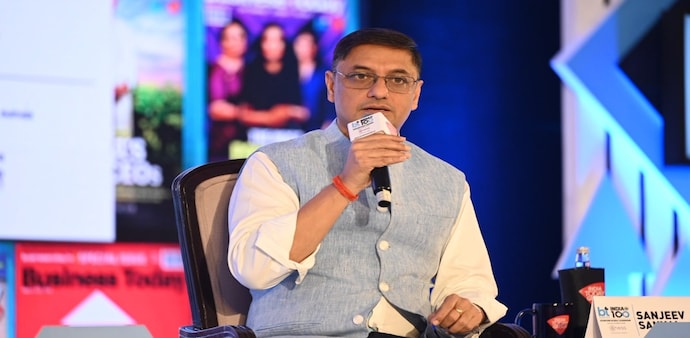
Sanjeev Sanyal, Member, Economic Advisory Council to the Prime Minister, said on Friday that Kolkata is the best bet to anchor eastern India's economic growth. In a conversation with Business Today's Siddharth Zarabi at Business Today's India @ 100 event, he said that unlike the rest of the country, eastern India doesn't have a highly dynamic urban network that can become its growth engine.
Making the case for Kolkata, Sanyal said, "We need to get some urban hub in Eastern India to grow at very high speeds. Now, the best bet on this, even today, just by sheer scale, is Kolkata. It still has a legacy industrial hub. It still has human capital. It has infrastructure. And by sheer size, it is much bigger than the others."
DO CHECKOUT | India's $30 trillion goal needs 8-10% growth, $400 billion more annual investment: Jayant Sinha
He suggested connecting Kolkata with Bhubaneswar, Ranchi, Guwahati, and Patna to create a wider urban growth network. "But getting Kolkata right is very important, and that's why you have to begin to concentrate it. Generically spreading, sort of attempting to spread infrastructure, growth, human capital, etc. will not generate that," Sanjeev Sanyal added.
MUST READ | 'You don't need college to learn': Elon Musk says degrees don't prove ability; Sanjeev Sanyal agrees
India's east-west divide
Moreover, he said that India has a serious east-west divide on the issue of wealth distribution, and that growth is coming out of highly dynamic urban hubs. Sanyal said that economic activity happens in urban hubs and agglomerations.
DO CHECKOUT | 'Most interesting intellectual cluster in India': Sanjeev Sanyal praises IIT Madras, Prof Kamakoti
He said, "We have a serious east-west divide in this country. If you took Visakhapatnam and drew a longitudinal line north-south through Visakhapatnam, everything west of it is significantly richer than everything east of it. And this effect is so strong that it's even visible within large states. So, Western UP is richer than Eastern UP. Western Madhya Pradesh is richer than Eastern Madhya Pradesh. Western Maharashtra is richer than Eastern Maharashtra. Even Telangana is richer than Andhra Pradesh, which till very recently was the same state.
Growth hubs across India
Furthermore, he said that generically spread growth is not at the root of this disparity, but highly dynamic urban hubs are.
Sanyal said South India’s economic growth is not evenly distributed across the region, but is largely concentrated in the Hyderabad-Bengaluru-Chennai triangle, with some spillover into surrounding areas.
In Western India, economic activity is primarily driven by Mumbai, Pune and Ahmedabad, with Rajkot also emerging as part of the broader growth zone. In the North, growth is largely centred around the Delhi-NCR region, extending towards Jaipur, Noida and as far as Chandigarh.
Watch the full conversation here:
India@2047: Blueprint for a Developed Nation
Sanjeev Sanyal, Member, Economic Advisory Council to the Prime Minister, said on Friday that Kolkata is the best bet to anchor eastern India's economic growth. In a conversation with Business Today's Siddharth Zarabi at Business Today's India @ 100 event, he said that unlike the rest of the country, eastern India doesn't have a highly dynamic urban network that can become its growth engine.
Making the case for Kolkata, Sanyal said, "We need to get some urban hub in Eastern India to grow at very high speeds. Now, the best bet on this, even today, just by sheer scale, is Kolkata. It still has a legacy industrial hub. It still has human capital. It has infrastructure. And by sheer size, it is much bigger than the others."
DO CHECKOUT | India's $30 trillion goal needs 8-10% growth, $400 billion more annual investment: Jayant Sinha
He suggested connecting Kolkata with Bhubaneswar, Ranchi, Guwahati, and Patna to create a wider urban growth network. "But getting Kolkata right is very important, and that's why you have to begin to concentrate it. Generically spreading, sort of attempting to spread infrastructure, growth, human capital, etc. will not generate that," Sanjeev Sanyal added.
MUST READ | 'You don't need college to learn': Elon Musk says degrees don't prove ability; Sanjeev Sanyal agrees
India's east-west divide
Moreover, he said that India has a serious east-west divide on the issue of wealth distribution, and that growth is coming out of highly dynamic urban hubs. Sanyal said that economic activity happens in urban hubs and agglomerations.
DO CHECKOUT | 'Most interesting intellectual cluster in India': Sanjeev Sanyal praises IIT Madras, Prof Kamakoti
He said, "We have a serious east-west divide in this country. If you took Visakhapatnam and drew a longitudinal line north-south through Visakhapatnam, everything west of it is significantly richer than everything east of it. And this effect is so strong that it's even visible within large states. So, Western UP is richer than Eastern UP. Western Madhya Pradesh is richer than Eastern Madhya Pradesh. Western Maharashtra is richer than Eastern Maharashtra. Even Telangana is richer than Andhra Pradesh, which till very recently was the same state.
Growth hubs across India
Furthermore, he said that generically spread growth is not at the root of this disparity, but highly dynamic urban hubs are.
Sanyal said South India’s economic growth is not evenly distributed across the region, but is largely concentrated in the Hyderabad-Bengaluru-Chennai triangle, with some spillover into surrounding areas.
In Western India, economic activity is primarily driven by Mumbai, Pune and Ahmedabad, with Rajkot also emerging as part of the broader growth zone. In the North, growth is largely centred around the Delhi-NCR region, extending towards Jaipur, Noida and as far as Chandigarh.
Watch the full conversation here:
India@2047: Blueprint for a Developed Nation