
Will India’s new labour rules finally give manufacturers room to grow and hire?
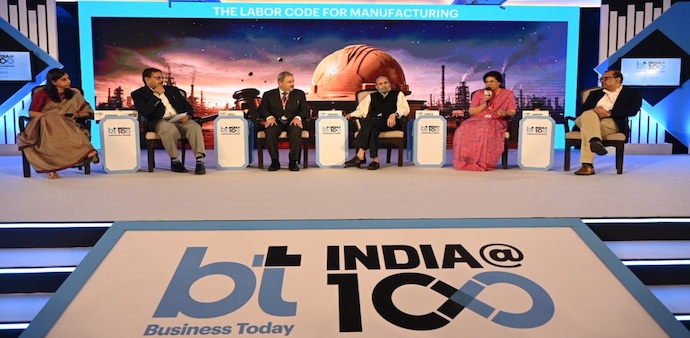
India’s new labour codes seek to make it easier for manufacturers to scale up and hire, while expanding protections for workers. But experts at an India@100 LIVE session said the reforms must deliver simpler compliance, greater hiring flexibility and stronger social security without leaving implementation gaps across states.
- Aug 22, 2026,
- Updated Aug 22, 2026 11:10 AM IST
India’s new labour framework seeks to change a long-standing constraint on manufacturing: the fear that expanding the workforce could bring greater regulatory complexity and industrial disputes. At Business Today's India@100 session, experts said the reforms could make it easier for companies to scale, hire workers and formalise employment, provided states implement them consistently.
Manufacturers' situation
Lohit Bhatia, ED & Group CEO, Quess Corp, said Indian manufacturers historically had an incentive to remain small because expanding their workforce could increase the risk of industrial disputes and regulatory complications.
He recalled that companies would avoid expanding plants once their workforce grew significantly. “Everybody thought it’s better to remain small. It’s better to remain insignificant rather than fight the world over, rather to become big, rather to have 5,000, 10,000 or 50,000 workers,” Bhatia said.
He said the labour codes could change that equation by creating a more enabling framework for manufacturing and blue-collar employment.
“What we’ve changed with labour code is we are giving the same signal to manufacturing and blue collar workers which we are giving to white collar workers,” Bhatia said.
Labour codes and hiring
Bhatia said the reforms could make it easier for businesses to deploy workers across locations and during seasonal demand. He cited an international investor seeking 10,000 workers across 100 warehouses during Diwali. Under the earlier system, multiple licences across locations could delay hiring until the season had passed.
“Many times what happens is your season has come and gone and you have not got the licence,” he said, adding that this could push workers into informality.
Under the new framework, Bhatia said, businesses could have a national labour licence for five years, while remaining accountable for minimum wages, social security, maternity benefits and other protections.
Single licence and cut compliance
Former Labour Secretary Sumita Dawra said the reforms are intended to balance worker welfare with business competitiveness.
“The labour codes, the rationale, the intention... are very much for labour welfare, for promoting competitiveness of industry,” she said.
She highlighted “single registration, single Pan-India license, and the single return” instead of multiple registrations and returns. Dawra also pointed to technology-driven compliance and the inspector-cum-facilitator system, saying “compliances have reduced, cost of compliance has reduced.”
Codes and Pan-India framework
Dawra stressed that implementation will be critical because labour is a concurrent subject. “It’s very important that they all harmonize, and deliver a pan-India experience to business,” she said.
Worker protection at core
Santosh Mehrotra, Senior Economist, said he would have liked to see three changes. First, he called for renewed discussion between industry and workers on the Industrial Disputes Act, particularly around the notice period, saying, “Two weeks becomes six weeks.”
Second, he argued that India cannot become Viksit Bharat without social insurance for the vast majority of its workforce. “Those are social insurance,” he said, identifying pension, death and disability insurance, and maternity benefit as “absolute non-negotiables”.
His third concern was the distinction between core and non-core activities for contract labour. “Who’s going to define this core/non-core?” he asked, arguing that fixed-term appointments could offer a clearer alternative.
“Forget about this damn core versus non-core because you will never have an agreement on what is core, what is non-core,” Mehrotra said.
India@2047: Blueprint for a Developed Nation
India’s new labour framework seeks to change a long-standing constraint on manufacturing: the fear that expanding the workforce could bring greater regulatory complexity and industrial disputes. At Business Today's India@100 session, experts said the reforms could make it easier for companies to scale, hire workers and formalise employment, provided states implement them consistently.
Manufacturers' situation
Lohit Bhatia, ED & Group CEO, Quess Corp, said Indian manufacturers historically had an incentive to remain small because expanding their workforce could increase the risk of industrial disputes and regulatory complications.
He recalled that companies would avoid expanding plants once their workforce grew significantly. “Everybody thought it’s better to remain small. It’s better to remain insignificant rather than fight the world over, rather to become big, rather to have 5,000, 10,000 or 50,000 workers,” Bhatia said.
He said the labour codes could change that equation by creating a more enabling framework for manufacturing and blue-collar employment.
“What we’ve changed with labour code is we are giving the same signal to manufacturing and blue collar workers which we are giving to white collar workers,” Bhatia said.
Labour codes and hiring
Bhatia said the reforms could make it easier for businesses to deploy workers across locations and during seasonal demand. He cited an international investor seeking 10,000 workers across 100 warehouses during Diwali. Under the earlier system, multiple licences across locations could delay hiring until the season had passed.
“Many times what happens is your season has come and gone and you have not got the licence,” he said, adding that this could push workers into informality.
Under the new framework, Bhatia said, businesses could have a national labour licence for five years, while remaining accountable for minimum wages, social security, maternity benefits and other protections.
Single licence and cut compliance
Former Labour Secretary Sumita Dawra said the reforms are intended to balance worker welfare with business competitiveness.
“The labour codes, the rationale, the intention... are very much for labour welfare, for promoting competitiveness of industry,” she said.
She highlighted “single registration, single Pan-India license, and the single return” instead of multiple registrations and returns. Dawra also pointed to technology-driven compliance and the inspector-cum-facilitator system, saying “compliances have reduced, cost of compliance has reduced.”
Codes and Pan-India framework
Dawra stressed that implementation will be critical because labour is a concurrent subject. “It’s very important that they all harmonize, and deliver a pan-India experience to business,” she said.
Worker protection at core
Santosh Mehrotra, Senior Economist, said he would have liked to see three changes. First, he called for renewed discussion between industry and workers on the Industrial Disputes Act, particularly around the notice period, saying, “Two weeks becomes six weeks.”
Second, he argued that India cannot become Viksit Bharat without social insurance for the vast majority of its workforce. “Those are social insurance,” he said, identifying pension, death and disability insurance, and maternity benefit as “absolute non-negotiables”.
His third concern was the distinction between core and non-core activities for contract labour. “Who’s going to define this core/non-core?” he asked, arguing that fixed-term appointments could offer a clearer alternative.
“Forget about this damn core versus non-core because you will never have an agreement on what is core, what is non-core,” Mehrotra said.
India@2047: Blueprint for a Developed Nation