
‘19% for Pakistan, 50% for India’: Raghuram Rajan questions friendship between Trump and Modi
Raghuram Rajan said India cannot be the most tariffed country in the world – more than China – and then have Washington talk about “military friendship and alignments and joint manoeuvres and so on”.
- Nov 10, 2025,
- Updated Nov 10, 2025 11:56 AM IST
Where is the much-extolled friendship between US President Donald Trump and Prime Minister Narendra Modi when the US can slap a 50 per cent tariff on India but impose only 19 per cent on Pakistan, questioned economist and former RBI Governor Raghuram Rajan. He said America cannot be trusted and the entire tariff saga has been rather disappointing for New Delhi.
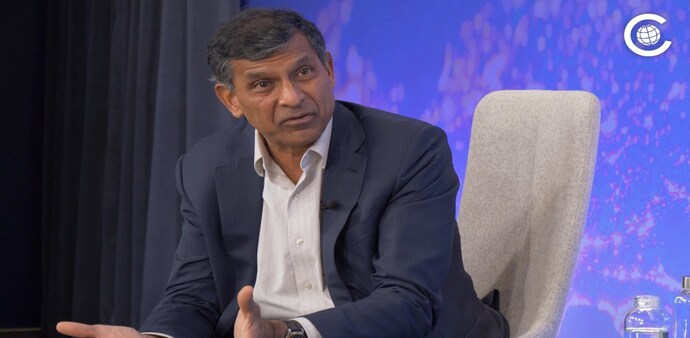
Speaking at a conversation hosted by Chicago Council on Global Affairs, Rajan said, “I think India was getting closer to the United States over the last 20 years and it is very disappointed. I'm not talking about leadership, I'm talking about people who get hit with this tariff. I don’t mean to rub salt in the wound – at the same time Pakistan has a tariff rate of 19 per cent, India has 50 per cent. Where is the friendship between Modi and Trump that was extolled? It's a slap in the face for Modi because the Indian opposition is asking him ‘where's your friendship?’”
Rajan said India cannot be the most tariffed country in the world – more than China – and then have Washington talk about “military friendship and alignments and joint manoeuvres and so on”. He said these kinds of actions stay long in people’s minds.
“The US cannot be trusted. I mean earlier it took a long time. In the 1970s (former US President Richard) Nixon and (former Secretary of State Henry) Kissinger tilted the US towards Pakistan in the Indo-Pak War in 1971. They sent the seventh fleet to stop the war, to help Pakistan. Indians were very miffed at that and the Soviet Union helped India. That put India in the Soviet camp for 25 years,” said Rajan, adding that it took a lot of time to get India out of that camp.
Rajan said the QUAD relationship and joint military exercises happen but the tariffs had the effect of disappointing India.
“India doesn't have a lot of other places to go, shares a border with China, has fought one serious border war and a bunch of skirmishes with China. India is suspicious of China. It's also very worried about Chinese goods coming and swamping India. It's happy for Chinese investment but it wants to be a little careful about becoming dependent on China,” he highlighted. Rajan said that while India has a good relationship with Japan, Australia and other QUAD nations, it wants to build a relationship with Washington and was left very disappointed that this has not become transactional.
The economist explained that the 50 per cent tariff has hit different industries in different ways. For instance, there are companies like Apple that can persuade the administration and get waivers, which means it might not be hugely impacted. But then there are smaller companies that are not finding it sustainable to sell their products in the US for a 50 per cent tariff.
“Those relationships once disrupted are hard to build back because somebody else has taken up the slack in Bangladesh or Vietnam and so it's something that will have costs. It's typically small and medium enterprises that will bear that cost and the longer this lasts the more it becomes a permanent rupture,” he said.
Where is the much-extolled friendship between US President Donald Trump and Prime Minister Narendra Modi when the US can slap a 50 per cent tariff on India but impose only 19 per cent on Pakistan, questioned economist and former RBI Governor Raghuram Rajan. He said America cannot be trusted and the entire tariff saga has been rather disappointing for New Delhi.
Speaking at a conversation hosted by Chicago Council on Global Affairs, Rajan said, “I think India was getting closer to the United States over the last 20 years and it is very disappointed. I'm not talking about leadership, I'm talking about people who get hit with this tariff. I don’t mean to rub salt in the wound – at the same time Pakistan has a tariff rate of 19 per cent, India has 50 per cent. Where is the friendship between Modi and Trump that was extolled? It's a slap in the face for Modi because the Indian opposition is asking him ‘where's your friendship?’”
Rajan said India cannot be the most tariffed country in the world – more than China – and then have Washington talk about “military friendship and alignments and joint manoeuvres and so on”. He said these kinds of actions stay long in people’s minds.
“The US cannot be trusted. I mean earlier it took a long time. In the 1970s (former US President Richard) Nixon and (former Secretary of State Henry) Kissinger tilted the US towards Pakistan in the Indo-Pak War in 1971. They sent the seventh fleet to stop the war, to help Pakistan. Indians were very miffed at that and the Soviet Union helped India. That put India in the Soviet camp for 25 years,” said Rajan, adding that it took a lot of time to get India out of that camp.
Rajan said the QUAD relationship and joint military exercises happen but the tariffs had the effect of disappointing India.
“India doesn't have a lot of other places to go, shares a border with China, has fought one serious border war and a bunch of skirmishes with China. India is suspicious of China. It's also very worried about Chinese goods coming and swamping India. It's happy for Chinese investment but it wants to be a little careful about becoming dependent on China,” he highlighted. Rajan said that while India has a good relationship with Japan, Australia and other QUAD nations, it wants to build a relationship with Washington and was left very disappointed that this has not become transactional.
The economist explained that the 50 per cent tariff has hit different industries in different ways. For instance, there are companies like Apple that can persuade the administration and get waivers, which means it might not be hugely impacted. But then there are smaller companies that are not finding it sustainable to sell their products in the US for a 50 per cent tariff.
“Those relationships once disrupted are hard to build back because somebody else has taken up the slack in Bangladesh or Vietnam and so it's something that will have costs. It's typically small and medium enterprises that will bear that cost and the longer this lasts the more it becomes a permanent rupture,” he said.