
36,444 kg of CO₂ saved: India’s hydrogen train could change how the railways run in future
If the Jind–Sonipat corridor proves operationally robust, similar sets could be deployed on other short-distance, non-electrified or partially electrified routes, helping Indian Railways decarbonise the “last mile” of its network.
- Aug 27, 2026,
- Updated Aug 27, 2026 12:53 PM IST
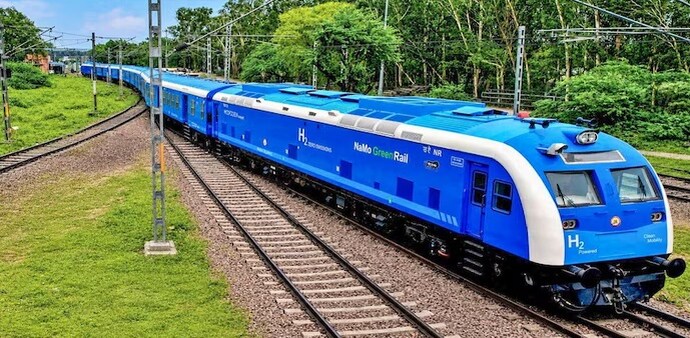
India has rolled out the world’s most powerful hydrogen-powered train, a 2,400-kW (3,200 HP) zero-emission passenger service that has already clocked about 6,000 km within days of its launch, according to the latest information from Indian Railways. The train is operated between Jind and Sonipat in Haryana; the 10-coach train can carry up to 2,600 passengers and runs at a maximum operational speed of 75 kmph, though it is designed for 110 kmph.
Zero-emission technology, Indian engineering
The train emits only water vapour and heat, as onboard fuel cells generate electricity by combining stored hydrogen with oxygen. This makes it the cleanest fuel-tech train in regular passenger service, with Indian Railways estimating a CO₂ reduction of around 36,444 kg (nearly 36 tonnes) so far compared to a conventional DEMU, which emits about 6.074 kg CO₂-equivalent per km.
Unlike many global hydrogen trains that run with two or three coaches, India’s 10-coach set is currently the longest in operation and among the most powerful. The project is fully indigenous: design, engineering and integration were handled by RDSO, ICF and Medha, with an indigenous hydrogen storage and refuelling facility supporting operations at Jind.
Why hydrogen trains matter for India
Although 99% of India’s rail network is electrified, hydrogen trains offer a practical green solution for sections where overhead electrification is difficult or costly. They are especially suited to remote and heritage routes such as Kalka–Shimla, where they can replace diesel without major infrastructure changes. Hydrogen trains also align with India’s net-zero-by-2030 target for railways, even if their initial share of total traffic remains small. By providing a quiet, zero-local-emission alternative, they can improve air quality around stations and along non-electrified corridors while reducing dependence on diesel.
ALSO READ: After 800 locomotives, Alstom eyes fresh 200-unit order from Indian Railways' Madhepura plant
Affordability and scalability
Passengers are not paying a premium for the green technology: fares on the Jind–Sonipat hydrogen service are the same as ordinary DEMU tickets, ranging between ₹10 and ₹25. This pricing strategy is crucial for scaling adoption, as it removes a key barrier to ridership while the technology matures.
With Germany and China already running hydrogen trains and countries like France, Italy, Japan, the US, UK and South Korea in pilot or rollout phases, India’s entry marks a significant step in the global race for clean rail mobility. If the Jind–Sonipat corridor proves operationally robust, similar sets could be deployed on other short-distance, non-electrified or partially electrified routes, helping Indian Railways decarbonise the “last mile” of its network.
India has rolled out the world’s most powerful hydrogen-powered train, a 2,400-kW (3,200 HP) zero-emission passenger service that has already clocked about 6,000 km within days of its launch, according to the latest information from Indian Railways. The train is operated between Jind and Sonipat in Haryana; the 10-coach train can carry up to 2,600 passengers and runs at a maximum operational speed of 75 kmph, though it is designed for 110 kmph.
Zero-emission technology, Indian engineering
The train emits only water vapour and heat, as onboard fuel cells generate electricity by combining stored hydrogen with oxygen. This makes it the cleanest fuel-tech train in regular passenger service, with Indian Railways estimating a CO₂ reduction of around 36,444 kg (nearly 36 tonnes) so far compared to a conventional DEMU, which emits about 6.074 kg CO₂-equivalent per km.
Unlike many global hydrogen trains that run with two or three coaches, India’s 10-coach set is currently the longest in operation and among the most powerful. The project is fully indigenous: design, engineering and integration were handled by RDSO, ICF and Medha, with an indigenous hydrogen storage and refuelling facility supporting operations at Jind.
Why hydrogen trains matter for India
Although 99% of India’s rail network is electrified, hydrogen trains offer a practical green solution for sections where overhead electrification is difficult or costly. They are especially suited to remote and heritage routes such as Kalka–Shimla, where they can replace diesel without major infrastructure changes. Hydrogen trains also align with India’s net-zero-by-2030 target for railways, even if their initial share of total traffic remains small. By providing a quiet, zero-local-emission alternative, they can improve air quality around stations and along non-electrified corridors while reducing dependence on diesel.
ALSO READ: After 800 locomotives, Alstom eyes fresh 200-unit order from Indian Railways' Madhepura plant
Affordability and scalability
Passengers are not paying a premium for the green technology: fares on the Jind–Sonipat hydrogen service are the same as ordinary DEMU tickets, ranging between ₹10 and ₹25. This pricing strategy is crucial for scaling adoption, as it removes a key barrier to ridership while the technology matures.
With Germany and China already running hydrogen trains and countries like France, Italy, Japan, the US, UK and South Korea in pilot or rollout phases, India’s entry marks a significant step in the global race for clean rail mobility. If the Jind–Sonipat corridor proves operationally robust, similar sets could be deployed on other short-distance, non-electrified or partially electrified routes, helping Indian Railways decarbonise the “last mile” of its network.