
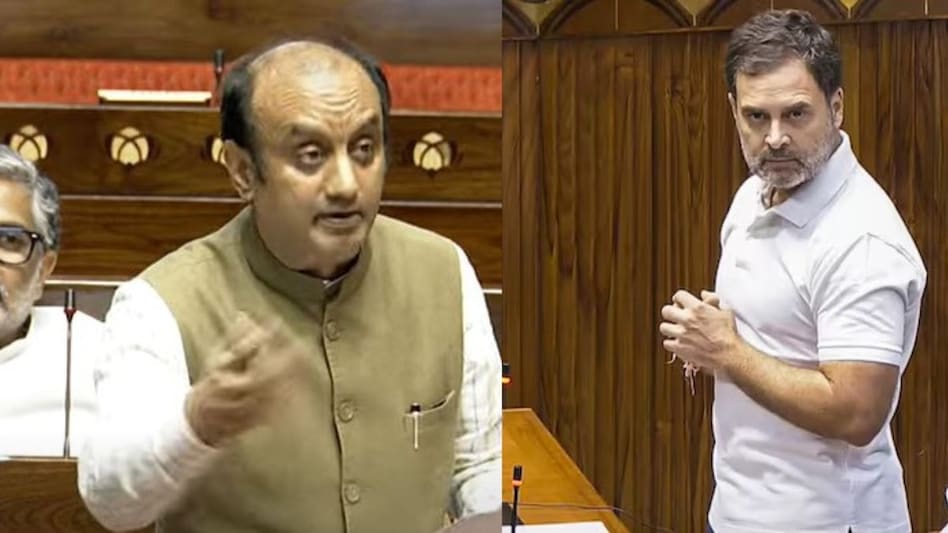
'Abhi se udne lage hawa me...': BJP's Sudhanshu Trivedi counters Rahul Gandhi on neglect towards SC, ST and OBC castes
He criticized opposition members for questioning the budget’s focus on these groups, pointing out historical discrepancies where previous governments failed to adequately support SCs, STs, and OBCs.
- Jul 29, 2024,
- Updated Jul 29, 2024 11:27 PM IST
Bharatiya Janata Party (BJP) MP Sudhanshu Trivedi on Monday gave a rebuttal to Congress leader Rahul Gandhi's allegations of neglect towards Scheduled Castes (SC), Scheduled Tribes (ST), and Other Backward Classes (OBC) by the central government. In his speech, Trivedi defended the government's record on social welfare.
He criticized opposition members for questioning the budget’s focus on these groups, pointing out historical discrepancies where previous governments failed to adequately support SCs, STs, and OBCs.
"Before the budget, there was a traditional ritual of making halwa, and there were questions about the inclusion of SC, ST, and OBC communities. However, those questioning this are the same who enjoyed halwa for sixty years while the public suffered. I would like to point out that during the period when the Mandal Commission report came in 1980, OBCs were neglected, and it was only under Modi Ji’s government that the OBC Commission received constitutional status. I challenge anyone to name even three OBC ministers from their cabinet in 2014," he said in his speech.
Trivedi referred to past instances where OBC commissions were not given constitutional status and criticized opposition leaders for their lack of contribution to social welfare initiatives. He praised the Modi government for giving constitutional status to the OBC commission and supporting the upliftment of marginalized communities.
Earlier in the day, Rahul Gandhi criticized the Narendra Modi-led government during the Union Budget 2024 debate by showing a photo from the traditional "halwa ceremony" that takes place at the Ministry of Finance before the budget is presented.
"Budget ka halwa is being distributed in this photo. I can't see one OBC or tribal or a Dalit officer in this. Desh ka halwa bant raha hai aur 73% hai hi nahi. 20 officers prepared the Budget of India...Hindustan ka halwa 20 logon ne baatne ka kaam kiya hai...," Gandhi said.
While reciting a famous poem written by Imran Pratap from Uttar Pradesh, he said, "Khamosh labh hai, jhuki hai palke dilo mein ulfat nayi nayi hai magar yaha toh ulta hai gustakh labh hai, dilo mein nafrat nayi nayi hai, zara sa kudrat kya nawaza jo aake baithe ho pehli row mein, zara sa kudrat ne kya nawaza jo ake baithe ho pehli mein, abhi se lage hawa mein abhi to toh shohrat nayi nayi hai" (Silent lips are bent down, Love in hearts is nothing new, But here the situation is reversed: The bold lips are raised, And the love in hearts is not new either. But, there's a continuation: A little bit of nature has done, What has happened that you are now in the first row, A little bit of nature has done, What has happened that you are now in the first row, You’re already basking in fame, But you haven’t achieved it yet.)"
Trivedi began his speech by emphasizing the historical significance of the current budget, claiming that Finance Minister Nirmala Sitharaman has achieved a milestone by presenting the budget seven times consecutively—a feat surpassing Morarji Desai's record of six consecutive budgets. He lauded Prime Minister Narendra Modi's leadership for securing a third consecutive term.
"The budget is a reflection of the government’s efforts, yet some people are deceived by appearances and fail to grasp the reality. Before our government came into power, the economy was ranked tenth and was weak. Today, it is ranked fifth and has improved significantly, but some still view it negatively," he said while targeting the opposition.
Trivedi compared the Modi government's achievements with the past, arguing that while previous records were set under leaders who enjoyed aristocratic privileges, the current government is led by a prime minister who rose from humble beginnings. He also said that the government’s focus on development is evident from India’s rise in global economic rankings, moving from the 10th to the 5th largest economy in the world.
While speaking about the criticisms related to inflation and economic growth, he pointed out that while earlier periods of high inflation and low growth were deemed acceptable by critics, the current economic indicators show a favorable shift. He noted that inflation rates have decreased from 10% to around 5%, and growth rates have improved from under 5% to over 7%.
Referencing various historical periods of economic downturn, Trivedi argued that the Modi government’s economic policies have effectively reversed past trends. He said that India's growth rate as one of the highest globally, and praised the government’s efforts to improve per capita income and reduce fiscal and current account deficits.
While speaking about economic stability, Trivedi said that India’s contribution to global GDP has risen to 15%, as noted by IMF’s chief Kristalina Georgieva. Additionally, he pointed out that India has surpassed China in foreign remittance, with significant contributions coming from developed economies.
He also emphasized improvements in credit ratings and economic outlooks by institutions like the World Bank, which now view India’s economic prospects positively. Trivedi argued that these positive evaluations stand in stark contrast to past criticisms and demonstrate the effectiveness of the government’s economic strategies.
"Today India's growth rate has significantly improved, and we are no longer dependent on international financial institutions like the World Bank and IMF," he said in his fiery speech.
"The World Bank and IMF once viewed India as a beggar, but now the President of the World Bank, Ajay Banga, has expressed optimism about India’s economy. In the past, India’s contribution to the world was zero. Today, under Prime Minister Modi’s leadership, India contributes fifteen percent to global GDP, making it a bright spot in the global economy," he added.
In his defense of the current budget, Trivedi argued that it reflects the government's commitment to economic growth and development. He praised various schemes introduced by the Modi government, including the Employee Provident Fund (EPF) contribution initiative, which he claimed would boost job creation. He also mentioned important infrastructure projects, such as new highways, railways, and defense corridors, as evidence of the government’s focus on development.
Trivedi responded to claims that the budget was similar to past policies, stating that the current budget builds upon previous successes and introduces new measures to enhance economic stability and growth. He highlighted the government’s efforts to modernize tax structures, support businesses, and encourage foreign investment.
Trivedi criticized the opposition for their perceived lack of support for national development and their tendency to create confusion and negativity. He accused opposition leaders of using misleading statements and creating unnecessary controversies to undermine the government’s achievements.
He specifically criticized Congress leader Rahul Gandhi for his comments on various issues, including budget allocations and economic policies. Trivedi accused Gandhi and his party of engaging in political theatrics and spreading misinformation to detract from the government’s successes.
Bharatiya Janata Party (BJP) MP Sudhanshu Trivedi on Monday gave a rebuttal to Congress leader Rahul Gandhi's allegations of neglect towards Scheduled Castes (SC), Scheduled Tribes (ST), and Other Backward Classes (OBC) by the central government. In his speech, Trivedi defended the government's record on social welfare.
He criticized opposition members for questioning the budget’s focus on these groups, pointing out historical discrepancies where previous governments failed to adequately support SCs, STs, and OBCs.
"Before the budget, there was a traditional ritual of making halwa, and there were questions about the inclusion of SC, ST, and OBC communities. However, those questioning this are the same who enjoyed halwa for sixty years while the public suffered. I would like to point out that during the period when the Mandal Commission report came in 1980, OBCs were neglected, and it was only under Modi Ji’s government that the OBC Commission received constitutional status. I challenge anyone to name even three OBC ministers from their cabinet in 2014," he said in his speech.
Trivedi referred to past instances where OBC commissions were not given constitutional status and criticized opposition leaders for their lack of contribution to social welfare initiatives. He praised the Modi government for giving constitutional status to the OBC commission and supporting the upliftment of marginalized communities.
Earlier in the day, Rahul Gandhi criticized the Narendra Modi-led government during the Union Budget 2024 debate by showing a photo from the traditional "halwa ceremony" that takes place at the Ministry of Finance before the budget is presented.
"Budget ka halwa is being distributed in this photo. I can't see one OBC or tribal or a Dalit officer in this. Desh ka halwa bant raha hai aur 73% hai hi nahi. 20 officers prepared the Budget of India...Hindustan ka halwa 20 logon ne baatne ka kaam kiya hai...," Gandhi said.
While reciting a famous poem written by Imran Pratap from Uttar Pradesh, he said, "Khamosh labh hai, jhuki hai palke dilo mein ulfat nayi nayi hai magar yaha toh ulta hai gustakh labh hai, dilo mein nafrat nayi nayi hai, zara sa kudrat kya nawaza jo aake baithe ho pehli row mein, zara sa kudrat ne kya nawaza jo ake baithe ho pehli mein, abhi se lage hawa mein abhi to toh shohrat nayi nayi hai" (Silent lips are bent down, Love in hearts is nothing new, But here the situation is reversed: The bold lips are raised, And the love in hearts is not new either. But, there's a continuation: A little bit of nature has done, What has happened that you are now in the first row, A little bit of nature has done, What has happened that you are now in the first row, You’re already basking in fame, But you haven’t achieved it yet.)"
Trivedi began his speech by emphasizing the historical significance of the current budget, claiming that Finance Minister Nirmala Sitharaman has achieved a milestone by presenting the budget seven times consecutively—a feat surpassing Morarji Desai's record of six consecutive budgets. He lauded Prime Minister Narendra Modi's leadership for securing a third consecutive term.
"The budget is a reflection of the government’s efforts, yet some people are deceived by appearances and fail to grasp the reality. Before our government came into power, the economy was ranked tenth and was weak. Today, it is ranked fifth and has improved significantly, but some still view it negatively," he said while targeting the opposition.
Trivedi compared the Modi government's achievements with the past, arguing that while previous records were set under leaders who enjoyed aristocratic privileges, the current government is led by a prime minister who rose from humble beginnings. He also said that the government’s focus on development is evident from India’s rise in global economic rankings, moving from the 10th to the 5th largest economy in the world.
While speaking about the criticisms related to inflation and economic growth, he pointed out that while earlier periods of high inflation and low growth were deemed acceptable by critics, the current economic indicators show a favorable shift. He noted that inflation rates have decreased from 10% to around 5%, and growth rates have improved from under 5% to over 7%.
Referencing various historical periods of economic downturn, Trivedi argued that the Modi government’s economic policies have effectively reversed past trends. He said that India's growth rate as one of the highest globally, and praised the government’s efforts to improve per capita income and reduce fiscal and current account deficits.
While speaking about economic stability, Trivedi said that India’s contribution to global GDP has risen to 15%, as noted by IMF’s chief Kristalina Georgieva. Additionally, he pointed out that India has surpassed China in foreign remittance, with significant contributions coming from developed economies.
He also emphasized improvements in credit ratings and economic outlooks by institutions like the World Bank, which now view India’s economic prospects positively. Trivedi argued that these positive evaluations stand in stark contrast to past criticisms and demonstrate the effectiveness of the government’s economic strategies.
"Today India's growth rate has significantly improved, and we are no longer dependent on international financial institutions like the World Bank and IMF," he said in his fiery speech.
"The World Bank and IMF once viewed India as a beggar, but now the President of the World Bank, Ajay Banga, has expressed optimism about India’s economy. In the past, India’s contribution to the world was zero. Today, under Prime Minister Modi’s leadership, India contributes fifteen percent to global GDP, making it a bright spot in the global economy," he added.
In his defense of the current budget, Trivedi argued that it reflects the government's commitment to economic growth and development. He praised various schemes introduced by the Modi government, including the Employee Provident Fund (EPF) contribution initiative, which he claimed would boost job creation. He also mentioned important infrastructure projects, such as new highways, railways, and defense corridors, as evidence of the government’s focus on development.
Trivedi responded to claims that the budget was similar to past policies, stating that the current budget builds upon previous successes and introduces new measures to enhance economic stability and growth. He highlighted the government’s efforts to modernize tax structures, support businesses, and encourage foreign investment.
Trivedi criticized the opposition for their perceived lack of support for national development and their tendency to create confusion and negativity. He accused opposition leaders of using misleading statements and creating unnecessary controversies to undermine the government’s achievements.
He specifically criticized Congress leader Rahul Gandhi for his comments on various issues, including budget allocations and economic policies. Trivedi accused Gandhi and his party of engaging in political theatrics and spreading misinformation to detract from the government’s successes.