
After Operation Sindoor, IAF eyes Israel’s Air LORA missile for deeper strike reach. 10 key facts
Unlike typical cruise missiles like BrahMos, LORA follows a high, depressed trajectory rather than skimming close to the ground. This lofted path makes it harder to intercept.
- Jul 10, 2025,
- Updated Jul 10, 2025 7:46 PM IST
The Indian Air Force (IAF) wants more reach. Despite owning the formidable BrahMos, it’s now looking at Israel Aerospace Industries’ Air-Launched Long-Range Artillery (Air LORA) missile. This comes hot on the heels of May’s Operation Sindoor, where the Rampage missile got its first taste of combat and proved how vital stand-off range really is.**
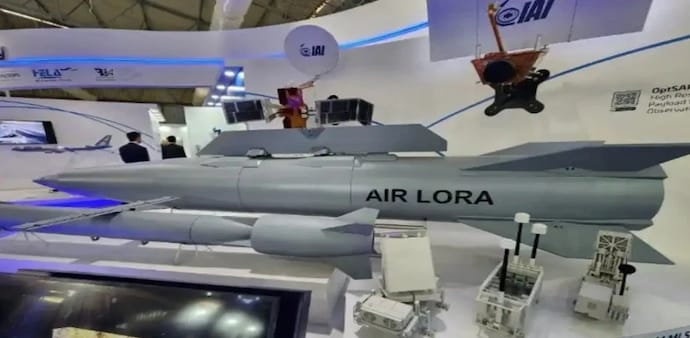
Air LORA isn’t merely a modified weapon. It’s a quasi-ballistic, supersonic missile that can fly 400–430 kilometres and land within ten metres of its target, offering the ability to hit high-value sites deep inside enemy territory without exposing pilots or aircraft to dense air defences. According to Israel Aerospace Industries (IAI), *“Air LORA addresses these operational challenges with unparalleled efficiency and precision.”*
Unlike typical cruise missiles like BrahMos, LORA follows a high, depressed trajectory rather than skimming close to the ground. This lofted path makes it harder to intercept, while its fire-and-forget design lets pilots disengage the moment it’s launched. Critically, LORA can adjust its course mid-flight, maneuvering at speeds up to Mach 5, thanks to a GPS and Inertial Navigation System safeguarded by anti-jamming technology.
LORA also omits an active seeker, reducing complexity and cost without sacrificing accuracy.
Ten key facts
- Air LORA has a range of 400–430 km.
- It travels at supersonic speeds of about Mach 5.
- The missile boasts an accuracy of less than a 10-metre Circular Error Probable (CEP).
- Warhead options include blast fragmentation or deep penetration, weighing up to 570 kg.
- Each missile weighs around 1,600 kg and measures 5.2 metres in length.
- A single Su-30MKI fighter can carry up to four LORA missiles.
- BrahMos remains crucial for low-level, high-speed attacks but is bulkier and costlier than LORA.
- LORA offers a lighter, cheaper solution suitable for integration on a broader range of aircraft.
- IAI and Bharat Electronics Limited signed an MoU in 2023 to co-produce missile systems, opening doors for “Make in India” production.
- The IAF aims to induct the first LORA squadrons by 2026-27.
Despite its promise, integrating LORA into Indian fighter jets will require rigorous testing, particularly to confirm its electronic warfare resilience across India’s diverse terrain. Moreover, it must prove its value alongside indigenous systems like BrahMos or the upcoming Long-Range Land-Attack Cruise Missile.
The Indian Air Force (IAF) wants more reach. Despite owning the formidable BrahMos, it’s now looking at Israel Aerospace Industries’ Air-Launched Long-Range Artillery (Air LORA) missile. This comes hot on the heels of May’s Operation Sindoor, where the Rampage missile got its first taste of combat and proved how vital stand-off range really is.**
Air LORA isn’t merely a modified weapon. It’s a quasi-ballistic, supersonic missile that can fly 400–430 kilometres and land within ten metres of its target, offering the ability to hit high-value sites deep inside enemy territory without exposing pilots or aircraft to dense air defences. According to Israel Aerospace Industries (IAI), *“Air LORA addresses these operational challenges with unparalleled efficiency and precision.”*
Unlike typical cruise missiles like BrahMos, LORA follows a high, depressed trajectory rather than skimming close to the ground. This lofted path makes it harder to intercept, while its fire-and-forget design lets pilots disengage the moment it’s launched. Critically, LORA can adjust its course mid-flight, maneuvering at speeds up to Mach 5, thanks to a GPS and Inertial Navigation System safeguarded by anti-jamming technology.
LORA also omits an active seeker, reducing complexity and cost without sacrificing accuracy.
Ten key facts
- Air LORA has a range of 400–430 km.
- It travels at supersonic speeds of about Mach 5.
- The missile boasts an accuracy of less than a 10-metre Circular Error Probable (CEP).
- Warhead options include blast fragmentation or deep penetration, weighing up to 570 kg.
- Each missile weighs around 1,600 kg and measures 5.2 metres in length.
- A single Su-30MKI fighter can carry up to four LORA missiles.
- BrahMos remains crucial for low-level, high-speed attacks but is bulkier and costlier than LORA.
- LORA offers a lighter, cheaper solution suitable for integration on a broader range of aircraft.
- IAI and Bharat Electronics Limited signed an MoU in 2023 to co-produce missile systems, opening doors for “Make in India” production.
- The IAF aims to induct the first LORA squadrons by 2026-27.
Despite its promise, integrating LORA into Indian fighter jets will require rigorous testing, particularly to confirm its electronic warfare resilience across India’s diverse terrain. Moreover, it must prove its value alongside indigenous systems like BrahMos or the upcoming Long-Range Land-Attack Cruise Missile.