
Alarm bells for Tejashwi: RJD suffers the most dramatic fall in 15 years
The most dramatic fall in 2025 is not Congress's, but the principal opposition RJD's.
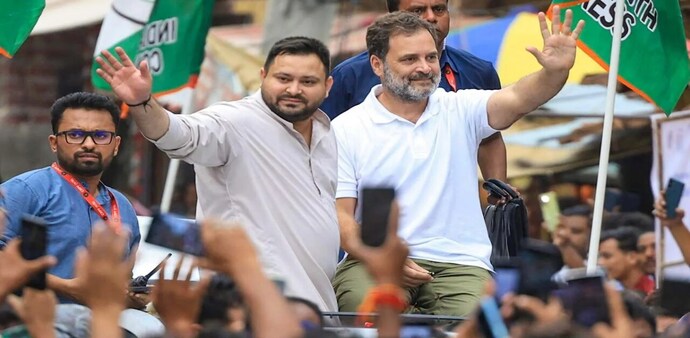
- Nov 14, 2025,
- Updated Nov 14, 2025 2:14 PM IST
In 2020, the RJD under Tejashwi Yadav had come within striking distance of forming government in Bihar. The Mahagathbandhan won 110 seats - just 12 short of the majority mark - with the RJD securing 75 of the 144 seats it contested. The grand alliance's narrow miss was widely attributed to the Congress's low strike rate, as it won only 19 of 70 seats.
For years, the Congress has been seen as the weak link in the Mahagathbandhan. This year, too, the grand alliance partners had hoped it would improve. But instead, the party collapsed further - down to just four seats. Yet the most dramatic fall in 2025 is not Congress's, but the principal opposition RJD's.
The RJD has now fallen to its lowest tally since 2010, when it won 22 seats with 18.84% votes. In 2015, contesting alongside JDU, the party bounced back with 80 of 101 seats and 32.92% votes. In 2020, it dipped to 75 seats with 23.11% votes. This year, its tally has slipped below 30 seats with roughly the same vote share - around 23%.
The new NDA configuration - with Chirag Paswan's LJP back in the fold, BJP's consolidation, and Nitish Kumar's JDU bouncing back - has turned into a nightmare for Tejashwi, leaving his party's influence sharply diminished. The RJD continues to rely heavily on its MY (Muslim-Yadav) base, but its inability to penetrate EBCs, Mahadalits, and sections of the upper castes has capped its expansion.
For Tejashwi, it's a crushing defeat. Despite two decades of anti-incumbency against Nitish Kumar, the RJD failed to convert ground anger into votes. A major factor remains the shadow of his father's tenure - the period widely referred to by rivals as 'jungle raj'.
Leaders of the ruling NDA - including Prime Minister Narendra Modi, Home Minister Amit Shah, and Nitish Kumar - repeatedly invoked the jungle raj narrative throughout the campaign. The term continues to resonate with a section of voters who associate the 1990s with lawlessness and administrative collapse.
Earlier, PTI reported that residents in Patna - particularly older voters and those who were in schools or workplaces in the 1990s - acknowledged improvements in law and order since then.
"You must have heard of the 'jungle raj' that was. We don't want to see the return of that misrule, we want safety and security," an 80-year-old resident of Patna told PTI ahead of polling.
Political observers say this sense of "voter anxiety" and the "baggage of the past" continues to be exploited effectively by the NDA - cutting into RJD's attempts to position Tejashwi as the face of a new generation.
The 2025 verdict has deepened the crisis not just for the Congress, but also for Tejashwi Yadav.
In 2020, the RJD under Tejashwi Yadav had come within striking distance of forming government in Bihar. The Mahagathbandhan won 110 seats - just 12 short of the majority mark - with the RJD securing 75 of the 144 seats it contested. The grand alliance's narrow miss was widely attributed to the Congress's low strike rate, as it won only 19 of 70 seats.
For years, the Congress has been seen as the weak link in the Mahagathbandhan. This year, too, the grand alliance partners had hoped it would improve. But instead, the party collapsed further - down to just four seats. Yet the most dramatic fall in 2025 is not Congress's, but the principal opposition RJD's.
The RJD has now fallen to its lowest tally since 2010, when it won 22 seats with 18.84% votes. In 2015, contesting alongside JDU, the party bounced back with 80 of 101 seats and 32.92% votes. In 2020, it dipped to 75 seats with 23.11% votes. This year, its tally has slipped below 30 seats with roughly the same vote share - around 23%.
The new NDA configuration - with Chirag Paswan's LJP back in the fold, BJP's consolidation, and Nitish Kumar's JDU bouncing back - has turned into a nightmare for Tejashwi, leaving his party's influence sharply diminished. The RJD continues to rely heavily on its MY (Muslim-Yadav) base, but its inability to penetrate EBCs, Mahadalits, and sections of the upper castes has capped its expansion.
For Tejashwi, it's a crushing defeat. Despite two decades of anti-incumbency against Nitish Kumar, the RJD failed to convert ground anger into votes. A major factor remains the shadow of his father's tenure - the period widely referred to by rivals as 'jungle raj'.
Leaders of the ruling NDA - including Prime Minister Narendra Modi, Home Minister Amit Shah, and Nitish Kumar - repeatedly invoked the jungle raj narrative throughout the campaign. The term continues to resonate with a section of voters who associate the 1990s with lawlessness and administrative collapse.
Earlier, PTI reported that residents in Patna - particularly older voters and those who were in schools or workplaces in the 1990s - acknowledged improvements in law and order since then.
"You must have heard of the 'jungle raj' that was. We don't want to see the return of that misrule, we want safety and security," an 80-year-old resident of Patna told PTI ahead of polling.
Political observers say this sense of "voter anxiety" and the "baggage of the past" continues to be exploited effectively by the NDA - cutting into RJD's attempts to position Tejashwi as the face of a new generation.
The 2025 verdict has deepened the crisis not just for the Congress, but also for Tejashwi Yadav.