
'AQI already touching 400': CJI-led bench flags rising pollution levels, says this on Delhi-NCR traffic
The remarks came during a discussion on the rising pollution around Diwali, with the Centre's counsel saying that pollution levels rose further due to festive season and movement of people on roads.
- Nov 6, 2026,
- Updated Nov 6, 2026 12:56 PM IST
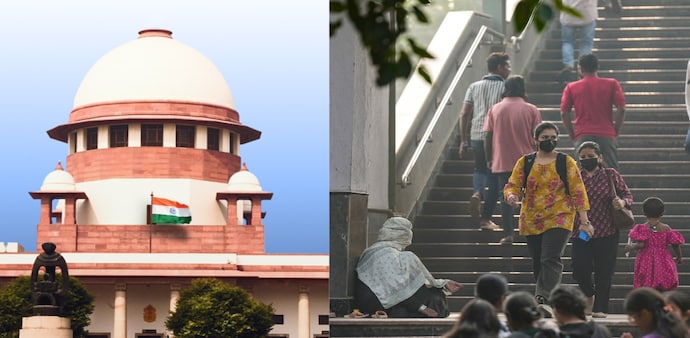
The Supreme Court bench, led by Chief Justice of India (CJI) Surya Kant, on Friday took note of the rising pollution levels in Delhi. Commenting on the rising pollution levels in Delhi, CJI Surya Kant was quoted as saying by PTI, "We keep talking, make statements but point is AQI is already touching 400."
The remarks came during a discussion on the rising pollution around Diwali, with the Centre's counsel saying that pollution levels rose further due to festive season and movement of people on roads.
It also said that there is "bumper-to-bumper traffic" in Delhi-NCR and questioned the authorities concerned on anti-pollution measures that have been taken so far, adding that vehicular emission is a major reason for rise in air pollution in the region.
DON'T MISS | Delhi pollution: AQI hits 389 on Dhanteras morning, experts make grim prediction for Diwali
The CJI cautioned against blaming the economically weaker sections for the pollution, adding that Diwali was an important period for people dependent on seasonal work and festivities for their livelihood. “Poor people do not generate any pollution. They are the sufferers. It is those who can afford it and those who can contribute to it,” the CJI remarked.
The top court added that it will go by expert opinion on whether physical classes in schools should be closed for all age groups if AQI rises further. It further urged the Centre and state governments to educate farmers, adding they will stop burning stubble once they understand the economics of it.
Furthermore, the CJI said that the rich turned the practice of exchanging Diwali gifts into a social and status symbol. The bench said that simply imposing more restrictions or passing orders is of no use.
“No restriction is going to work. The more orders we pass, the more violations will multiply,” the Court observed, stressing the need for behavioural change and pollution awareness.
DO CHECKOUT | Punjab's Barnala chokes as AQI hits 1,104; farm fire incidents surge past 2,100
Delhi AQI today
Meanwhile, Delhi's air quality remained 'very poor' on Friday, with AQI at 391, according to the data by Central Pollution Control Board (CPCB). Of the 59 monitoring stations across the city, 30 recorded severe air quality in morning, while the remaining stations were in the very poor category.
As of 12 pm, Jawaharlal Nehru Stadium reported 'severe' air quality with an AQI of 425. Bawana (435), Burari Crossing (412), Dwarka Sector 8 (424), IIT Delhi (403), JNU (414), Mundka (446), and North Campus, DU (427) also reported 'severe' air quality.
As per the CPCB, an AQI between zero and 50 is classified as 'good', 51 and 100 as 'satisfactory', 101 and 200 as 'moderate', 201 and 300 as 'poor', 301 and 400 as 'very poor', and 401 and 500 as 'severe'.
(With agency inputs)