
Aviation ministry studying lifting of height restrictions for airport-area buildings: Naidu
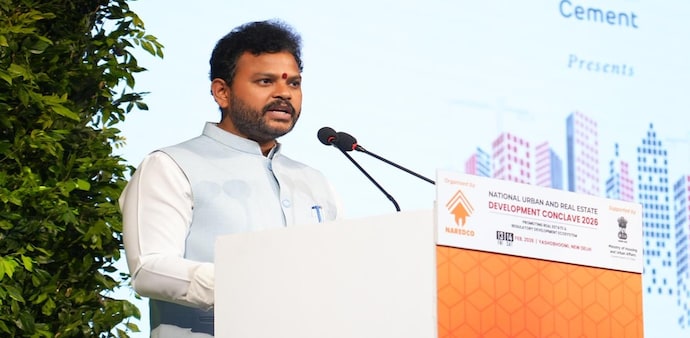
Speaking at the National Urban and Real Estate Development Conclave-2026, Naidu acknowledged the continuous growth of the civil aviation sector but pointed out the significant challenge posed by height restrictions for buildings near airports, particularly in major metro cities.
- Feb 13, 2026,
- Updated Feb 13, 2026 5:30 PM IST
Civil Aviation Minister K Ram Mohan Naidu revealed on February 13 that a study, in collaboration with the global aviation body International Civil Aviation Organisation (ICAO), is underway to explore solutions to address the height restrictions for buildings around airports.
Speaking at the National Urban and Real Estate Development Conclave-2026, Naidu acknowledged the continuous growth of the civil aviation sector but pointed out the significant challenge posed by height restrictions for buildings near airports, particularly in major metropolitan cities like Mumbai, Hyderabad, Kolkata, and Chennai.
“To tackle this issue, we have partnered with ICAO to conduct a comprehensive study,” Naidu stated. “The team is visiting all major cities, reviewing relevant technologies and aviation operations. After gathering feedback, a report will be compiled to propose actionable solutions.”
Naidu further underscored the potential growth of India’s real estate market, which is expected to reach $1 trillion by 2030, fueled by structural reforms, enhanced transparency, and rising investor confidence. He forecasted that the market could expand to $5-7 trillion by 2047. Given the limitations of horizontal expansion, he emphasized that vertical development would be crucial to meet future housing and construction demands.
“India is planning to add nearly 50 airports in the next five years, with a total of 200 airports by 2047. This expansion will not only transform the aviation sector but will also have a profound impact on the real estate, housing, and construction industries,” Naidu remarked.
During his speech, Naidu also urged the National Real Estate Development Council (NAREDCO) to accelerate the development of rental housing to cater to the needs of India’s growing urban youth. He pointed to global trends, particularly in North America, Europe, and Southeast Asia, where rental housing has become increasingly popular, and stressed the importance of adapting policies to these changes.
Shri Tokhan Sahu, Minister of State for Housing and Urban Affairs, reassured the real estate sector of the government’s unwavering support in formulating policies and frameworks to achieve targets in construction, housing, and affordable housing. He emphasized the government’s commitment to providing affordable housing, especially through the Pradhan Mantri Awas Yojana, to support the nation’s poorest citizens.
Niranjan Hiranandani, Chairman of NAREDCO, spoke about India’s readiness for transformative change. He highlighted that urban India, which currently houses 37% of the population and contributes 65% of the GDP, will be instrumental in shaping the country’s future. “By 2047, more than half of India will be urban. The key question is whether we will proactively shape this urbanization or let it unfold on its own,” he stated.
(With inputs from PTI)
Civil Aviation Minister K Ram Mohan Naidu revealed on February 13 that a study, in collaboration with the global aviation body International Civil Aviation Organisation (ICAO), is underway to explore solutions to address the height restrictions for buildings around airports.
Speaking at the National Urban and Real Estate Development Conclave-2026, Naidu acknowledged the continuous growth of the civil aviation sector but pointed out the significant challenge posed by height restrictions for buildings near airports, particularly in major metropolitan cities like Mumbai, Hyderabad, Kolkata, and Chennai.
“To tackle this issue, we have partnered with ICAO to conduct a comprehensive study,” Naidu stated. “The team is visiting all major cities, reviewing relevant technologies and aviation operations. After gathering feedback, a report will be compiled to propose actionable solutions.”
Naidu further underscored the potential growth of India’s real estate market, which is expected to reach $1 trillion by 2030, fueled by structural reforms, enhanced transparency, and rising investor confidence. He forecasted that the market could expand to $5-7 trillion by 2047. Given the limitations of horizontal expansion, he emphasized that vertical development would be crucial to meet future housing and construction demands.
“India is planning to add nearly 50 airports in the next five years, with a total of 200 airports by 2047. This expansion will not only transform the aviation sector but will also have a profound impact on the real estate, housing, and construction industries,” Naidu remarked.
During his speech, Naidu also urged the National Real Estate Development Council (NAREDCO) to accelerate the development of rental housing to cater to the needs of India’s growing urban youth. He pointed to global trends, particularly in North America, Europe, and Southeast Asia, where rental housing has become increasingly popular, and stressed the importance of adapting policies to these changes.
Shri Tokhan Sahu, Minister of State for Housing and Urban Affairs, reassured the real estate sector of the government’s unwavering support in formulating policies and frameworks to achieve targets in construction, housing, and affordable housing. He emphasized the government’s commitment to providing affordable housing, especially through the Pradhan Mantri Awas Yojana, to support the nation’s poorest citizens.
Niranjan Hiranandani, Chairman of NAREDCO, spoke about India’s readiness for transformative change. He highlighted that urban India, which currently houses 37% of the population and contributes 65% of the GDP, will be instrumental in shaping the country’s future. “By 2047, more than half of India will be urban. The key question is whether we will proactively shape this urbanization or let it unfold on its own,” he stated.
(With inputs from PTI)