
Big infrastructure push for Varanasi: Cabinet clears Ganga Elevated Corridor; travel time to drop from 60 to 20 minutes
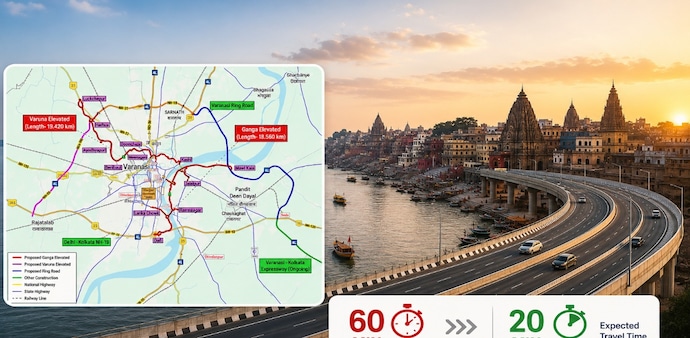
The corridor will provide connectivity between NH-19 and the Varanasi Ring Road while improving access to major transport hubs, including Lal Bahadur Shastri Airport, Kashi Railway Station, Banaras Railway Station, and Varanasi City Railway Station
- Jul 15, 2026,
- Updated Jul 15, 2026 4:06 PM IST
The Cabinet Committee on Economic Affairs (CCEA), chaired by Prime Minister Narendra Modi, on Wednesday approved the construction of a 46.039-km Link/Connector Corridor between National Highway-19 (NH-19) and the Varanasi Ring Road along the River Ganga to ease congestion in Varanasi, Uttar Pradesh.
The project, to be developed under the Hybrid Annuity Model (HAM), will be built at a total capital cost of ₹14,447.64 crore, including ₹6,037.85 crore in civil construction cost (including utility shifting but excluding GST) and ₹541.11 crore towards land acquisition under NH(O).
Don't Miss: Stuck in Varanasi traffic? New ₹10,998 crore corridor promises faster journeys
Travel Time To Reduce Sharply
The six-lane elevated corridor has been designed for speeds of 80-100 kmph and is expected to reduce average travel time across the project area from around 60 minutes to 20 minutes, according to a Cabinet note.
Travel time between NH-19 and Kashi Railway Station is also expected to come down from about 50 minutes to 25 minutes, saving nearly half the travel time.
Major Engineering Features
The project will comprise a six-lane elevated main carriageway, loops, ramps, service roads, and link roads.
Among its key features are a 910-metre iconic cable-stayed bridge across the River Ganga and a 1.32-km extradosed Foot Over Bridge-cum-Major Bridge equipped with travelators to provide seamless pedestrian connectivity to the Kashi Vishwanath Temple.
The project will also include a Rail Over Bridge over the existing and proposed Malviya Bridge, dedicated emergency parking bays, noise barriers, façade lighting, and architectural elements inspired by Varanasi's cultural heritage.
Better Connectivity To Key Landmarks
The corridor will provide connectivity between NH-19 and the Varanasi Ring Road while improving access to major transport hubs, including Lal Bahadur Shastri Airport, Kashi Railway Station, Banaras Railway Station, Varanasi City Railway Station, Pt. Deen Dayal Upadhyay Junction and Ramnagar IWAI Port.
It will also improve connectivity to major religious, educational, and cultural landmarks such as the Kashi Vishwanath Temple, Banaras Hindu University (BHU), Namo Ghat, Ramnagar Fort, and the Ghats of Varanasi.
An elevated spur between BHU/Lanka and Samne Ghat has also been planned to ease congestion at the busy Lanka Junction by separating through traffic from local traffic.
Boost To Tourism And Logistics
The government said the project aligns with the PM Gati Shakti National Master Plan and will strengthen multimodal connectivity by linking one economic node (Chandauli SEZ), one social node (Chandauli Aspirational District) and six major logistics nodes.
With more than 15 crore tourists and pilgrims visiting Varanasi every year, the corridor is expected to improve access to key destinations, enhance tourism and pilgrimage infrastructure, improve logistics efficiency, strengthen road safety and support regional economic growth across eastern Uttar Pradesh.
The government said the project will also decongest NH-19, the BHU-Ramnagar corridor, and NH-35 by diverting through traffic away from the city's densely populated core, while reducing vehicle operating costs, emissions, and improving travel reliability.
Overall, the proposed Ganga Elevated Corridor is expected to create a high-capacity urban transport network that improves mobility, strengthens multimodal integration and supports sustainable development in line with the vision of PM Gati Shakti and Viksit Bharat.
The Cabinet Committee on Economic Affairs (CCEA), chaired by Prime Minister Narendra Modi, on Wednesday approved the construction of a 46.039-km Link/Connector Corridor between National Highway-19 (NH-19) and the Varanasi Ring Road along the River Ganga to ease congestion in Varanasi, Uttar Pradesh.
The project, to be developed under the Hybrid Annuity Model (HAM), will be built at a total capital cost of ₹14,447.64 crore, including ₹6,037.85 crore in civil construction cost (including utility shifting but excluding GST) and ₹541.11 crore towards land acquisition under NH(O).
Don't Miss: Stuck in Varanasi traffic? New ₹10,998 crore corridor promises faster journeys
Travel Time To Reduce Sharply
The six-lane elevated corridor has been designed for speeds of 80-100 kmph and is expected to reduce average travel time across the project area from around 60 minutes to 20 minutes, according to a Cabinet note.
Travel time between NH-19 and Kashi Railway Station is also expected to come down from about 50 minutes to 25 minutes, saving nearly half the travel time.
Major Engineering Features
The project will comprise a six-lane elevated main carriageway, loops, ramps, service roads, and link roads.
Among its key features are a 910-metre iconic cable-stayed bridge across the River Ganga and a 1.32-km extradosed Foot Over Bridge-cum-Major Bridge equipped with travelators to provide seamless pedestrian connectivity to the Kashi Vishwanath Temple.
The project will also include a Rail Over Bridge over the existing and proposed Malviya Bridge, dedicated emergency parking bays, noise barriers, façade lighting, and architectural elements inspired by Varanasi's cultural heritage.
Better Connectivity To Key Landmarks
The corridor will provide connectivity between NH-19 and the Varanasi Ring Road while improving access to major transport hubs, including Lal Bahadur Shastri Airport, Kashi Railway Station, Banaras Railway Station, Varanasi City Railway Station, Pt. Deen Dayal Upadhyay Junction and Ramnagar IWAI Port.
It will also improve connectivity to major religious, educational, and cultural landmarks such as the Kashi Vishwanath Temple, Banaras Hindu University (BHU), Namo Ghat, Ramnagar Fort, and the Ghats of Varanasi.
An elevated spur between BHU/Lanka and Samne Ghat has also been planned to ease congestion at the busy Lanka Junction by separating through traffic from local traffic.
Boost To Tourism And Logistics
The government said the project aligns with the PM Gati Shakti National Master Plan and will strengthen multimodal connectivity by linking one economic node (Chandauli SEZ), one social node (Chandauli Aspirational District) and six major logistics nodes.
With more than 15 crore tourists and pilgrims visiting Varanasi every year, the corridor is expected to improve access to key destinations, enhance tourism and pilgrimage infrastructure, improve logistics efficiency, strengthen road safety and support regional economic growth across eastern Uttar Pradesh.
The government said the project will also decongest NH-19, the BHU-Ramnagar corridor, and NH-35 by diverting through traffic away from the city's densely populated core, while reducing vehicle operating costs, emissions, and improving travel reliability.
Overall, the proposed Ganga Elevated Corridor is expected to create a high-capacity urban transport network that improves mobility, strengthens multimodal integration and supports sustainable development in line with the vision of PM Gati Shakti and Viksit Bharat.