
Brass Xorai, Naga Loin Loon weaves, Assamese Gamosa: Northeast crafts at President’s ‘At Home’ reception for Ursula von der Leyen
The installations transformed Rashtrapati Bhavan into a living gallery of Northeast India’s landscapes, livelihoods and craftsmanship.
- Jan 27, 2026,
- Updated Jan 27, 2026 4:37 PM IST
For the first time, the rich handlooms, handicrafts and indigenous traditions of all eight Northeastern states were showcased at the President of India’s prestigious ‘At Home’ reception at Rashtrapati Bhavan hosted for European Commission President Ursula von der Leyen and European Council President Antonio Costa on Republic Day, marking a landmark moment for the region’s cultural diplomacy.
Curated and presented by the North Eastern Handicrafts and Handlooms Development Corporation (NEHHDC), the exhibition brought together the collective cultural identity of Assam, Arunachal Pradesh, Manipur, Meghalaya, Mizoram, Nagaland, Tripura and Sikkim on India’s highest ceremonial stage. President Droupadi Murmu and Prime Minister Narendra Modi, along with Union ministers, senior officials, diplomats and international dignitaries, witnessed the display. European Commission President Ursula von der Leyen and European Council President António Costa were also present.
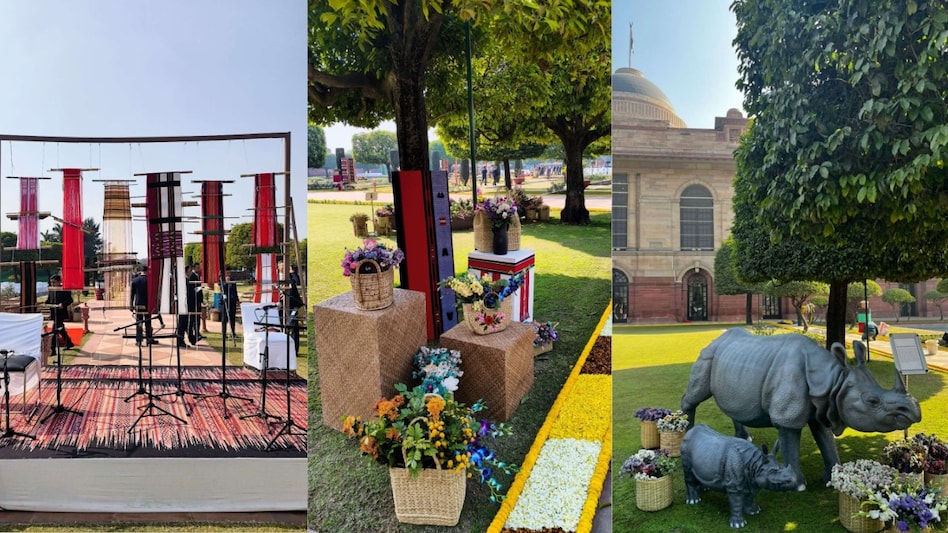
The installations transformed Rashtrapati Bhavan into a living gallery of Northeast India’s landscapes, livelihoods and craftsmanship. Guests were welcomed with traditional symbols of respect, such as the Brass Xorai and Assamese Gamosa, alongside Singtha Naga plates and bundles of dry corn husks reflecting Naga hospitality and agrarian abundance.
Nature-inspired displays paid tribute to the region’s ecology, with Kauna grass baskets from Manipur holding dried statice flowers to evoke the misty Dzüko Valley, while traditional bamboo fishing gears—Jakoi, Polo and Juluki—highlighted indigenous engineering rooted in riverine life. Rare Longpi (Nungbi) black pottery from Manipur, crafted from a unique stone-clay fusion, was showcased alongside motifs of the endemic Shirui Lily.
Life-sized cane sculptures of the one-horned rhinoceros and the elephant underscored the Northeast’s deep ecological memory, while a centrepiece ‘Boat Fruit Basket’ symbolised the lifelines of the Brahmaputra and Loktak Lake. The installation featured GI-tagged produce such as Kaji Nemu, Khasi Mandarin, Queen Pineapple and the Naga King Chilli. A woven cane structure reimagined the Indian Tricolour using organic produce.
Textiles formed a major highlight. The ‘Loinloom Stage’ showcased ancient back-strap weaving traditions, while octagonal table mats—symbolising the eight states—featured motifs such as Manipur’s Moirang Phee, Mizoram’s Puanropui, Tripura’s Risa and bold Naga geometric patterns. Towering above the venue was the ornate Assamese Fulam Japi, a powerful emblem of cultural pride.
Traditional performances from all eight states added vibrancy, reinforcing the Northeast’s living heritage and marking a historic moment of national recognition.
For the first time, the rich handlooms, handicrafts and indigenous traditions of all eight Northeastern states were showcased at the President of India’s prestigious ‘At Home’ reception at Rashtrapati Bhavan hosted for European Commission President Ursula von der Leyen and European Council President Antonio Costa on Republic Day, marking a landmark moment for the region’s cultural diplomacy.
Curated and presented by the North Eastern Handicrafts and Handlooms Development Corporation (NEHHDC), the exhibition brought together the collective cultural identity of Assam, Arunachal Pradesh, Manipur, Meghalaya, Mizoram, Nagaland, Tripura and Sikkim on India’s highest ceremonial stage. President Droupadi Murmu and Prime Minister Narendra Modi, along with Union ministers, senior officials, diplomats and international dignitaries, witnessed the display. European Commission President Ursula von der Leyen and European Council President António Costa were also present.
The installations transformed Rashtrapati Bhavan into a living gallery of Northeast India’s landscapes, livelihoods and craftsmanship. Guests were welcomed with traditional symbols of respect, such as the Brass Xorai and Assamese Gamosa, alongside Singtha Naga plates and bundles of dry corn husks reflecting Naga hospitality and agrarian abundance.
Nature-inspired displays paid tribute to the region’s ecology, with Kauna grass baskets from Manipur holding dried statice flowers to evoke the misty Dzüko Valley, while traditional bamboo fishing gears—Jakoi, Polo and Juluki—highlighted indigenous engineering rooted in riverine life. Rare Longpi (Nungbi) black pottery from Manipur, crafted from a unique stone-clay fusion, was showcased alongside motifs of the endemic Shirui Lily.
Life-sized cane sculptures of the one-horned rhinoceros and the elephant underscored the Northeast’s deep ecological memory, while a centrepiece ‘Boat Fruit Basket’ symbolised the lifelines of the Brahmaputra and Loktak Lake. The installation featured GI-tagged produce such as Kaji Nemu, Khasi Mandarin, Queen Pineapple and the Naga King Chilli. A woven cane structure reimagined the Indian Tricolour using organic produce.
Textiles formed a major highlight. The ‘Loinloom Stage’ showcased ancient back-strap weaving traditions, while octagonal table mats—symbolising the eight states—featured motifs such as Manipur’s Moirang Phee, Mizoram’s Puanropui, Tripura’s Risa and bold Naga geometric patterns. Towering above the venue was the ornate Assamese Fulam Japi, a powerful emblem of cultural pride.
Traditional performances from all eight states added vibrancy, reinforcing the Northeast’s living heritage and marking a historic moment of national recognition.