
BT Explainer: Why are Indian airports seeing frequent wing clip incidents
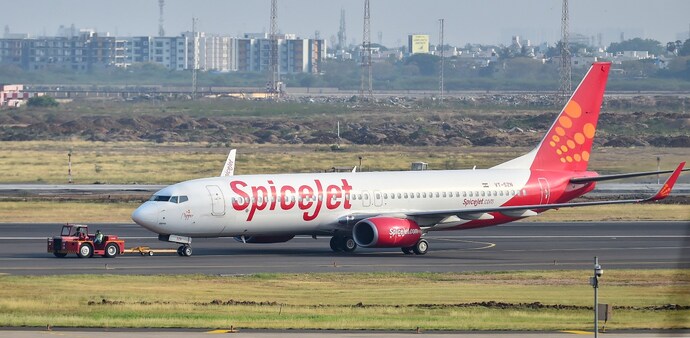
In the most recent case, wings of a SpiceJet and an Akasa aircraft collided at Delhi airport, damaging both planes. There has been persistent high runway incursion and aircraft proximity rates.
- Apr 17, 2026,
- Updated Apr 17, 2026 1:20 PM IST
New Delhi: Wings of an Akasa aircraft was about to take-off and a taxiing SpiceJet aircraft collided at the Delhi airport on Thursday. Initial reports suggested that SpiceJet pilots executed a turn without wing walker clearance from the Air Traffic Control (ATC) officer. The Directorate General of Civil aviation (DGCA) has ordered that the pilots of the SpiceJet aircraft and the ATC officer concerned be taken off duty till an inquiry is conducted.
This has brought similar incidents in the past two months into the spotlight, highlighting concerns about aviation safety standards at airports.
A major disaster was averted at Mumbai’s Chhatrapati Shivaji Maharaj International Airport on February 3 after the wing tips of two aircraft were involved in a ground collision. In this case, it was an Air India flight pushing back for its departure to Coimbatore and an IndiGo flight taxiing after arriving from Hyderabad. Earlier this month, an IndiGo aircraft was hit by an unmanned catering truck at Kolkata airport.
These incidents have raised questions about safety standards at Indian airports, highlighting the need for immediate attention.
A Parliamentary Standing Committee report on review of safety in civil aviation tabled in 2025 said that AIRPROX (aircraft proximity) rates exceeded the acceptable benchmark, further reinforcing the conclusion that systemic issues related to airspace management, standard operating procedures, and pilot-controller communication are not being adequately resolved by the DGCA. The aviation regulator has set up an Occurrence Review Board (ORB) to look into such incidents.
Poor safety track record at runways
Runway incursions by aircraft were recorded at a rate of 14.12 per million movements, significantly exceeding the established target of 9.78 in 2024. Similarly, incursions attributed to a loss of situational awareness stood at 5.91 per million movements, against a target of 4.54. These are high-consequence events that pose a direct risk of collision on the ground.
The persistence of high runway incursion and AIRPROX rates indicates that the mitigation and prevention phases of the safety management cycle are broken.
“This points to a potentially superficial level of analysis within the current process. The system may be addressing the immediate, apparent cause of an incident (e.g., classifying it as ‘pilot error’ or ‘controller error’) without conducting a deep, systemic root-cause analysis,” the committee said in its report.
It further said that without a deeper level of inquiry, the ORB functions more as a data collection and classification body than as a powerful agent for systemic change. It is destined to review an endless stream of similar, recurring incidents because the underlying conditions that create them remain unaddressed.
“The problem is not a lack of data on incidents, but a lack of deep analysis and enforced, systemic solutions,” it added.
Lack of ATC technological upgrades
The pace of technological upgradation in India’s critical ATC infrastructure has failed to keep pace with the exponential growth in air traffic and airspace complexity.
The Air Traffic Controllers’ Guild (India) brought a critical technological issue to the Parliament committee’s attention. It was submitted that the existing automation systems used for ATC, particularly at high-density airports such as Delhi and Mumbai, have begun to exhibit significant performance degradation.
This includes issues of slow systems, data processing lags, and a lack of modern decision-support features, which directly impact operational efficiency and compromise the safety margins within which controllers must operate.
The existing Indian ATC systems lack many of the advanced, integrated capabilities that are now standard in modern air traffic management systems used by global counterparts like EUROCONTROL or the FAA. These missing features include sophisticated, AI-enabled conflict detection and alerting tools, predictive analytics for traffic flow management, and seamless, real-time data sharing capabilities between different control units and with aircraft.
This technological deficit places an enormous additional cognitive strain on the already-overworked air traffic controllers. They are forced to manually compensate for the system's shortcomings, performing mental calculations and cross-checks that a modern system would automate. This not only increases the risk of human error but also limits the overall capacity of the airspace.
Mismatch between fleet size and airport capacity
The current trajectory of uncoordinated growth between fleet size and infrastructure capacity is unsustainable and is pushing the aviation system towards a saturation point. Adding more and more aircraft into a system with a relatively fixed infrastructure capacity is a recipe for chronic congestion, delays, and, most importantly, increased risk.
When more aircraft are competing for the same limited number of landing and takeoff slots, taxiways, and parking bays, it inevitably leads to ground delays, airborne holding patterns, and a more complex operational environment.
This heightened complexity significantly increases the cognitive workload on both pilots and air traffic controllers, thereby increasing the probability of safety lapses such as ground collisions, runway incursions, and other operational errors.
The system’s safety margins, which are designed to absorb unexpected events, are progressively eroded by this constant state of high-density operation. Without a national-level strategic plan to align these two critical growth vectors, the system risks reaching a tipping point where these safety margins become dangerously thin, and the very growth that the sector celebrates becomes its greatest liability.
New Delhi: Wings of an Akasa aircraft was about to take-off and a taxiing SpiceJet aircraft collided at the Delhi airport on Thursday. Initial reports suggested that SpiceJet pilots executed a turn without wing walker clearance from the Air Traffic Control (ATC) officer. The Directorate General of Civil aviation (DGCA) has ordered that the pilots of the SpiceJet aircraft and the ATC officer concerned be taken off duty till an inquiry is conducted.
This has brought similar incidents in the past two months into the spotlight, highlighting concerns about aviation safety standards at airports.
A major disaster was averted at Mumbai’s Chhatrapati Shivaji Maharaj International Airport on February 3 after the wing tips of two aircraft were involved in a ground collision. In this case, it was an Air India flight pushing back for its departure to Coimbatore and an IndiGo flight taxiing after arriving from Hyderabad. Earlier this month, an IndiGo aircraft was hit by an unmanned catering truck at Kolkata airport.
These incidents have raised questions about safety standards at Indian airports, highlighting the need for immediate attention.
A Parliamentary Standing Committee report on review of safety in civil aviation tabled in 2025 said that AIRPROX (aircraft proximity) rates exceeded the acceptable benchmark, further reinforcing the conclusion that systemic issues related to airspace management, standard operating procedures, and pilot-controller communication are not being adequately resolved by the DGCA. The aviation regulator has set up an Occurrence Review Board (ORB) to look into such incidents.
Poor safety track record at runways
Runway incursions by aircraft were recorded at a rate of 14.12 per million movements, significantly exceeding the established target of 9.78 in 2024. Similarly, incursions attributed to a loss of situational awareness stood at 5.91 per million movements, against a target of 4.54. These are high-consequence events that pose a direct risk of collision on the ground.
The persistence of high runway incursion and AIRPROX rates indicates that the mitigation and prevention phases of the safety management cycle are broken.
“This points to a potentially superficial level of analysis within the current process. The system may be addressing the immediate, apparent cause of an incident (e.g., classifying it as ‘pilot error’ or ‘controller error’) without conducting a deep, systemic root-cause analysis,” the committee said in its report.
It further said that without a deeper level of inquiry, the ORB functions more as a data collection and classification body than as a powerful agent for systemic change. It is destined to review an endless stream of similar, recurring incidents because the underlying conditions that create them remain unaddressed.
“The problem is not a lack of data on incidents, but a lack of deep analysis and enforced, systemic solutions,” it added.
Lack of ATC technological upgrades
The pace of technological upgradation in India’s critical ATC infrastructure has failed to keep pace with the exponential growth in air traffic and airspace complexity.
The Air Traffic Controllers’ Guild (India) brought a critical technological issue to the Parliament committee’s attention. It was submitted that the existing automation systems used for ATC, particularly at high-density airports such as Delhi and Mumbai, have begun to exhibit significant performance degradation.
This includes issues of slow systems, data processing lags, and a lack of modern decision-support features, which directly impact operational efficiency and compromise the safety margins within which controllers must operate.
The existing Indian ATC systems lack many of the advanced, integrated capabilities that are now standard in modern air traffic management systems used by global counterparts like EUROCONTROL or the FAA. These missing features include sophisticated, AI-enabled conflict detection and alerting tools, predictive analytics for traffic flow management, and seamless, real-time data sharing capabilities between different control units and with aircraft.
This technological deficit places an enormous additional cognitive strain on the already-overworked air traffic controllers. They are forced to manually compensate for the system's shortcomings, performing mental calculations and cross-checks that a modern system would automate. This not only increases the risk of human error but also limits the overall capacity of the airspace.
Mismatch between fleet size and airport capacity
The current trajectory of uncoordinated growth between fleet size and infrastructure capacity is unsustainable and is pushing the aviation system towards a saturation point. Adding more and more aircraft into a system with a relatively fixed infrastructure capacity is a recipe for chronic congestion, delays, and, most importantly, increased risk.
When more aircraft are competing for the same limited number of landing and takeoff slots, taxiways, and parking bays, it inevitably leads to ground delays, airborne holding patterns, and a more complex operational environment.
This heightened complexity significantly increases the cognitive workload on both pilots and air traffic controllers, thereby increasing the probability of safety lapses such as ground collisions, runway incursions, and other operational errors.
The system’s safety margins, which are designed to absorb unexpected events, are progressively eroded by this constant state of high-density operation. Without a national-level strategic plan to align these two critical growth vectors, the system risks reaching a tipping point where these safety margins become dangerously thin, and the very growth that the sector celebrates becomes its greatest liability.