
'China diversified, India made profits': US Treasury on why no tariff on Beijing over Russian oil
Secretary Scott Bessent argued that such purchases were helping Moscow sustain its war economy
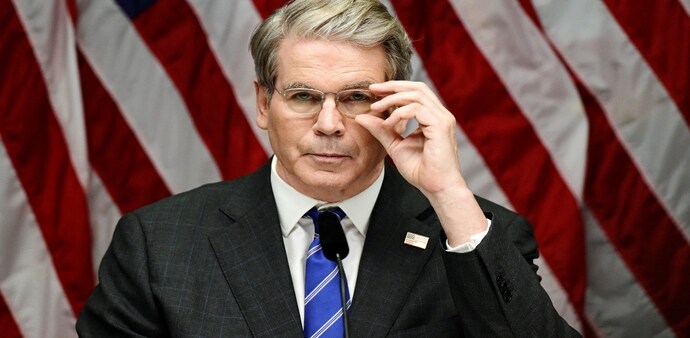
- Aug 19, 2025,
- Updated Aug 19, 2025 8:01 PM IST
US Treasury Secretary Scott Bessent on Tuesday defended Washington's decision to impose additional tariffs on India over its imports of Russian oil while sparing China, arguing that Beijing's reliance on Russian crude had grown only marginally compared to New Delhi's sharp escalation.
"Let's go back and look at the history. And China importing it is suboptimal. But if you go back and look pre-2022, 13% of China's oil was already coming from Russia. Now it's 16%. So, China has a diversified input of oil," Bessent told CNBC.
By contrast, he said India's imports had soared from negligible levels. "If you go back and look now, I believe India had less than 1% of their oil. And now I believe it's up to 42%. So, India is just profiteering. They are reselling. They made $16 billion in excess profits. Some of the richest families in India. So, this is a completely different thing. What I would call the Indian arbitrage, buying cheap Russian oil, reselling it as product has just sprung up during the war, which is unacceptable," he said.
Bessent argued that such purchases were helping Moscow sustain its war economy. "The Russian economy has 20% plus inflation right now. It is a war economy. More than 25% of the GDP is coming from the military buildup. So, it's a very imbalanced economy there. The frozen Russian assets, the runoff from those is now being used to finance the war. So, there are a lot of moving pieces here," he said.
Earlier, Secretary of State Marco Rubio also explained why China had been spared. In an interview with Fox Business, Rubio said sanctioning Chinese refiners would disrupt the global market. "If you put secondary sanctions on a country — let's say you were to go after the oil sales of Russian oil to China - well, China just refines that oil. That oil is then sold into the global marketplace, and anyone who's buying that oil would be paying more for it or, if it doesn't exist, would have to find an alternative source for it," he said.
Rubio noted that European buyers of refined Russian oil from China had signaled unease over punitive measures. "We have heard, when you talk about the Senate bill that was being proposed - where there was a hundred per cent tariff on China and India - we did hear from a number of European countries - not in press releases, but we heard from them - some concern about what that could mean," he said.
While both China and India are now among Russia's top oil customers, Washington has imposed 50% tariffs on Indian goods as penalty for its Russian oil purchases.
US Treasury Secretary Scott Bessent on Tuesday defended Washington's decision to impose additional tariffs on India over its imports of Russian oil while sparing China, arguing that Beijing's reliance on Russian crude had grown only marginally compared to New Delhi's sharp escalation.
"Let's go back and look at the history. And China importing it is suboptimal. But if you go back and look pre-2022, 13% of China's oil was already coming from Russia. Now it's 16%. So, China has a diversified input of oil," Bessent told CNBC.
By contrast, he said India's imports had soared from negligible levels. "If you go back and look now, I believe India had less than 1% of their oil. And now I believe it's up to 42%. So, India is just profiteering. They are reselling. They made $16 billion in excess profits. Some of the richest families in India. So, this is a completely different thing. What I would call the Indian arbitrage, buying cheap Russian oil, reselling it as product has just sprung up during the war, which is unacceptable," he said.
Bessent argued that such purchases were helping Moscow sustain its war economy. "The Russian economy has 20% plus inflation right now. It is a war economy. More than 25% of the GDP is coming from the military buildup. So, it's a very imbalanced economy there. The frozen Russian assets, the runoff from those is now being used to finance the war. So, there are a lot of moving pieces here," he said.
Earlier, Secretary of State Marco Rubio also explained why China had been spared. In an interview with Fox Business, Rubio said sanctioning Chinese refiners would disrupt the global market. "If you put secondary sanctions on a country — let's say you were to go after the oil sales of Russian oil to China - well, China just refines that oil. That oil is then sold into the global marketplace, and anyone who's buying that oil would be paying more for it or, if it doesn't exist, would have to find an alternative source for it," he said.
Rubio noted that European buyers of refined Russian oil from China had signaled unease over punitive measures. "We have heard, when you talk about the Senate bill that was being proposed - where there was a hundred per cent tariff on China and India - we did hear from a number of European countries - not in press releases, but we heard from them - some concern about what that could mean," he said.
While both China and India are now among Russia's top oil customers, Washington has imposed 50% tariffs on Indian goods as penalty for its Russian oil purchases.