
China issues licences to Indian firms to import rare earth magnets
New Delhi has faced challenges sourcing rare earths after China halted fertiliser and mineral exports to several countries, including India, last year.
- Oct 31, 2025,
- Updated Oct 31, 2025 11:14 AM IST
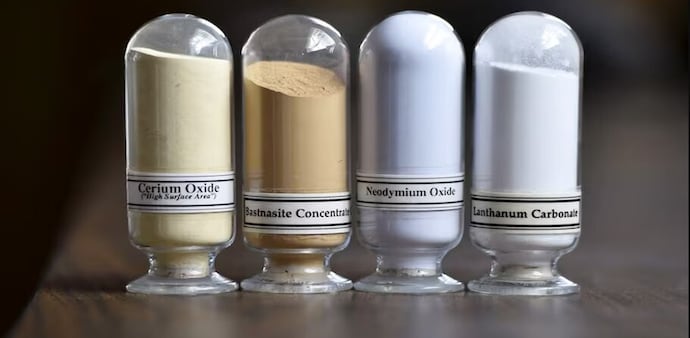
China has issued licences to certain Indian companies for importing rare earth magnets, marking a significant development in efforts to stabilise the minerals supply chain between the two countries. Rare earth minerals, critical for sectors such as electric vehicles and battery storage, are essential to India’s economic growth. China holds a dominant position in global rare earth mining, accounting for around 70 per cent of global production.
The decision could offer India a more reliable supply of these resources, potentially impacting various industrial sectors.
The Ministry of External Affairs (MEA) in New Delhi confirmed the move on Thursday. At his weekly media briefing, External Affairs Ministry spokesperson Randhir Jaiswal stated, "Some Indian companies have received licences for importing rare earth magnets from China."
No further details were provided regarding the licence recipients or the volume of imports permitted. The step is seen in the context of broader initiatives to improve India-China relations, which has suffered setbacks in recent years.
New Delhi has faced challenges sourcing rare earths after China halted fertiliser and mineral exports to several countries, including India, last year. Although Beijing relaxed restrictions for other nations in June, it had not extended the same to India until now. Recently, China introduced new limitations on the export of technology and equipment related to rare earth processing and battery production, reinforcing its tight control over critical mineral supply chains.
China’s decision to grant licences to Indian firms is viewed as part of a wider effort to rebuild bilateral trust. The change comes amid a series of steps by both governments to reset diplomatic ties, including the resumption of the Kailash Mansarovar Yatra and India’s renewal of tourist visa issuance to Chinese nationals. These developments follow a reduction in military tensions in eastern Ladakh, where a disengagement agreement was implemented in October last year.
For India, securing a steady supply of rare earth minerals is crucial for sustaining industrial and technological growth. Rare earths are vital in the manufacture of high-tech products, ranging from electric vehicles and drones to advanced battery systems. India’s reliance on imports to meet domestic demand has been shaped by China's longstanding dominance in the global supply chain. The current licensing move could help diversify and stabilise India's access to these critical inputs.
The decision to revive various dialogue mechanisms between India and China followed a meeting between Prime Minister Narendra Modi and Chinese President Xi Jinping in Kazan, Russia, in October last year. The conclusion of the military disengagement in eastern Ladakh, including at Demchok and Depsang, marked a turning point after more than four years of strained relations and border tensions.
China has issued licences to certain Indian companies for importing rare earth magnets, marking a significant development in efforts to stabilise the minerals supply chain between the two countries. Rare earth minerals, critical for sectors such as electric vehicles and battery storage, are essential to India’s economic growth. China holds a dominant position in global rare earth mining, accounting for around 70 per cent of global production.
The decision could offer India a more reliable supply of these resources, potentially impacting various industrial sectors.
The Ministry of External Affairs (MEA) in New Delhi confirmed the move on Thursday. At his weekly media briefing, External Affairs Ministry spokesperson Randhir Jaiswal stated, "Some Indian companies have received licences for importing rare earth magnets from China."
No further details were provided regarding the licence recipients or the volume of imports permitted. The step is seen in the context of broader initiatives to improve India-China relations, which has suffered setbacks in recent years.
New Delhi has faced challenges sourcing rare earths after China halted fertiliser and mineral exports to several countries, including India, last year. Although Beijing relaxed restrictions for other nations in June, it had not extended the same to India until now. Recently, China introduced new limitations on the export of technology and equipment related to rare earth processing and battery production, reinforcing its tight control over critical mineral supply chains.
China’s decision to grant licences to Indian firms is viewed as part of a wider effort to rebuild bilateral trust. The change comes amid a series of steps by both governments to reset diplomatic ties, including the resumption of the Kailash Mansarovar Yatra and India’s renewal of tourist visa issuance to Chinese nationals. These developments follow a reduction in military tensions in eastern Ladakh, where a disengagement agreement was implemented in October last year.
For India, securing a steady supply of rare earth minerals is crucial for sustaining industrial and technological growth. Rare earths are vital in the manufacture of high-tech products, ranging from electric vehicles and drones to advanced battery systems. India’s reliance on imports to meet domestic demand has been shaped by China's longstanding dominance in the global supply chain. The current licensing move could help diversify and stabilise India's access to these critical inputs.
The decision to revive various dialogue mechanisms between India and China followed a meeting between Prime Minister Narendra Modi and Chinese President Xi Jinping in Kazan, Russia, in October last year. The conclusion of the military disengagement in eastern Ladakh, including at Demchok and Depsang, marked a turning point after more than four years of strained relations and border tensions.