
'Combat role for women can be done tomorrow if...': Gen Dwivedi on if Indian Army is ready to induct women in infantry
Stressing that women should not be seen as vulnerable, the Army Chief said the focus of the force is on “gender neutrality”.
- Jan 14, 2026,
- Updated Jan 14, 2026 4:46 PM IST
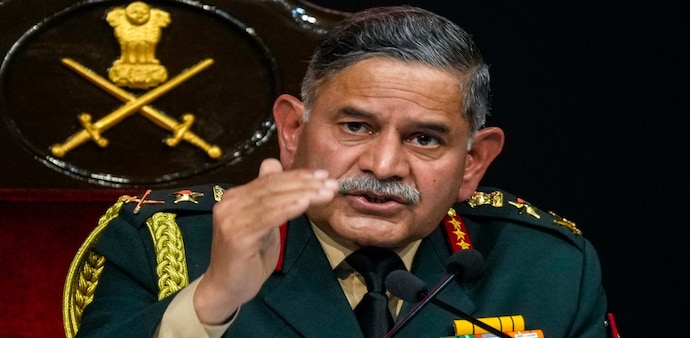
Chief of the Army Staff (COAS) General Upendra Dwivedi on Tuesday said the Indian Army is ready to induct women into the infantry, but this will depend on societal acceptance. He made the remarks during a media briefing.
Stressing that women should not be seen as vulnerable, the Army Chief said the focus of the force is on “gender neutrality”. “If standards are same, if capabilities are same, and in India as a nation, society is ready to accept it, it (combat role) can be done tomorrow,” he said.
General Dwivedi said uniform standards are essential, but achieving them remains a challenge because of medical and operational constraints. He said the performance data of women officers will decide the opening of more roles, starting with supporting arms, followed by combat arms and eventually special forces. He described this as a “sequential and welcome social change”.
Giving details on women’s induction, the Army Chief said that at the National Defence Academy (NDA), there are currently 60 women Army cadets, and every year the Army plans to induct 20 cadets. He added that at the Officers’ Training Academy (OTA) in Chennai and Gaya, around 120 women are inducted every year.
He said that inducting women in other ranks (ORs) would require a change in Section 12 of the Army Act. The Army is looking at a 12-times increase in women’s induction in ORs by 2032. “Currently, the total number of women officers is 8,000,” he said.
General Dwivedi also said the Territorial Army has been opened to women and that 110 vacancies will be made available.
Speaking on modernisation, the Chief of the Army Staff said the Indian Army is focusing on preparing for future warfare by learning from conflicts around the world. He said dedicated drone regiments with enhanced capabilities, rocket-cum-missile forces, loitering munitions, and new battalions like Bhairav, equipped with modern technology, advanced weapons, and anti-missile defence radar systems, are on the cards.
He said over 90% of ammunition is now indigenised, highlighting the push towards self-reliance. “After Operation Sindoor, drones got a new thrust,” he said, adding that new drone formations have been raised. He said each command currently has the capability to manufacture up to 5,000 drones depending on operational requirements, which can be increased to 20,000 or even one lakh drones based on threat perception or conflict.
“As of today, we have raised 13 Bhairav battalions, which are meant to bridge the gap between lethal platoons and special forces within infantry battalions,” the Army Chief said.
On artillery modernisation, General Dwivedi said the Army has created a Divyastra battery, which will be part of the artillery regiment and provide support to a division commander. He said this involves unmanned aerial systems (UAS) equipment.
For counter-unmanned aircraft system (CUAS) ammunition, he said the Army has a powerful regiment and is currently raising three units, with plans to raise 12 more later. “We will then expand this further,” he added.
Chief of the Army Staff (COAS) General Upendra Dwivedi on Tuesday said the Indian Army is ready to induct women into the infantry, but this will depend on societal acceptance. He made the remarks during a media briefing.
Stressing that women should not be seen as vulnerable, the Army Chief said the focus of the force is on “gender neutrality”. “If standards are same, if capabilities are same, and in India as a nation, society is ready to accept it, it (combat role) can be done tomorrow,” he said.
General Dwivedi said uniform standards are essential, but achieving them remains a challenge because of medical and operational constraints. He said the performance data of women officers will decide the opening of more roles, starting with supporting arms, followed by combat arms and eventually special forces. He described this as a “sequential and welcome social change”.
Giving details on women’s induction, the Army Chief said that at the National Defence Academy (NDA), there are currently 60 women Army cadets, and every year the Army plans to induct 20 cadets. He added that at the Officers’ Training Academy (OTA) in Chennai and Gaya, around 120 women are inducted every year.
He said that inducting women in other ranks (ORs) would require a change in Section 12 of the Army Act. The Army is looking at a 12-times increase in women’s induction in ORs by 2032. “Currently, the total number of women officers is 8,000,” he said.
General Dwivedi also said the Territorial Army has been opened to women and that 110 vacancies will be made available.
Speaking on modernisation, the Chief of the Army Staff said the Indian Army is focusing on preparing for future warfare by learning from conflicts around the world. He said dedicated drone regiments with enhanced capabilities, rocket-cum-missile forces, loitering munitions, and new battalions like Bhairav, equipped with modern technology, advanced weapons, and anti-missile defence radar systems, are on the cards.
He said over 90% of ammunition is now indigenised, highlighting the push towards self-reliance. “After Operation Sindoor, drones got a new thrust,” he said, adding that new drone formations have been raised. He said each command currently has the capability to manufacture up to 5,000 drones depending on operational requirements, which can be increased to 20,000 or even one lakh drones based on threat perception or conflict.
“As of today, we have raised 13 Bhairav battalions, which are meant to bridge the gap between lethal platoons and special forces within infantry battalions,” the Army Chief said.
On artillery modernisation, General Dwivedi said the Army has created a Divyastra battery, which will be part of the artillery regiment and provide support to a division commander. He said this involves unmanned aerial systems (UAS) equipment.
For counter-unmanned aircraft system (CUAS) ammunition, he said the Army has a powerful regiment and is currently raising three units, with plans to raise 12 more later. “We will then expand this further,” he added.