
'Completely blown away': Airbus chairman praises India's engineering excellence
The Airbus chairman described India as a strategic, long-term partner for the company and a vital pillar in the company's global supply chain
- Oct 26, 2025,
- Updated Oct 26, 2025 3:00 PM IST
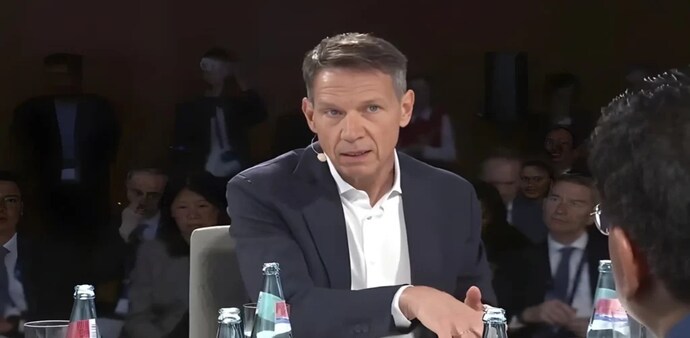
Airbus Chairman Rene Obermann has said he is "very bullish on India," calling the country's engineering talent, ambition, and quality among the best in the world. Speaking at the Berlin Global Dialogue, Obermann described India as a strategic, long-term partner for Airbus and a vital pillar in the company's global supply chain.
"I'm very bullish on India. I think the ambition which I sensed - I'll tell you - the ambition on the entrepreneurial level was beyond what I heard everywhere in the world before," Obermann said. "They're coming from a position where there's a lot to catch up still if you think about GDP per capita, etc., but everyone I spoke to had massive ambition and excellent education and super good engineering."
Recounting his recent visit, Obermann said the experience left a strong impression. "I was in India, I spent one week there, and I was completely blown away by the level of excellence, engineering excellence, quality in India. For Airbus, India is a strategic long-term partner," he said.
He added that Airbus's engagement with India is not limited to cost advantages but focuses on technological collaboration. "Part of the discussions was not only how can you make things cheaper for us, but actually how can we make things better by leveraging the capabilities of Indian technology and tech talents there. It was part of the discussions on how to evolve the partnership with India," Obermann said.
Highlighting the company's global production footprint, Obermann said Airbus's strategy hinges on "local for local" manufacturing and co-development. "We have European roots, but we are a global company and we do a lot of local for local. We support India in its Make in India strategy. We try to partner very closely with local supply chains—not only suppliers but co-developers of components. We even build some planes like the C295 in India. We have a final assembly line. We do the same in China. We produce in the US. Otherwise, this new world order is against us," he said.
Addressing the broader challenges of global trade and supply chain disruption, Obermann said complete decoupling between economies remains unrealistic. "I think it's still an illusion when people talk about decoupling because the world is so interconnected and supply chains are so interconnected that a real decoupling is hard to imagine, if not impossible. But I do believe in building leverage for negotiations and to establish mutual dependencies," he said.
He added that the aerospace industry requires balance because of its complexity. "We can't pursue one strategy for ten years, believing things are stable. It's about building leverage and gradually having more redundant elements in the supply chain. In aerospace, it's not so trivial because it's a small number of planes that get produced. You don't have for each certified and expensive component a zillion suppliers," he said.
Obermann said the changing geopolitical climate also presents new openings for collaboration between Europe and India. "The situation offers unique opportunities for Europe. In the past, India never looked at Europe as a whole - it looked at individual countries. Now Europe as a whole has a voice, and that was largely driven by the latest geopolitical developments," he said.
Airbus Chairman Rene Obermann has said he is "very bullish on India," calling the country's engineering talent, ambition, and quality among the best in the world. Speaking at the Berlin Global Dialogue, Obermann described India as a strategic, long-term partner for Airbus and a vital pillar in the company's global supply chain.
"I'm very bullish on India. I think the ambition which I sensed - I'll tell you - the ambition on the entrepreneurial level was beyond what I heard everywhere in the world before," Obermann said. "They're coming from a position where there's a lot to catch up still if you think about GDP per capita, etc., but everyone I spoke to had massive ambition and excellent education and super good engineering."
Recounting his recent visit, Obermann said the experience left a strong impression. "I was in India, I spent one week there, and I was completely blown away by the level of excellence, engineering excellence, quality in India. For Airbus, India is a strategic long-term partner," he said.
He added that Airbus's engagement with India is not limited to cost advantages but focuses on technological collaboration. "Part of the discussions was not only how can you make things cheaper for us, but actually how can we make things better by leveraging the capabilities of Indian technology and tech talents there. It was part of the discussions on how to evolve the partnership with India," Obermann said.
Highlighting the company's global production footprint, Obermann said Airbus's strategy hinges on "local for local" manufacturing and co-development. "We have European roots, but we are a global company and we do a lot of local for local. We support India in its Make in India strategy. We try to partner very closely with local supply chains—not only suppliers but co-developers of components. We even build some planes like the C295 in India. We have a final assembly line. We do the same in China. We produce in the US. Otherwise, this new world order is against us," he said.
Addressing the broader challenges of global trade and supply chain disruption, Obermann said complete decoupling between economies remains unrealistic. "I think it's still an illusion when people talk about decoupling because the world is so interconnected and supply chains are so interconnected that a real decoupling is hard to imagine, if not impossible. But I do believe in building leverage for negotiations and to establish mutual dependencies," he said.
He added that the aerospace industry requires balance because of its complexity. "We can't pursue one strategy for ten years, believing things are stable. It's about building leverage and gradually having more redundant elements in the supply chain. In aerospace, it's not so trivial because it's a small number of planes that get produced. You don't have for each certified and expensive component a zillion suppliers," he said.
Obermann said the changing geopolitical climate also presents new openings for collaboration between Europe and India. "The situation offers unique opportunities for Europe. In the past, India never looked at Europe as a whole - it looked at individual countries. Now Europe as a whole has a voice, and that was largely driven by the latest geopolitical developments," he said.