
Cross-border choke: Diwali fireworks in India push Lahore into world’s top polluted cities
As fireworks lit up India’s skies over the Diwali weekend, a thick haze crept across the border into Pakistan — blurring the line between celebration and suffocation.
- Oct 21, 2025,
- Updated Oct 21, 2025 6:16 PM IST
By Tuesday morning, Lahore’s Air Quality Index (AQI) stood at 266 — second only to New Delhi, where most stations recorded levels well above 300. As fireworks lit up India’s skies over the Diwali weekend, a thick haze crept across the border into Pakistan — blurring the line between celebration and suffocation.
Officials in Pakistan said the choking air was caused by a mix of local pollution and smoke drifting in from India after the Diwali festivities, made worse by low wind speeds, India Today reported, citing Karachi-based Dawn. The Punjab Environment Protection Department added that “winds carrying pollutants from New Delhi and other northern Indian cities contributed significantly to worsening air conditions in Pakistan's Punjab.”
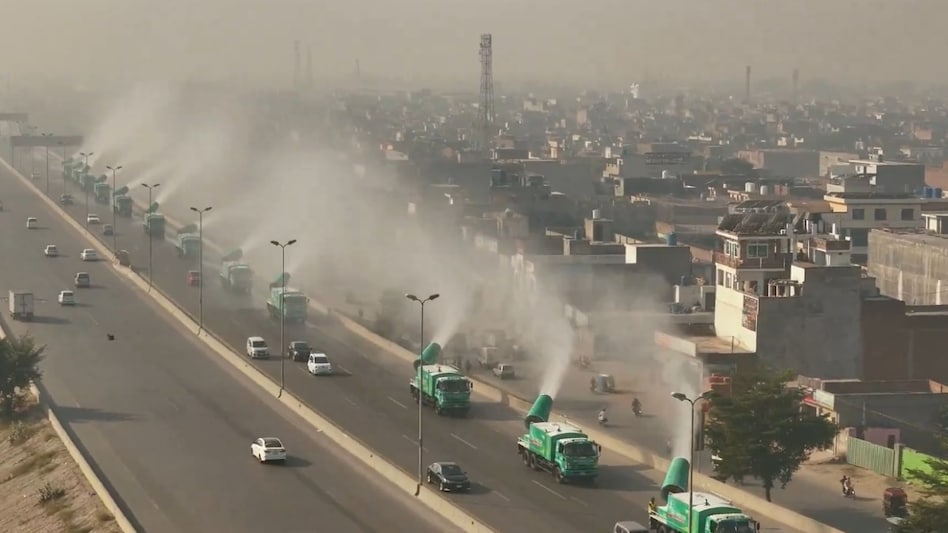
By Tuesday morning, Lahore’s Air Quality Index (AQI) stood at 266 — second only to New Delhi, where most stations recorded levels well above 300. The provincial government responded by rolling out emergency steps: anti-smog guns on key roads, water sprinkling drives, and a crackdown on factories and vehicles adding to the crisis. Nine departments have been brought together for the clean-up effort, and special “smog response squads” have been tasked with conducting raids.
With wind speeds of just 4–7 km/h, fine particles from across the border hung in the air, spreading to cities like Faisalabad, Gujranwala, Sahiwal, and Multan.
On Monday, Lahore was already ranked the third most polluted city in the world, behind Kolkata and New Delhi — both hit by post-Diwali spikes. By Tuesday, it climbed to second place. Swiss air monitoring firm IQAir reported PM2.5 levels in Lahore at 187 µg/m³ — roughly 37 times higher than the World Health Organisation’s safe limit.
Marriyum Aurangzeb, a minister in Maryam Nawaz’s Cabinet, called it a “cross-border environmental challenge,” urging citizens to play their part in cutting local emissions while officials tracked pollution entering from India.
“Winds coming from Amritsar, Ludhiana, and Haryana will bring pollution into the air. Lahore's AQI is expected to remain between 210 and 230,” she wrote on X.
She added that “construction materials in open areas would be covered, traffic on key routes would be restricted, and vehicles emitting smoke would be fined or seized.”
Lahore Police, meanwhile, arrested 83 people in its anti-smog crackdown, including factory operators and others accused of burning tyres and waste.
Across the border, Delhi too was blanketed in toxic air, with PM2.5 levels exceeding 248 µg/m³ in most areas. Despite a court order restricting fireworks to “green crackers,” compliance was poor, and firework use remained widespread.
By Tuesday morning, Lahore’s Air Quality Index (AQI) stood at 266 — second only to New Delhi, where most stations recorded levels well above 300. As fireworks lit up India’s skies over the Diwali weekend, a thick haze crept across the border into Pakistan — blurring the line between celebration and suffocation.
Officials in Pakistan said the choking air was caused by a mix of local pollution and smoke drifting in from India after the Diwali festivities, made worse by low wind speeds, India Today reported, citing Karachi-based Dawn. The Punjab Environment Protection Department added that “winds carrying pollutants from New Delhi and other northern Indian cities contributed significantly to worsening air conditions in Pakistan's Punjab.”
By Tuesday morning, Lahore’s Air Quality Index (AQI) stood at 266 — second only to New Delhi, where most stations recorded levels well above 300. The provincial government responded by rolling out emergency steps: anti-smog guns on key roads, water sprinkling drives, and a crackdown on factories and vehicles adding to the crisis. Nine departments have been brought together for the clean-up effort, and special “smog response squads” have been tasked with conducting raids.
With wind speeds of just 4–7 km/h, fine particles from across the border hung in the air, spreading to cities like Faisalabad, Gujranwala, Sahiwal, and Multan.
On Monday, Lahore was already ranked the third most polluted city in the world, behind Kolkata and New Delhi — both hit by post-Diwali spikes. By Tuesday, it climbed to second place. Swiss air monitoring firm IQAir reported PM2.5 levels in Lahore at 187 µg/m³ — roughly 37 times higher than the World Health Organisation’s safe limit.
Marriyum Aurangzeb, a minister in Maryam Nawaz’s Cabinet, called it a “cross-border environmental challenge,” urging citizens to play their part in cutting local emissions while officials tracked pollution entering from India.
“Winds coming from Amritsar, Ludhiana, and Haryana will bring pollution into the air. Lahore's AQI is expected to remain between 210 and 230,” she wrote on X.
She added that “construction materials in open areas would be covered, traffic on key routes would be restricted, and vehicles emitting smoke would be fined or seized.”
Lahore Police, meanwhile, arrested 83 people in its anti-smog crackdown, including factory operators and others accused of burning tyres and waste.
Across the border, Delhi too was blanketed in toxic air, with PM2.5 levels exceeding 248 µg/m³ in most areas. Despite a court order restricting fireworks to “green crackers,” compliance was poor, and firework use remained widespread.