
Death certificate rules change from October 1: Registration process, documents, delayed registration explained
The rules governing delayed registration of deaths will become stricter from October 1 under the Registration of Births and Deaths (Amendment) Act, 2026
- Sep 26, 2026,
- Updated Sep 26, 2026 6:35 AM IST
A death certificate is an important legal document that officially records a person's death and is required by families to settle several financial and legal matters.
The document is commonly needed to claim life insurance, provident fund and mutual fund proceeds, transfer demat and stock holdings, deal with property and estate matters, and complete the deceased person's income tax-related formalities. Registration of deaths is mandatory under the Registration of Births and Deaths Act, 1969, according to Mint.
Where can a death be registered?
A death has to be registered with the local authority in the area where it occurred. Depending on the location, this may be a municipal corporation, municipality, panchayat or another designated registration authority.
Several states and local bodies provide online registration facilities through government or municipal portals. In case of a death in a hospital, the institution generally provides the medical certification of the cause of death and follows the prescribed reporting procedure.
READ THIS: This is not a tax, cess, surcharge...: FM Sitharaman explains what the new UPI MDR really means
Documents required for death certificate
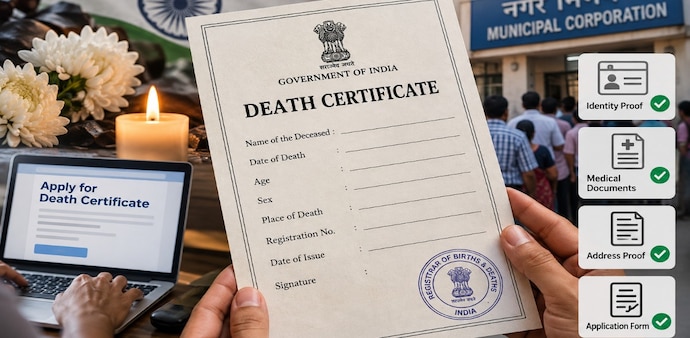
While requirements can vary between states and local authorities, applicants generally need a medical certificate or certificate of cause of death issued by the hospital or doctor.
Other details and documents may include the deceased person's name, date and place of birth, details of the person reporting the death, relevant hospital documents and the prescribed application form with supporting documents.
Applicants should check the requirements of their respective municipal or local authority before submitting the application.
ALSO READ: ₹10,000 minimum pension for Railway employees: Who qualifies and how it works
What changes from October 1, 2026?
The rules governing delayed registration of deaths will become stricter from October 1 under the Registration of Births and Deaths (Amendment) Act, 2026. The new provisions are aimed at encouraging timely reporting of births and deaths.
For deaths reported more than one year but within two years of the actual event, registration will require an order from the District Magistrate, Sub-Divisional Magistrate or an Executive Magistrate authorised by the District Magistrate.
For delays of more than two years, registration will require an order from a Judicial Magistrate First Class. Authorities will also be required to verify the correctness and authenticity of the reported event before permitting delayed registration.
A death certificate is an important legal document that officially records a person's death and is required by families to settle several financial and legal matters.
The document is commonly needed to claim life insurance, provident fund and mutual fund proceeds, transfer demat and stock holdings, deal with property and estate matters, and complete the deceased person's income tax-related formalities. Registration of deaths is mandatory under the Registration of Births and Deaths Act, 1969, according to Mint.
Where can a death be registered?
A death has to be registered with the local authority in the area where it occurred. Depending on the location, this may be a municipal corporation, municipality, panchayat or another designated registration authority.
Several states and local bodies provide online registration facilities through government or municipal portals. In case of a death in a hospital, the institution generally provides the medical certification of the cause of death and follows the prescribed reporting procedure.
READ THIS: This is not a tax, cess, surcharge...: FM Sitharaman explains what the new UPI MDR really means
Documents required for death certificate
While requirements can vary between states and local authorities, applicants generally need a medical certificate or certificate of cause of death issued by the hospital or doctor.
Other details and documents may include the deceased person's name, date and place of birth, details of the person reporting the death, relevant hospital documents and the prescribed application form with supporting documents.
Applicants should check the requirements of their respective municipal or local authority before submitting the application.
ALSO READ: ₹10,000 minimum pension for Railway employees: Who qualifies and how it works
What changes from October 1, 2026?
The rules governing delayed registration of deaths will become stricter from October 1 under the Registration of Births and Deaths (Amendment) Act, 2026. The new provisions are aimed at encouraging timely reporting of births and deaths.
For deaths reported more than one year but within two years of the actual event, registration will require an order from the District Magistrate, Sub-Divisional Magistrate or an Executive Magistrate authorised by the District Magistrate.
For delays of more than two years, registration will require an order from a Judicial Magistrate First Class. Authorities will also be required to verify the correctness and authenticity of the reported event before permitting delayed registration.