
'Deficit is still $100 bn': Ex-foreign secretary warns against overplaying 22% export rise to China
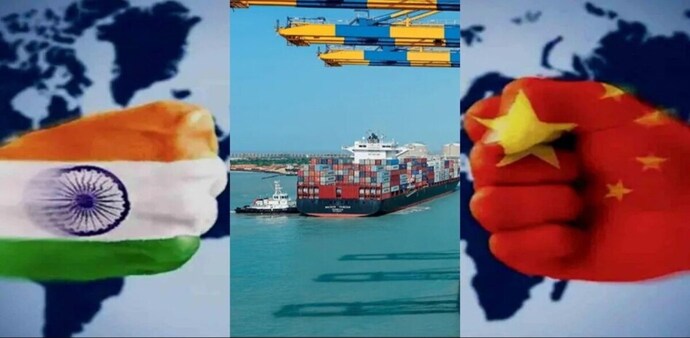
India's exports to China surged about 22% in the first half of 2025–26 compared to the first half of FY25.
- Oct 27, 2025,
- Updated Oct 27, 2025 1:50 PM IST
Former foreign secretary Kanwal Sibal has cautioned against reading too much into India's recent surge in exports to China, saying the country's massive trade deficit with Beijing remains "unsustainable."
"Any increase in Indian exports to China is positive news but our total exports to China last year amounted to $14.9 billion," Sibal said in a post on X. "If there is half yearly 22% increase the figure could go up by approximately $3 billion. The deficit will still be around $100 billion, which is unsustainable. Let’s not be satisfied with small mercies."
Chinese Ambassador to India Xu Feihong, citing a report, said on Sunday that India's exports to China surged about 22% in the first half of 2025–26 compared to the first half of FY25. "China welcomes more premium Indian goods in its market and stands ready to help offset the impact of U.S. tariffs on India’s trade," he said.
There has been a sharp rise in India's shipments to China, led by commodities such as telephone set components, shrimps, aluminium, and capsicum.
The Hindustan Times, citing government data, reported that India's exports to China stood at $8.41 billion in April–September 2025, compared to $6.90 billion in the same period last year - a 22% jump. The surge gained pace after the U.S. imposed steep tariffs on Indian goods in August, prompting a 34% rise in exports to China in September alone, from $1.09 billion to $1.47 billion year-on-year.
The increase was driven by light oils and petroleum products, which grew 116% to $1.48 billion, and parts of telephone sets, up 162% to $467.65 million. Shipments of frozen shrimps and prawns rose 25% to $467.51 million, sulphur exports jumped 175% to $116.80 million, and aluminium exports climbed 59% to $191.93 million.
Several new product categories also emerged, including flat panel display modules of OLED, which rose from zero in H1 FY25 to $246.26 million in H1 FY26.
According to Ajay Sahai, Director General and CEO of the Federation of Indian Export Organisations (FIEO), the data reflects exporters' growing adaptability and competitiveness. "India's 22% surge in exports to China in H1 FY26 is an encouraging sign of our exporters' agility and growing competitiveness, particularly in value-added segments like shrimp, aluminium, and telephone sets," Sahai said.
However, he cautioned that it was premature to view the shift as structural. "While this growth suggests some diversification beyond traditional markets like the U.S., it is still too early to view it as a structural shift. Sustained export diversification will require deepening our presence in emerging Asian, African, and Latin American markets, while simultaneously consolidating our high-value trade with the U.S. and EU," he said.
Former foreign secretary Kanwal Sibal has cautioned against reading too much into India's recent surge in exports to China, saying the country's massive trade deficit with Beijing remains "unsustainable."
"Any increase in Indian exports to China is positive news but our total exports to China last year amounted to $14.9 billion," Sibal said in a post on X. "If there is half yearly 22% increase the figure could go up by approximately $3 billion. The deficit will still be around $100 billion, which is unsustainable. Let’s not be satisfied with small mercies."
Chinese Ambassador to India Xu Feihong, citing a report, said on Sunday that India's exports to China surged about 22% in the first half of 2025–26 compared to the first half of FY25. "China welcomes more premium Indian goods in its market and stands ready to help offset the impact of U.S. tariffs on India’s trade," he said.
There has been a sharp rise in India's shipments to China, led by commodities such as telephone set components, shrimps, aluminium, and capsicum.
The Hindustan Times, citing government data, reported that India's exports to China stood at $8.41 billion in April–September 2025, compared to $6.90 billion in the same period last year - a 22% jump. The surge gained pace after the U.S. imposed steep tariffs on Indian goods in August, prompting a 34% rise in exports to China in September alone, from $1.09 billion to $1.47 billion year-on-year.
The increase was driven by light oils and petroleum products, which grew 116% to $1.48 billion, and parts of telephone sets, up 162% to $467.65 million. Shipments of frozen shrimps and prawns rose 25% to $467.51 million, sulphur exports jumped 175% to $116.80 million, and aluminium exports climbed 59% to $191.93 million.
Several new product categories also emerged, including flat panel display modules of OLED, which rose from zero in H1 FY25 to $246.26 million in H1 FY26.
According to Ajay Sahai, Director General and CEO of the Federation of Indian Export Organisations (FIEO), the data reflects exporters' growing adaptability and competitiveness. "India's 22% surge in exports to China in H1 FY26 is an encouraging sign of our exporters' agility and growing competitiveness, particularly in value-added segments like shrimp, aluminium, and telephone sets," Sahai said.
However, he cautioned that it was premature to view the shift as structural. "While this growth suggests some diversification beyond traditional markets like the U.S., it is still too early to view it as a structural shift. Sustained export diversification will require deepening our presence in emerging Asian, African, and Latin American markets, while simultaneously consolidating our high-value trade with the U.S. and EU," he said.