
Delhi AQI rises to 339; Bawana crosses 400 as city wakes up to smog and fog
In Bawana, the AQI breached 400, while a shallow layer of fog settled over the capital amid dipping temperatures.
- Nov 8, 2025,
- Updated Nov 8, 2025 11:31 AM IST
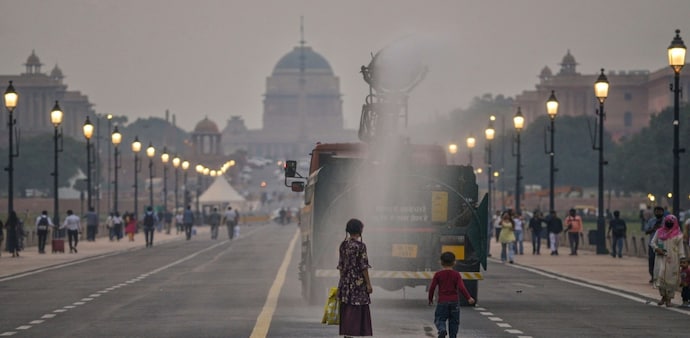
Delhi woke up to yet another smog-laden morning on Saturday, with the city’s air quality locked in the ‘very poor’ category. The overall Air Quality Index (AQI) touched 339 at 10 am, a marginal rise from Friday evening, as parts of the city hovered dangerously close to the ‘severe’ zone. In Bawana, the AQI breached 400, while a shallow layer of fog settled over the capital amid dipping temperatures.
According to data from the Central Pollution Control Board (CPCB), Delhi’s overall AQI climbed to 355, with several monitoring stations reporting hazardous levels. Bawana recorded an AQI of 403, categorised as ‘severe’, while Burari (380), Ashok Vihar (367), and Mathura Road (366) also remained heavily polluted.
On Friday, Delhi’s air quality stood at 311, slipping back into the ‘very poor’ category after two days of relative improvement. The CPCB defines AQI ranges as: 0–50 (good), 51–100 (satisfactory), 101–200 (moderate), 201–300 (poor), 301–400 (very poor), and 401–500 (severe).
In the National Capital Region, air quality continued to deteriorate. Noida recorded an AQI of 325, Greater Noida stood at 304, both in the ‘very poor’ category, while Gurugram fared slightly better at 220, classified as ‘poor’.
With pollution levels persisting at unhealthy levels, Delhi Chief Minister Rekha Gupta on Friday announced staggered working hours for Delhi government and Municipal Corporation of Delhi (MCD) employees, effective from November 15 to February 15. According to the order, government offices will function from 10 am to 6:30 pm, while MCD offices will operate from 8:30 am to 5 pm. The measure aims to ease vehicular congestion and reduce emissions during peak hours.
The India Meteorological Department (IMD) reported a minimum temperature of 13.8°C, with forecasts of a mainly clear sky and shallow fog during the morning hours. Night temperatures are expected to remain 2–5°C below normal across the plains of northwest and central India over the next week.
While weather conditions continue to trap pollutants close to the ground, officials warn that consistent fog, low wind speed, and local emissions from vehicles, construction, and stubble burning are likely to keep Delhi’s air quality in the ‘very poor’ zone through the weekend.
Delhi woke up to yet another smog-laden morning on Saturday, with the city’s air quality locked in the ‘very poor’ category. The overall Air Quality Index (AQI) touched 339 at 10 am, a marginal rise from Friday evening, as parts of the city hovered dangerously close to the ‘severe’ zone. In Bawana, the AQI breached 400, while a shallow layer of fog settled over the capital amid dipping temperatures.
According to data from the Central Pollution Control Board (CPCB), Delhi’s overall AQI climbed to 355, with several monitoring stations reporting hazardous levels. Bawana recorded an AQI of 403, categorised as ‘severe’, while Burari (380), Ashok Vihar (367), and Mathura Road (366) also remained heavily polluted.
On Friday, Delhi’s air quality stood at 311, slipping back into the ‘very poor’ category after two days of relative improvement. The CPCB defines AQI ranges as: 0–50 (good), 51–100 (satisfactory), 101–200 (moderate), 201–300 (poor), 301–400 (very poor), and 401–500 (severe).
In the National Capital Region, air quality continued to deteriorate. Noida recorded an AQI of 325, Greater Noida stood at 304, both in the ‘very poor’ category, while Gurugram fared slightly better at 220, classified as ‘poor’.
With pollution levels persisting at unhealthy levels, Delhi Chief Minister Rekha Gupta on Friday announced staggered working hours for Delhi government and Municipal Corporation of Delhi (MCD) employees, effective from November 15 to February 15. According to the order, government offices will function from 10 am to 6:30 pm, while MCD offices will operate from 8:30 am to 5 pm. The measure aims to ease vehicular congestion and reduce emissions during peak hours.
The India Meteorological Department (IMD) reported a minimum temperature of 13.8°C, with forecasts of a mainly clear sky and shallow fog during the morning hours. Night temperatures are expected to remain 2–5°C below normal across the plains of northwest and central India over the next week.
While weather conditions continue to trap pollutants close to the ground, officials warn that consistent fog, low wind speed, and local emissions from vehicles, construction, and stubble burning are likely to keep Delhi’s air quality in the ‘very poor’ zone through the weekend.