
Delhi pollution: AQI nears 400 ahead of Diwali, stubble burning drives worsening air quality
With pollution levels near hazardous thresholds, health experts typically advise children, the elderly and people with respiratory or cardiac conditions to limit outdoor exertion.
- Nov 5, 2026,
- Updated Nov 5, 2026 9:52 AM IST
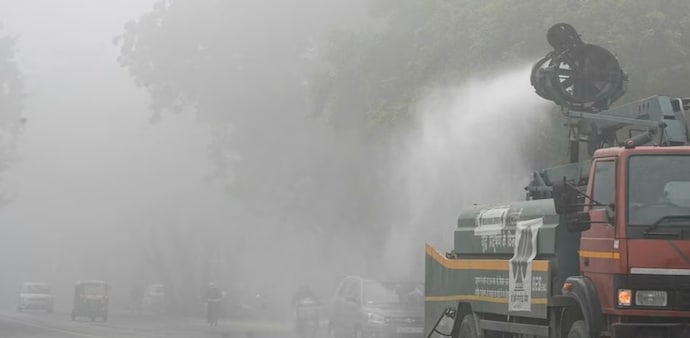
With Diwali just around the corner, Delhi’s air quality remained firmly in the danger zone on Thursday, November 5, as the capital woke to another thick layer of smog. The city’s overall Air Quality Index (AQI) stood at 367 at 9 am, placing it in the ‘very poor’ category, while several monitoring stations, including Jahangirpuri and IIT Delhi, recorded ‘severe’ readings above 400.
Delhi’s air quality has deteriorated sharply over the past week. On Wednesday, the city’s 24-hour average AQI stood at 377, up from 350 a day earlier, according to Central Pollution Control Board (CPCB) data.
As many as 22 of Delhi’s 59 monitoring stations recorded ‘severe’ air quality on Wednesday, with AQI above 400. IIT Delhi recorded the highest reading at 458, followed by Jahangirpuri and Punjabi Bagh at 448 each, and Mundka at 439.
Under the CPCB’s classification, an AQI between 301 and 400 is ‘very poor’, while 401 to 500 is ‘severe’—a level at which air pollution can affect healthy people and seriously impact those with existing diseases.
NCR Cities Also Choke
Neighbouring NCR cities are also struggling. On Wednesday early morning, Noida recorded an AQI of 330 and Gurugram 322, both in the ‘very poor’ category, while Ghaziabad stood at 257 in the ‘poor’ category.
Noida’s Sector 62 was particularly polluted at 425, while Haryana’s Panchgaon recorded 391 and Bahadurgarh 365. A district-wise assessment placed Ghaziabad’s contribution to Delhi’s pollution at 7 per cent, followed by Rohtak at 3.8 per cent and Gurugram at 2.7 per cent.
Stubble Burning Drives Delhi’s Pollution Spike
The latest Decision Support System (DSS) assessment attributed 20.2% of Delhi’s pollution on Wednesday to stubble burning, while transport emissions accounted for 15.5%. Satellite data detected 467 farm fires across six states on November 4, including 151 in Punjab and 10 in Haryana.
Between September 15 and November 4, 4,800 residue-burning events were recorded across seven states and UTs, with Punjab accounting for 2,347 and Haryana 62, according to ICAR-IARI’s CREAMS Laboratory.
Smoke and fine particulate matter from these fires travel toward Delhi-NCR under north-westerly winds, adding to pollution from vehicles, road dust, construction and waste burning.
Relief Not Expected Soon
There appears to be little immediate respite for residents. Forecasts cited in reports suggest Delhi’s air will remain ‘very poor’ on November 5 and could slip into the ‘severe’ category on November 6 and 7.
The India Meteorological Department has forecast clear skies for the next four days, with maximum temperatures of 27–29 degrees Celsius and minimums of 15–17 degrees Celsius, alongside morning mist or shallow fog in some areas—conditions that can trap pollutants close to the surface.
The deterioration comes just days after Cyclone Montha-related rain improved air quality: Delhi’s AQI was 60 on October 30, in the ‘satisfactory’ category, before rising rapidly in the following days.
DON'T MISS: Delhi air quality turns 'very poor': GRAP 2 imposed, tighter curbs on vehicles and generators
What Residents Should Do
With pollution levels near hazardous thresholds, health experts typically advise children, the elderly and people with respiratory or cardiac conditions to limit outdoor exertion, use N95 masks outdoors where possible, and keep windows closed during peak smog hours. Authorities are expected to continue monitoring conditions closely as winter pollution season intensifies.