
Delhi pollution: Capital city breathes a little easier, but AQI remains poor; Experts issue this warning
According to the Central Pollution Control Board (CPCB), Delhi’s average AQI was 281 (‘poor’) on Wednesday, down from 309 on Tuesday and 316 on Monday, when the AQI was recorded at ‘very poor’.
- Nov 5, 2025,
- Updated Nov 5, 2025 2:30 PM IST
Delhi woke up to slightly cleaner air on Wednesday after several days of choking smog. But pollution levels are still far from safe. By early afternoon, the city’s Air Quality Index (AQI) was 161, still in the ‘unhealthy’ range.
Particulate matter or PM2.5 (fine particles made of dust, soot, smoke, metals, and liquid droplets) was recorded at 70 micrograms per cubic meter, and PM10 at 92, both well above safe limits. Other pollutants also remained high, carbon monoxide at 360 ppb (parts per billion), nitrogen dioxide at 35 ppb, sulfur dioxide at 5 ppb, and ozone at 18 ppb.
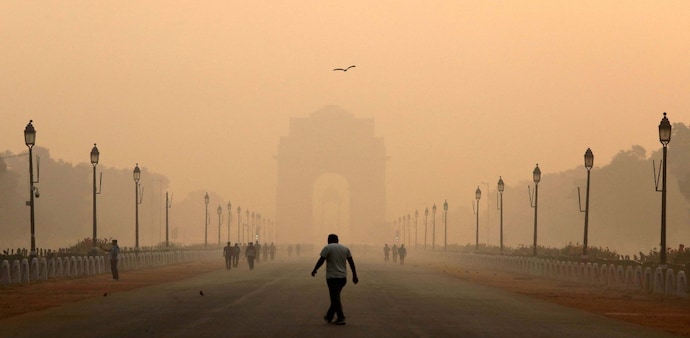
The temperature stood at 26°C with 61 percent humidity. Light winds at 7 km/h and a faint mist blurred the skyline. The India Meteorological Department (IMD) said calm winds are preventing pollutants from dispersing, though air quality has improved slightly in the past 24 hours.
According to the Central Pollution Control Board (CPCB), Delhi’s average AQI was 281 (‘poor’) on Wednesday, down from 309 on Tuesday and 316 on Monday, when the air was ‘very poor’.
Lodhi Road showed better air at 145 (‘moderate’), while ITO (276), Anand Vihar (280), and Punjabi Bagh (224) remained in the ‘poor’ range. Dwarka did a bit better at 188 (‘moderate’).
In the NCR, air quality also varied. Noida’s Sector 1 recorded an AQI of 227 (‘poor’), while Gurugram’s Vikas Sadan touched 300 (‘very poor’).
Experts say the small improvement doesn’t mean relief is here. The lingering haze is still caused by post-Diwali firecrackers, vehicle emissions, and stubble burning in nearby states. A western disturbance has also slowed wind speed, trapping pollutants close to the ground.
Authorities are continuing Stage 2 of the Graded Response Action Plan (GRAP), using sprinklers, water tankers, and anti-smog guns to control dust.
The Public Works Department plans to install automated mist-spraying systems along three high-pollution stretches — Narela, Bawana, and Jahangirpuri. These systems will spray RO-treated water at a rate of 2,000 litres per hour under a ₹4 crore project that includes five years of maintenance.
Doctors have advised people to limit outdoor activities, especially during mornings and evenings, warning that long exposure could worsen breathing problems. Some schools and care homes have started giving out masks and setting up air purifiers.
The IMD has forecast clear skies with light haze through the week and shallow fog on November 6 and 7. Experts warn that another smog spell could return if winds remain calm and stubble burning continues.
Delhi woke up to slightly cleaner air on Wednesday after several days of choking smog. But pollution levels are still far from safe. By early afternoon, the city’s Air Quality Index (AQI) was 161, still in the ‘unhealthy’ range.
Particulate matter or PM2.5 (fine particles made of dust, soot, smoke, metals, and liquid droplets) was recorded at 70 micrograms per cubic meter, and PM10 at 92, both well above safe limits. Other pollutants also remained high, carbon monoxide at 360 ppb (parts per billion), nitrogen dioxide at 35 ppb, sulfur dioxide at 5 ppb, and ozone at 18 ppb.
The temperature stood at 26°C with 61 percent humidity. Light winds at 7 km/h and a faint mist blurred the skyline. The India Meteorological Department (IMD) said calm winds are preventing pollutants from dispersing, though air quality has improved slightly in the past 24 hours.
According to the Central Pollution Control Board (CPCB), Delhi’s average AQI was 281 (‘poor’) on Wednesday, down from 309 on Tuesday and 316 on Monday, when the air was ‘very poor’.
Lodhi Road showed better air at 145 (‘moderate’), while ITO (276), Anand Vihar (280), and Punjabi Bagh (224) remained in the ‘poor’ range. Dwarka did a bit better at 188 (‘moderate’).
In the NCR, air quality also varied. Noida’s Sector 1 recorded an AQI of 227 (‘poor’), while Gurugram’s Vikas Sadan touched 300 (‘very poor’).
Experts say the small improvement doesn’t mean relief is here. The lingering haze is still caused by post-Diwali firecrackers, vehicle emissions, and stubble burning in nearby states. A western disturbance has also slowed wind speed, trapping pollutants close to the ground.
Authorities are continuing Stage 2 of the Graded Response Action Plan (GRAP), using sprinklers, water tankers, and anti-smog guns to control dust.
The Public Works Department plans to install automated mist-spraying systems along three high-pollution stretches — Narela, Bawana, and Jahangirpuri. These systems will spray RO-treated water at a rate of 2,000 litres per hour under a ₹4 crore project that includes five years of maintenance.
Doctors have advised people to limit outdoor activities, especially during mornings and evenings, warning that long exposure could worsen breathing problems. Some schools and care homes have started giving out masks and setting up air purifiers.
The IMD has forecast clear skies with light haze through the week and shallow fog on November 6 and 7. Experts warn that another smog spell could return if winds remain calm and stubble burning continues.