
'Don't go by meter... they extort money': Mohandas Pai blasts Goa’s taxi lobby after ban on Ola, Uber
Pai’s remarks came after the Goa government announced it would not allow external taxi aggregators to operate in the state, despite rolling out guidelines for regulating app-based services
- Jun 16, 2025,
- Updated Jun 16, 2025 3:14 PM IST
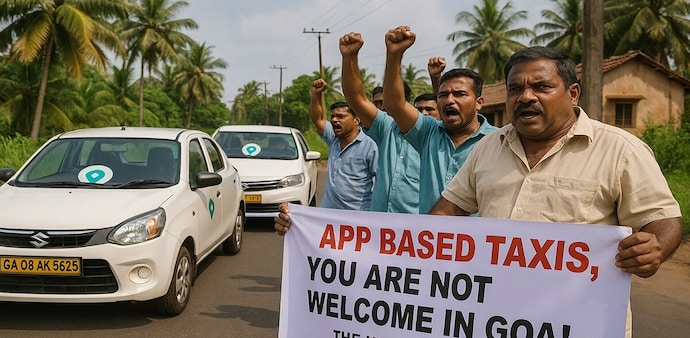
As Goa’s Chief Minister Pramod Sawant confirmed that app-based taxi aggregators like Uber and Ola would not be allowed to operate in the state, the backlash was swift and sharp.
Among the most vocal critics was Mohandas Pai, chairman of Aarin Capital and a long-time advocate for urban mobility. Taking to X, Pai blasted an article that had defended the state’s decision, calling it a smokescreen for “lawlessness” in the local taxi industry.
"An idiotic article. Govt first responsibility is to citizens, commuters not to a taxi lobby. Citizens have a right to all means of commute. These taxis, have official recognition, do not go by meter and are a law into themselves. They extort money. This stupid article tries to cover up this lawlessness," Pai posted.
Pai’s remarks came after the Goa government announced it would not allow external taxi aggregators to operate in the state, despite rolling out guidelines for regulating app-based services.
Despite the state earning over 16% of its revenue from tourism, and persistent complaints about high fares, arbitrary pricing, and limited taxi availability, the government has sided with local operators who fear being pushed out by larger players.
The move has reignited the debate around mobility access in tourism-heavy states, where local cab unions often oppose the entry of tech-driven platforms. Pai, a long-time advocate of urban mobility and transparent fare systems, highlighted the lack of metered pricing and commuter rights in his sharp criticism.
Tourists and locals alike, however, have expressed frustration at exorbitant fares and the lack of alternatives.
However, an IIM alumnus' breakdown of Goa’s ride-hailing void doesn’t hinge on government bans or outdated laws. It rests on hard, local economics, and a staggering electoral calculus.
Starting with the numbers, Goa has 24,000 taxi drivers. Most are sole breadwinners, supporting families of four.
That’s roughly 100,000 people tethered to the taxi economy. But these drivers aren’t just behind the wheel. “Drivers also act as commission agents—guiding tourists to hotels, cruises, shops, shacks,” the alumnus noted. Their earnings ripple through the entire tourism sector.
Factor that in, and the number of livelihoods connected to this informal network balloons to 200,000.
As Goa’s Chief Minister Pramod Sawant confirmed that app-based taxi aggregators like Uber and Ola would not be allowed to operate in the state, the backlash was swift and sharp.
Among the most vocal critics was Mohandas Pai, chairman of Aarin Capital and a long-time advocate for urban mobility. Taking to X, Pai blasted an article that had defended the state’s decision, calling it a smokescreen for “lawlessness” in the local taxi industry.
"An idiotic article. Govt first responsibility is to citizens, commuters not to a taxi lobby. Citizens have a right to all means of commute. These taxis, have official recognition, do not go by meter and are a law into themselves. They extort money. This stupid article tries to cover up this lawlessness," Pai posted.
Pai’s remarks came after the Goa government announced it would not allow external taxi aggregators to operate in the state, despite rolling out guidelines for regulating app-based services.
Despite the state earning over 16% of its revenue from tourism, and persistent complaints about high fares, arbitrary pricing, and limited taxi availability, the government has sided with local operators who fear being pushed out by larger players.
The move has reignited the debate around mobility access in tourism-heavy states, where local cab unions often oppose the entry of tech-driven platforms. Pai, a long-time advocate of urban mobility and transparent fare systems, highlighted the lack of metered pricing and commuter rights in his sharp criticism.
Tourists and locals alike, however, have expressed frustration at exorbitant fares and the lack of alternatives.
However, an IIM alumnus' breakdown of Goa’s ride-hailing void doesn’t hinge on government bans or outdated laws. It rests on hard, local economics, and a staggering electoral calculus.
Starting with the numbers, Goa has 24,000 taxi drivers. Most are sole breadwinners, supporting families of four.
That’s roughly 100,000 people tethered to the taxi economy. But these drivers aren’t just behind the wheel. “Drivers also act as commission agents—guiding tourists to hotels, cruises, shops, shacks,” the alumnus noted. Their earnings ripple through the entire tourism sector.
Factor that in, and the number of livelihoods connected to this informal network balloons to 200,000.