
'Drones are key, but tanks still matter': Ex-Army chief on balancing legacy systems with new tech
'Drones will form an important component of how you fight. But it is not as if the relevance of tanks, artillery, and the rest of the conventional system is any less,' says former army chief Manoj Pande
- Oct 21, 2025,
- Updated Oct 21, 2025 3:12 PM IST
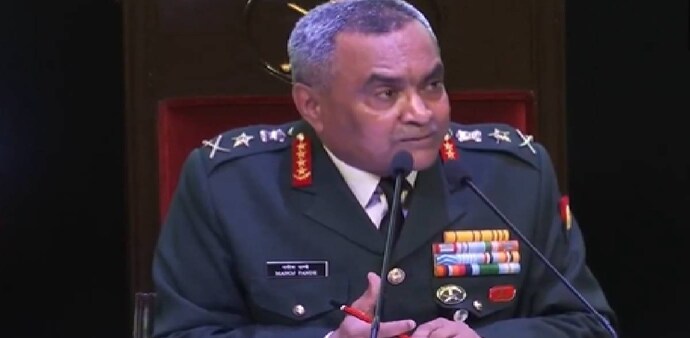
Former Army Chief General Manoj Pande has said that while drones will define future warfare, conventional systems like tanks, artillery, and infantry will continue to remain relevant to India's security needs. "There seems to be an impression that future wars are only going to be fought by drones. It is as if you're going to be firing only from beyond visual range and there's going to be no sort of contact warfare. In a manner suggesting that tanks or artillery guns or the infantry is going to be less relevant. In my view, that's not a correct assessment," he said while speaking to BharatShakti Dialogues.
Pande said India's "peculiar security challenges" along contested borders on both its northern and western fronts make legacy platforms indispensable. "The future wars are not only going to be drone wars. Drones will form an important component of how you fight. But it is not as if the relevance of tanks, artillery and the rest of the conventional system is any less," he said.
The former army chief added that the integration of new technology must strengthen, not replace, legacy systems. "One can argue and I would endorse that to say that you have a tank. It has a gun. It fires up to let's say 3 and 1/2 km. So do you now look at improving that gun to fire at 7-8 km or look at these weapon platforms totally differently? Do you need a tank with a drone which can fly, go up to 8 km, pick up targets, carry out reconnaissance, and then from the tank," he said. "We'll have to look at not only tanks even the artillery differently, the infantry soldier measured differently. These systems will remain relevant."
On lessons from Operation Sindoor, Pande said the exercise offered "a good glimpse of what future warfare would be like" and has direct implications for India's capability development plans. "You saw extensive use of drones, counter-drone systems. You saw beyond visual range weapon systems — so in a sense, non-contact, non-kinetic warfare from here on. From here, we could glean what our capability development requirements for all three forces would be for the future," he said.
He also underlined the performance of indigenous systems, calling it a validation of India's focus on self-reliance. "It endorsed or validated the requirement for us to have our own indigenous defense production capability," he said, adding that new domains like cyber and electronic warfare, and information operations would be "central to our war planning in the future."
Discussing capability development priorities, the former Army chief highlighted four focus areas — drones, counter-drones, electronic warfare, and autonomous ground systems. "In my view, drones are going to be the future. The more creative, the more imaginative you are as to how you can use drones for different military applications is going to be the key. But not only drones, the counter-drones. So in terms of how do you make drones ineffective, jamming, engaging them, neutralizing them — kinetic, soft kill, hard kill — that's another area," he said.
He added that the future of warfare lies in merging automation with intelligence. "All this with the backdrop of AI, machine learning, internet of things - a combination of all this will define what our future focus must be," he said.
Pande said legacy systems would need to coexist with new technologies for the foreseeable future. "It is not possible to change the entire kit or inventory and suddenly have all the high-tech weapon systems. That is neither desirable perhaps not possible. So we will have to phase it out and till then focus on how the legacy systems and the new technology are interoperable and can achieve the desired sort of aims or outcome," he said.
He concluded that Operation Sindoor also validated a key aspect of India’s defence reforms - the alignment between political and military objectives. "The convergence of the political aim, the military having understood the political aims and then translating this into achievable results - that was a very significant thing," he said. "It was a validation of whatever reforms have happened during the last 10 years and has set us on a correct trajectory for transformation to continue in the future."
Former Army Chief General Manoj Pande has said that while drones will define future warfare, conventional systems like tanks, artillery, and infantry will continue to remain relevant to India's security needs. "There seems to be an impression that future wars are only going to be fought by drones. It is as if you're going to be firing only from beyond visual range and there's going to be no sort of contact warfare. In a manner suggesting that tanks or artillery guns or the infantry is going to be less relevant. In my view, that's not a correct assessment," he said while speaking to BharatShakti Dialogues.
Pande said India's "peculiar security challenges" along contested borders on both its northern and western fronts make legacy platforms indispensable. "The future wars are not only going to be drone wars. Drones will form an important component of how you fight. But it is not as if the relevance of tanks, artillery and the rest of the conventional system is any less," he said.
The former army chief added that the integration of new technology must strengthen, not replace, legacy systems. "One can argue and I would endorse that to say that you have a tank. It has a gun. It fires up to let's say 3 and 1/2 km. So do you now look at improving that gun to fire at 7-8 km or look at these weapon platforms totally differently? Do you need a tank with a drone which can fly, go up to 8 km, pick up targets, carry out reconnaissance, and then from the tank," he said. "We'll have to look at not only tanks even the artillery differently, the infantry soldier measured differently. These systems will remain relevant."
On lessons from Operation Sindoor, Pande said the exercise offered "a good glimpse of what future warfare would be like" and has direct implications for India's capability development plans. "You saw extensive use of drones, counter-drone systems. You saw beyond visual range weapon systems — so in a sense, non-contact, non-kinetic warfare from here on. From here, we could glean what our capability development requirements for all three forces would be for the future," he said.
He also underlined the performance of indigenous systems, calling it a validation of India's focus on self-reliance. "It endorsed or validated the requirement for us to have our own indigenous defense production capability," he said, adding that new domains like cyber and electronic warfare, and information operations would be "central to our war planning in the future."
Discussing capability development priorities, the former Army chief highlighted four focus areas — drones, counter-drones, electronic warfare, and autonomous ground systems. "In my view, drones are going to be the future. The more creative, the more imaginative you are as to how you can use drones for different military applications is going to be the key. But not only drones, the counter-drones. So in terms of how do you make drones ineffective, jamming, engaging them, neutralizing them — kinetic, soft kill, hard kill — that's another area," he said.
He added that the future of warfare lies in merging automation with intelligence. "All this with the backdrop of AI, machine learning, internet of things - a combination of all this will define what our future focus must be," he said.
Pande said legacy systems would need to coexist with new technologies for the foreseeable future. "It is not possible to change the entire kit or inventory and suddenly have all the high-tech weapon systems. That is neither desirable perhaps not possible. So we will have to phase it out and till then focus on how the legacy systems and the new technology are interoperable and can achieve the desired sort of aims or outcome," he said.
He concluded that Operation Sindoor also validated a key aspect of India’s defence reforms - the alignment between political and military objectives. "The convergence of the political aim, the military having understood the political aims and then translating this into achievable results - that was a very significant thing," he said. "It was a validation of whatever reforms have happened during the last 10 years and has set us on a correct trajectory for transformation to continue in the future."